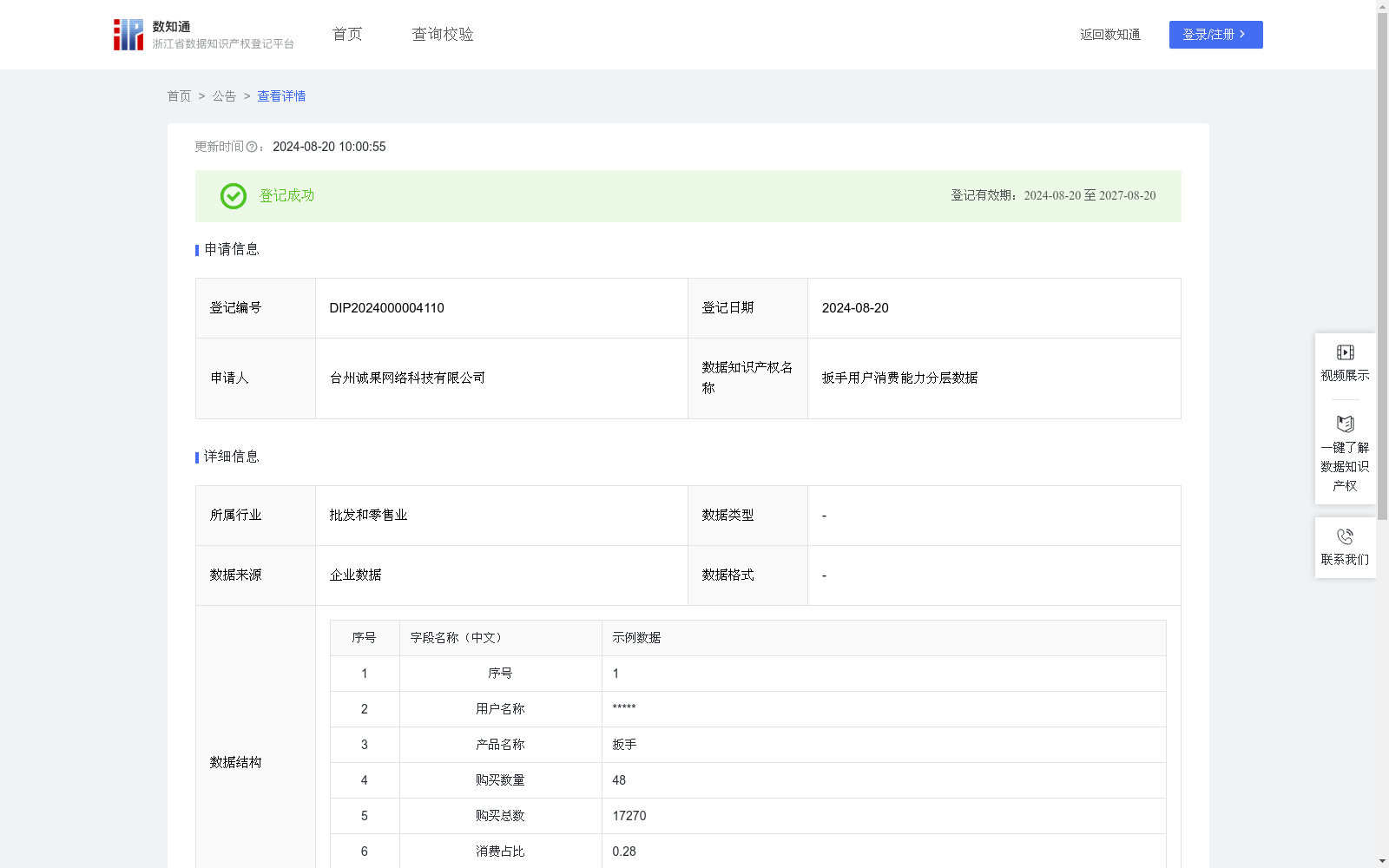
扳手用户消费能力分层数据
收藏资源简介:
扳手是一种常用的安装与拆卸工具,是利用杠杆原理拧转螺栓、螺钉、螺母和其他螺纹紧持螺栓或螺母的开口或套孔固件的手工工具,统计分析扳手的消费数据,通过对历史下单用户建立表格,对用户进行标签制定,定位用户消费级别,为企业在全国各地设立产品周转仓及针对各地区汽车维修店对扳手的购买量和使用量,制定广告营销策略提供数据支持。1. 数据采集:采集扳手在各个维修店消费等信息; 2. 用户购买扳手数量占总消费扳手数量的比例=用户购买扳手数量/总消费扳手数量*100%; 3. 用户消费占总消费的比例按从大到小进行排名;消费分类运用ABCDEF分类法,对占比0.26%以上的,给予“A类消费”分层;占比0.21%到0.25%区间的,则给予“B类消费”分层;占比在0.16%到0.20%区间,则给予“C类消费”分层;占比在0.11%到0.15%区间,则给予“D类消费”分层;占比在0.06%到0.1%区间,则给予“E类消费”分层;占比在0.05%以下,则给予“F类消费”分层; 4. 数据应用: 扳手的购买力结果可以作为扳手消费等级评价依据,为监管部门向监管提供技术支撑。
A wrench is a commonly used installation and disassembly hand tool that leverages the lever principle to rotate bolts, screws, nuts and other thread-fastened fixtures with open ends or socket holes. This dataset conducts statistical analysis on wrench consumption data: it builds tables for historical order-placing users, performs user tagging, and positions user consumption levels, providing data support for enterprises to set up product turnover warehouses across the country and formulate advertising and marketing strategies based on the purchase and usage volumes of wrenches by local auto repair shops. The detailed work is as follows: 1. Data Collection: Collect consumption-related information of wrenches in various repair shops; 2. Proportion Calculation: The proportion of a user's purchased wrenches in the total consumed wrenches = (User's purchased wrench quantity / Total consumed wrench quantity) * 100%; 3. Consumption Stratification: First, rank users in descending order according to their total consumption proportion. Then apply the ABCDEF classification method for stratification: users with a proportion above 0.26% are classified as "Class A consumption"; those with a proportion between 0.21% and 0.25% are "Class B consumption"; users with a proportion ranging from 0.16% to 0.20% are "Class C consumption"; 0.11% to 0.15% → Class D consumption; 0.06% to 0.10% → Class E consumption; and those with a proportion below 0.05% are "Class F consumption"; 4. Data Application: The purchasing power results of wrenches can be used as the basis for evaluating wrench consumption levels, providing technical support for regulatory departments to carry out supervision work.