
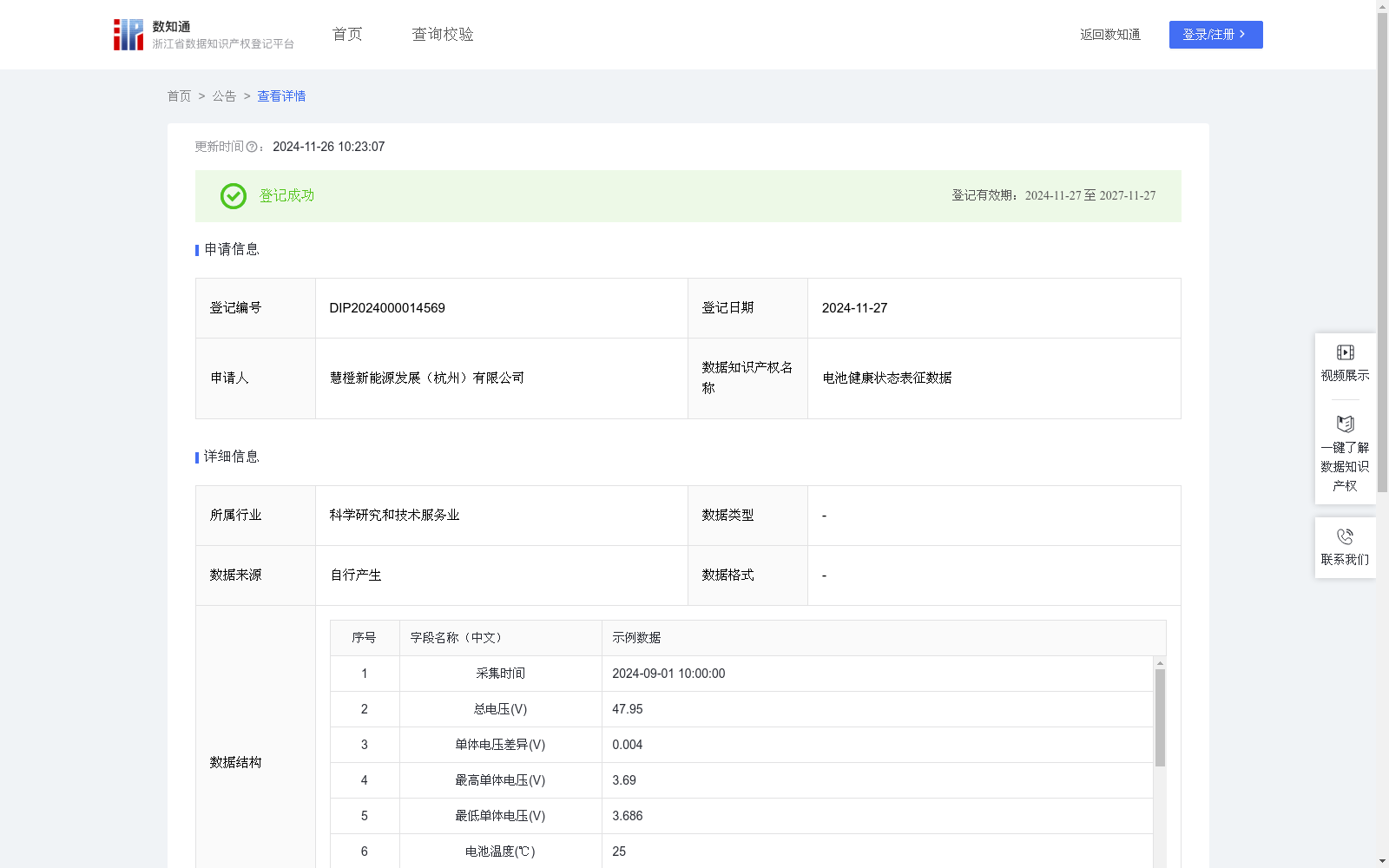
电池健康状态表征数据
收藏浙江省数据知识产权登记平台2024-11-26 更新2024-11-27 收录
下载链接:
https://www.zjip.org.cn/home/announce/trends/89156
下载链接
链接失效反馈官方服务:
资源简介:
随着城市化进程的加快,低速电动车保有量急剧增加,电池作为其核心部件,其健康状态的科学表征与管理至关重要。本文提出的电池健康度评价模型基于多维度量化评估方法,仅需总电压、单体电压差异、温度、内阻和SOH五个核心指标,通过标准化的计算方式可实现电池健康状态的精准表征。基于该表征数据,可快速识别电池状态并制定差异化策略:对于健康指数较高的电池,可进一步通过SOH趋势分析预测寿命周期,持续监测单体均衡度确保稳定性;对于需要重点关注的电池,则可根据各量化指标优化充放电策略、调整温控方案、评估性能衰减并识别潜在风险。这种基于精简数据、多维度量化评估的健康度表征数据,为低速电动车电池系统的科学化、精细化管理提供了有力支撑,有效提升了电池资源配置和管理效率。一、数据采集:原始数据来自公司业务采集数据,包含时间戳、总电压(V)、单体电压差异(V)、最高/最低单体电压(V)、电池温度(℃)、环境温度(℃)、放电电流(A)、内阻(mΩ)、SOC(%)、SOH(%)、电压均衡性(%)、温度均衡性(%)、放电深度(%)等原始数据字段。 二、算法规则:1)电压健康度评估:电压健康度 = (总电压 - 最低允许电压)/(最高允许电压 - 最低允许电压)×100%,最高允许电压为54.6V,最低允许电压为41.0V;2)温度健康度评估:温度健康度 = 100 - |电池温度 - 标准温度|×2,标准温度为25℃;3)内阻表现 = 100 - (内阻值/最大允许内阻) × 100%,其中最大允许内阻为200mΩ;4)单体均衡度评估:单体均衡度 = (1 - 单体电压差异/最大允许压差)×100%,最大允许压差0.05V;5)综合健康指数计算:综合健康指数 = (0.25×SOH + 0.2×电压健康度 + 0.15×温度健康度 + 0.15×内阻表现 + 0.25×单体均衡度)/100。
Against the backdrop of accelerating urbanization, the number of low-speed electric vehicles (LSEVs) in operation has increased dramatically. As the core component of LSEVs, the scientific characterization and management of battery health status are of critical importance. The battery health evaluation model proposed in this paper adopts a multi-dimensional quantitative assessment method, which enables accurate characterization of battery health status via standardized calculation procedures using only five core indicators: total voltage, single-cell voltage difference, temperature, internal resistance, and SOH. Based on such characterization data, battery status can be quickly identified and differentiated strategies can be formulated: For batteries with a high health index, life cycle prediction can be further carried out through SOH trend analysis, and continuous monitoring of cell balancing can be implemented to ensure stability; For batteries requiring close attention, charging and discharging strategies can be optimized, temperature control schemes adjusted, performance decay evaluated, and potential risks identified based on each quantitative indicator. This health characterization data based on streamlined data and multi-dimensional quantitative assessment provides strong support for the scientific and refined management of LSEV battery systems, effectively improving the efficiency of battery resource allocation and management.
1. Data Collection: The original data is sourced from the company's business collection system, including the following original data fields: timestamp, total voltage (V), single-cell voltage difference (V), maximum/minimum single-cell voltage (V), battery temperature (℃), ambient temperature (℃), discharge current (A), internal resistance (mΩ), SOC (%), SOH (%), voltage uniformity (%), temperature uniformity (%), depth of discharge (%), etc.
2. Algorithm Rules:
1) Voltage Health Assessment: Voltage Health = (Total Voltage - Minimum Allowable Voltage) / (Maximum Allowable Voltage - Minimum Allowable Voltage) × 100%, where the maximum allowable voltage is 54.6V and the minimum allowable voltage is 41.0V;
2) Temperature Health Assessment: Temperature Health = 100 - |Battery Temperature - Standard Temperature| × 2, where the standard temperature is 25℃;
3) Internal Resistance Performance = 100 - (Internal Resistance Value / Maximum Allowable Internal Resistance) × 100%, where the maximum allowable internal resistance is 200mΩ;
4) Single-cell Balancing Assessment: Single-cell Balancing = (1 - Single-cell Voltage Difference / Maximum Allowable Voltage Difference) × 100%, where the maximum allowable voltage difference is 0.05V;
5) Comprehensive Health Index Calculation: Comprehensive Health Index = (0.25×SOH + 0.2×Voltage Health + 0.15×Temperature Health + 0.15×Internal Resistance Performance + 0.25×Single-cell Balancing) / 100.
提供机构:
浙江慧橙云能科技有限公司
创建时间:
2024-11-02
搜集汇总
数据集介绍
以上内容由遇见数据集搜集并总结生成



