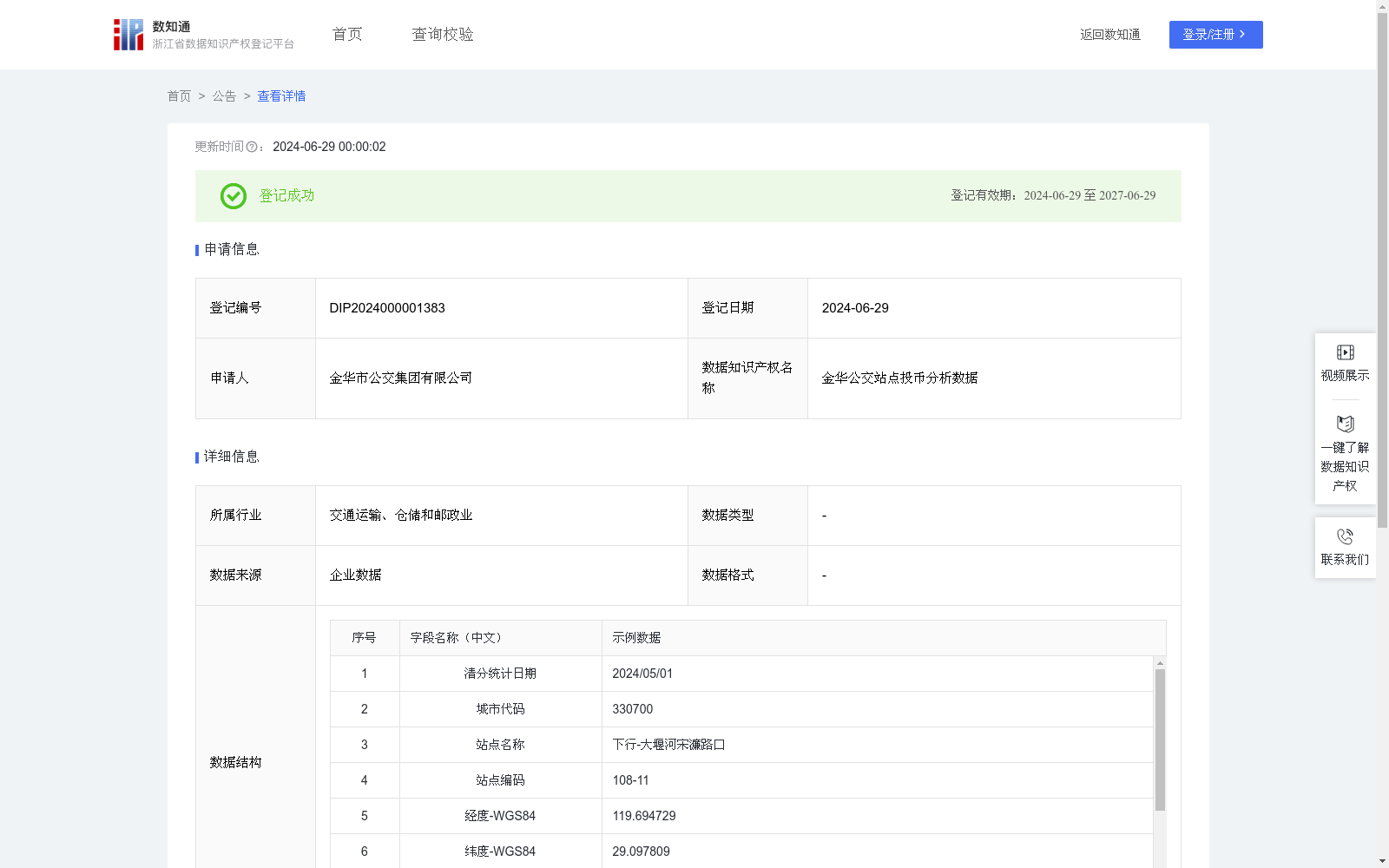
金华公交站点投币分析数据
收藏资源简介:
通过公交站点投币数据来分析各个站点的使用频率和收入情况,从而优化公交线路,调整车辆调度;通过分析监控站点的热度值,可以识别出拥挤站点,从而采取相应措施以提高运营效率。1、数据采集:从金华公交智能投币机系统实时采集金华市各公交站的站点编码、经纬度定位、交易信息等数据。2、数据处理:对采集到的数据按公交路线进行汇总分类、排列清洗,并按照时间序列,对各个站点的交易笔数和交易金额进行汇总。3、数据处理:公交站点热度值=(a1×笔数)+(a2×实付金额)+(a3×(笔数/当日总笔数))+(a4×(实付/当日总收款));其中a1、a2、a3、a4为权重系数,a1+ a2+a3+a4=1。4、数据应用:该数据将被用于进一步的决策分析和运营支持,帮助优化公交资源配置,提升服务效率,并为乘客提供更加便捷的出行体验。
Analyze the usage frequency and revenue of each bus stop using coin-in data collected at bus stops, so as to optimize bus routes and adjust vehicle dispatching; by analyzing the heat value of monitored stops, crowded stations can be identified and corresponding measures taken to improve operational efficiency. 1. Data Collection: Collect real-time data including station codes, longitude and latitude positioning, transaction information and other relevant data of each bus stop in Jinhua from the Jinhua Bus Intelligent Coin-operated Machine System. 2. Data Processing: Summarize, classify, sort and clean the collected data according to bus routes, and summarize the transaction count and transaction amount of each stop in accordance with the time series. 3. Data Processing: The heat value of a bus stop is calculated as: Heat Value = (a1 × Transaction Count) + (a2 × Actual Payment Amount) + (a3 × (Transaction Count / Total Daily Transactions)) + (a4 × (Actual Total Payment / Daily Total Revenue)), where a1, a2, a3, a4 are weight coefficients satisfying a1 + a2 + a3 + a4 = 1. 4. Data Application: This dataset will be used for further decision-making analysis and operation support, helping to optimize the allocation of bus resources, improve service efficiency, and provide passengers with a more convenient travel experience.