
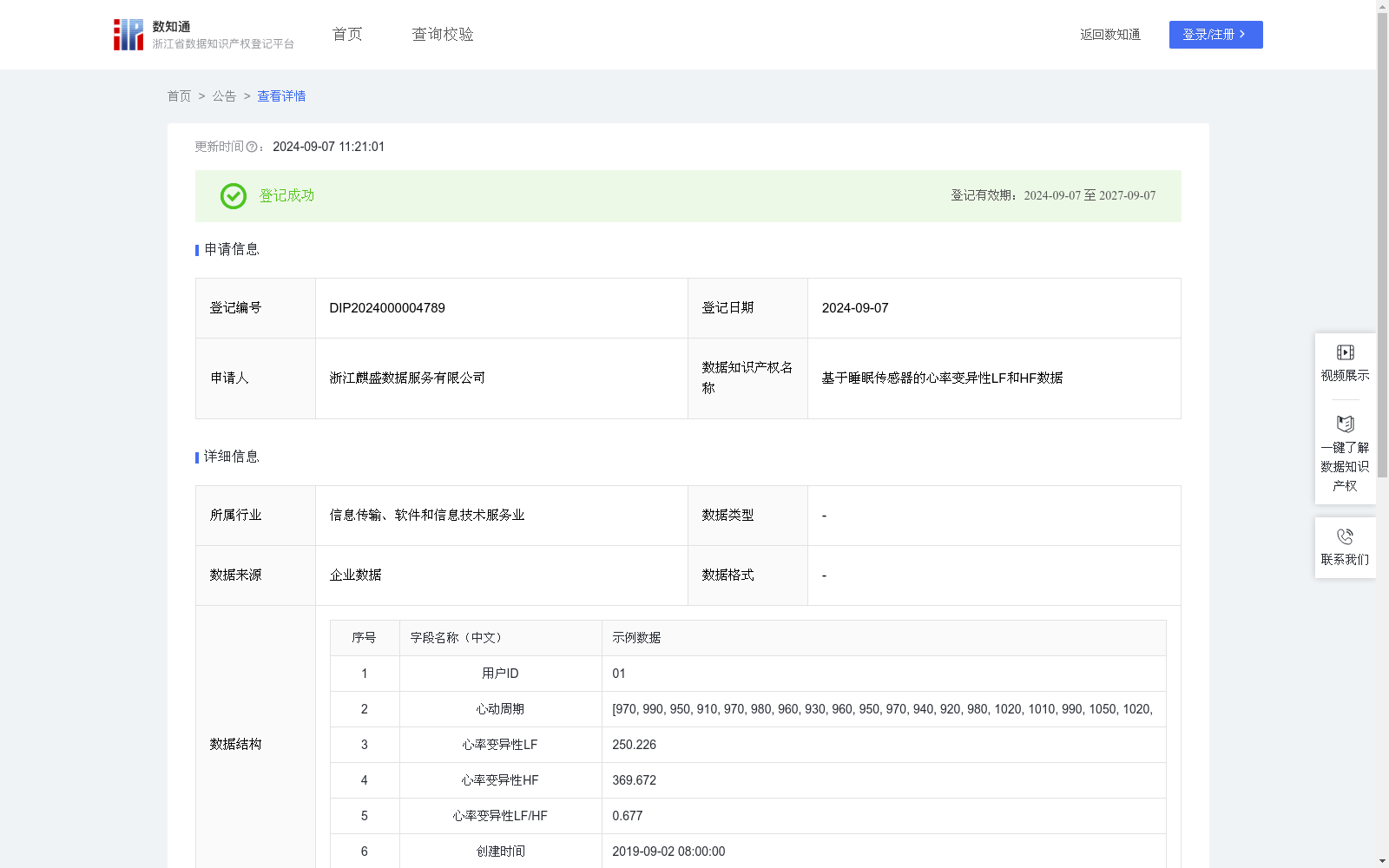
基于睡眠传感器的心率变异性LF和HF数据
收藏浙江省数据知识产权登记平台2024-09-07 更新2024-09-08 收录
下载链接:
https://www.zjip.org.cn/home/announce/trends/59028
下载链接
链接失效反馈官方服务:
资源简介:
以睡眠传感器的心率变异性LF和HF数据,可以应用于多个领域和场景:1)健康评估与监测:LF和HF数据可用于评估和监测个体的心脏健康状况。通过分析LF和HF的比例,可以评估自主神经系统的平衡性,从而了解个体的心脏功能和应激反应。2) 压力与情绪管理:LF和HF数据可以用于监测和管理压力水平和情绪状态。高频成分(HF)与心脏的短期变异性相关,反映了自主神经系统的副交感神经活动,与放松和恢复有关。低频成分(LF)则与交感神经活动相关,反映了应激和紧张状态。3)睡眠质量评估:LF和HF数据可以用于评估睡眠质量。较高的HF成分表示较好的睡眠质量,而较高的LF成分可能与睡眠障碍或应激相关。通过分析LF和HF的比例,可以了解个体的睡眠质量和自主神经系统的调节情况。通过内置传感器持续监测用户的心率、呼吸频率等生命体征数据。这些数据不仅有助于提高睡眠质量,还可以用于早期发现潜在的健康问题,如睡眠呼吸暂停综合症等。在大量个人睡眠数据的基础上,标准化的数据格式方便数据的交流和互通,后期进一步设计加密的数据格式,行业可以制定出更加科学合理的标准和规范。此数据能够为睡眠健康行业提供重要的参考信息。睡眠传感器实时收集用户在床状态下的心动间期数据,即每次心脏跳动与下一次心脏跳动之间的时间间隔,单位ms,记录在心动周期字段内,这些数据经过异常值处理后,将心动周期数据进行按频率4Hz进行数据重采样,重采样的数据计算功率谱密度,取频率范围0.04-0.15范围的功率谱密度值的总和作为LF, 取频率范围0.15-0.40范围的功率谱密度值的总和作为HF,计算LF和HF的比值,作为心率变异性LF/HF。
The heart rate variability (HRV) LF and HF data collected by sleep sensors can be applied to multiple domains and scenarios: 1. Health Assessment and Monitoring: LF and HF data can be used to evaluate and monitor an individual's cardiac health status. By analyzing the ratio of LF to HF, the balance of the autonomic nervous system can be assessed, so as to understand the individual's cardiac function and stress response. 2. Stress and Emotion Management: LF and HF data can be used to monitor and manage stress levels and emotional states. The high-frequency component (HF) is associated with the short-term variability of the heart, reflecting the parasympathetic nervous activity of the autonomic nervous system, and is related to relaxation and recovery. The low-frequency component (LF) is correlated with sympathetic nervous activity, reflecting stress and tension states. 3. Sleep Quality Assessment: LF and HF data can be used to evaluate sleep quality. A higher HF component indicates better sleep quality, while a higher LF component may be linked to sleep disorders or stress. By analyzing the LF/HF ratio, one can gain insights into an individual's sleep quality and the regulatory status of the autonomic nervous system. The built-in sensors of the sleep sensors continuously monitor vital sign data such as the user's heart rate and respiratory rate. These data not only contribute to improving sleep quality, but can also be used for the early detection of potential health issues, such as sleep apnea syndrome. Based on a large volume of personal sleep data, the standardized data format facilitates data exchange and interoperability. In the later stage, encrypted data formats can be further designed, enabling the industry to formulate more scientific and reasonable standards and specifications. This dataset can provide important reference information for the sleep health industry. The sleep sensor collects the user's beat-to-beat interval data (i.e., the time interval between each heartbeat and the subsequent heartbeat) in real time when the user is in bed, with the unit of milliseconds (ms), which is recorded in the cardiac cycle field. After outlier processing is performed on these data, the cardiac cycle data is resampled at a frequency of 4 Hz. The power spectral density of the resampled data is calculated, and the sum of the power spectral density values within the frequency range of 0.04–0.15 is taken as LF, while the sum of the power spectral density values within the frequency range of 0.15–0.40 is taken as HF. The ratio of LF to HF is calculated as the heart rate variability LF/HF.
提供机构:
浙江麒盛数据服务有限公司
创建时间:
2024-08-02
搜集汇总
数据集介绍
特点
该数据集包含基于睡眠传感器的心率变异性LF和HF数据,每日更新,适用于健康评估、压力管理和睡眠质量分析。数据通过传感器实时收集并经过处理,能够为睡眠健康行业提供重要参考。
以上内容由遇见数据集搜集并总结生成


