SIS-Bench
收藏资源简介:
SIS-Bench是一个用于评估具身无人机(UAV)场景中空间智能的综合基准数据集。该基准旨在评估多模态大语言模型(MLLMs)在两个互补维度——空间认知与自我意识——以及三个由易到难的认知层级(感知、记忆、推理)上的表现。数据集包含4,856个多项选择题,覆盖13个不同的任务类别,基于1,646个唯一的无人机视频构建。这些视频来源于三个互补的无人机视频数据集:AirScape、UrbanVideo-Bench和VisDrone,涵盖了丰富的城市环境和飞行场景。视频格式主要为H.264编码的MP4,分辨率分别为1280×720或1904×1070。数据以JSON Lines(.jsonl)格式组织,每个条目包含唯一的问题ID、视频文件名与路径、视频片段拼接数量(1表示单视频)、任务类型、自然语言问题、四个选项(A-D)以及正确答案标签。任务被系统性地组织在一个2×3的评估网格中:两个评估维度(空间认知:理解外部环境中的物体、地标、空间关系和场景布局;自我意识:理解无人机自身的运动、动作历史和未来行为)与三个认知层级(感知:基于单次观察的直接视觉与运动理解;记忆:整合多个具有时序依赖性的视频片段信息;推理:在长时序或时序被打乱的情况下进行高层级推断)。该数据集专门用于对视频MLLMs进行零样本评估,以探究模型在联合理解“空间”(外部环境)与“自我”(智能体自身状态与运动)方面的能力。其应用场景包括空间智能基准测试、自我意识能力诊断、时序推理评估、零样本模型泛化能力测评以及受控消融实验对比。
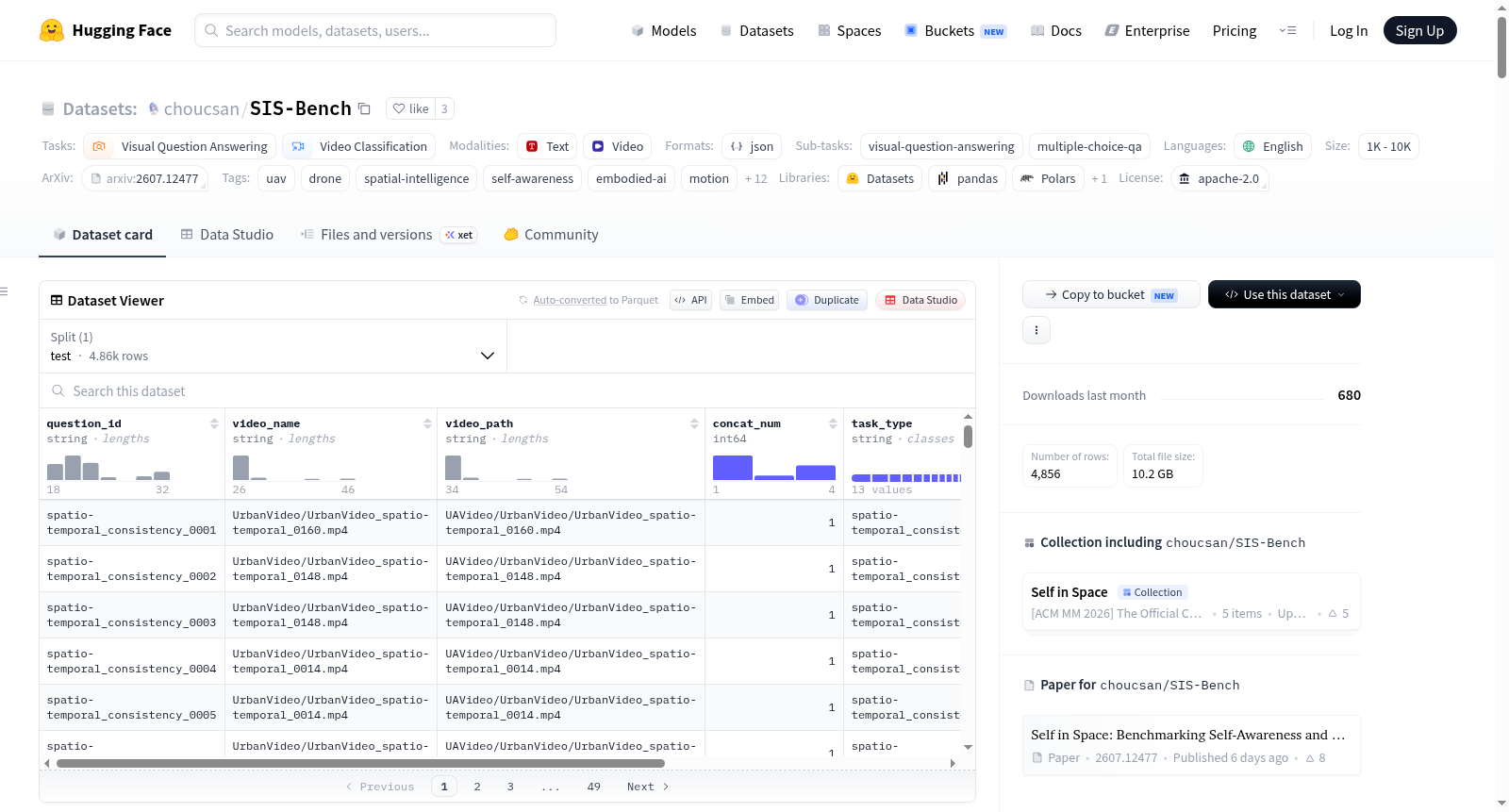
SIS-Bench is a comprehensive benchmark dataset for evaluating spatial intelligence in embodied unmanned aerial vehicle (UAV) scenarios. This benchmark aims to assess the performance of multimodal large language models (MLLMs) across two complementary dimensions—spatial cognition and self-awareness—and three cognitive levels of increasing difficulty (perception, memory, reasoning). The dataset comprises 4,856 multiple-choice questions covering 13 distinct task categories, built upon 1,646 unique UAV videos. These videos are sourced from three complementary UAV video datasets: AirScape, UrbanVideo-Bench, and VisDrone, encompassing a wide range of urban environments and flight scenarios. The video formats are primarily H.264-encoded MP4, with resolutions of 1280×720 or 1904×1070. The data is organized in JSON Lines (.jsonl) format, with each entry containing a unique question ID, video filename and path, number of video segments concatenated (1 for single video), task type, natural language question, four options (A-D), and the correct answer label. Tasks are systematically structured in a 2×3 evaluation grid: two evaluation dimensions (spatial cognition: understanding objects, landmarks, spatial relationships, and scene layouts in the external environment; self-awareness: understanding the UAVs own motion, action history, and future behavior) and three cognitive levels (perception: direct visual and motion understanding based on a single observation; memory: integrating information from multiple temporally dependent video segments; reasoning: high-level inference under long-term or temporally shuffled conditions). This dataset is specifically designed for zero-shot evaluation of video MLLMs to explore models capabilities in jointly understanding space (external environment) and self (agents own state and motion). Its application scenarios include spatial intelligence benchmarking, self-awareness capability diagnosis, temporal reasoning assessment, zero-shot model generalization evaluation, and controlled ablation experiment comparisons.
数据集总览
SIS-Bench 是一个专注于评估无人机(UAV)场景下空间智能的综合基准测试。它旨在评测多模态大语言模型(MLLMs)在空间认知与自我意识两个维度上的能力,涵盖感知、记忆和推理三个递增的认知难度层级。
- 语言:英语
- 许可证:Apache-2.0
- 任务类别:视觉问答、视频分类、多项选择问答
- 数据规模:包含 4,856 个多项选择题,覆盖 13 个任务,源自 1,646 个独特视频。
基准测试设计
SIS-Bench 按照两个维度和三个认知层级组织,形成一个 2×3 的评估网格。
两个维度
| 维度 | 关注点 | 问题示例 |
|---|---|---|
| 空间认知 | 理解外部环境,如物体、地标、空间关系和场景布局。 | "What object is located to the rear of the dark column-shaped parking sign?" |
| 自我意识 | 理解无人机自身的运动、动作历史和未来行为。 | "What flight action is the drone performing in the second clip?" |
三个认知层级
| 层级 | 描述 | 视频类型 |
|---|---|---|
| 感知 | 基于单一观察的直接视觉和运动理解。 | 单视频 |
| 记忆 | 整合跨多个片段的信息,具有时间依赖性。 | 拼接视频(2-4个片段) |
| 推理 | 对长或混乱时间跨度进行高阶推理。 | 长视频 / 乱序视频 |
任务分类与数据分布
基准测试包含 13 个具体任务,其分布如下:
| # | 任务 | 维度 | 层级 | 视频类型 | 条目数 |
|---|---|---|---|---|---|
| 1 | 物体存在性 | 空间认知 | 感知 | 单视频 | 492 |
| 2 | 物体属性 | 空间认知 | 感知 | 单视频 | 387 |
| 3 | 相对方向 | 空间认知 | 感知 | 单视频 | 200 |
| 4 | 地标出现顺序 | 空间认知 | 记忆 | 拼接视频 | 306 |
| 5 | 地标回忆 | 空间认知 | 记忆 | 拼接视频 | 443 |
| 6 | 位置关系 | 空间认知 | 记忆 | 拼接视频 | 252 |
| 7 | 空间一致性 | 空间认知 | 推理 | 乱序视频 | 195 |
| 8 | 时空一致性 | 空间认知 | 推理 | 乱序视频 | 241 |
| 9 | 动作识别 | 自我意识 | 感知 | 单视频 | 686 |
| 10 | 动作序列 | 自我意识 | 记忆 | 拼接视频 | 315 |
| 11 | 动作回忆 | 自我意识 | 记忆 | 拼接视频 | 804 |
| 12 | 动作预测 | 自我意识 | 推理 | 长视频 | 263 |
| 13 | 路径规划 | 自我意识 | 推理 | 长视频 | 272 |
总体分布总结:
| 感知 | 记忆 | 推理 | 总计 | |
|---|---|---|---|---|
| 空间认知 | 1,079 | 1,001 | 436 | 2,516 |
| 自我意识 | 686 | 1,119 | 535 | 2,340 |
| 总计 | 1,765 | 2,120 | 971 | 4,856 |
数据来源
基准测试的数据来源于三个无人机视频数据集:
- AirScape:大规模航拍素材,包含丰富的 GPS、相机和轨迹标注,3,885 个条目。
- UrbanVideo-Bench:多样的城市无人机视频,覆盖道路、建筑、公园和十字路口,838 个条目。
- VisDrone:真实世界无人机镜头,包含物体检测和跟踪标注,133 个条目。
所有视频均为 H.264 编码的 MP4 格式,分辨率为 1280×720(AirScape, UrbanVideo-Bench)或 1904×1070(VisDrone)。
数据格式
数据存储在一个名为 SIS-Bench.jsonl 的文件中,每一行是一个 JSON 对象,包含以下字段:
question_id: 唯一的问题标识符 (string)video_name: 包含子目录的源视频文件名 (string)video_path: 视频目录内的相对路径 (string)concat_num: 拼接片段的数量 (integer)task_type: 13个任务类别之一 (string)question: 自然语言问题 (string)options:A到D四个选项 (object)answer: 正确的选项标签 (A-D) (string)
数据集结构
SIS-Bench/ ├── SIS-Bench.jsonl # 4,856 个问答对 ├── video/ │ ├── AirScape/ # 1,156 个视频 │ ├── UrbanVideo/ # 427 个视频 │ └── VisDrone/ # 63 个视频 └── images/ ├── teaser.jpeg # 基准测试展示图 └── pipeline.webp # 构建流程概览图
应用场景
- 空间智能基准测试:评估视频 MLLM 在无人机场景下对空间和自我的联合理解能力。
- 自我意识诊断:衡量模型对智能体运动、动作历史和未来行为的理解程度。
- 时序推理评估:在感知、记忆、推理三个认知层级上测试模型。
- 零样本评估:评估预训练模型的泛化能力。
- 受控消融追踪:在相同的评估协议下比较模型变体。