electricsheepasia/asia-ilo-emp-5nif-sex-eco-rt-informal-employment-rate-by-sex-and-economic-activ
收藏资源简介:
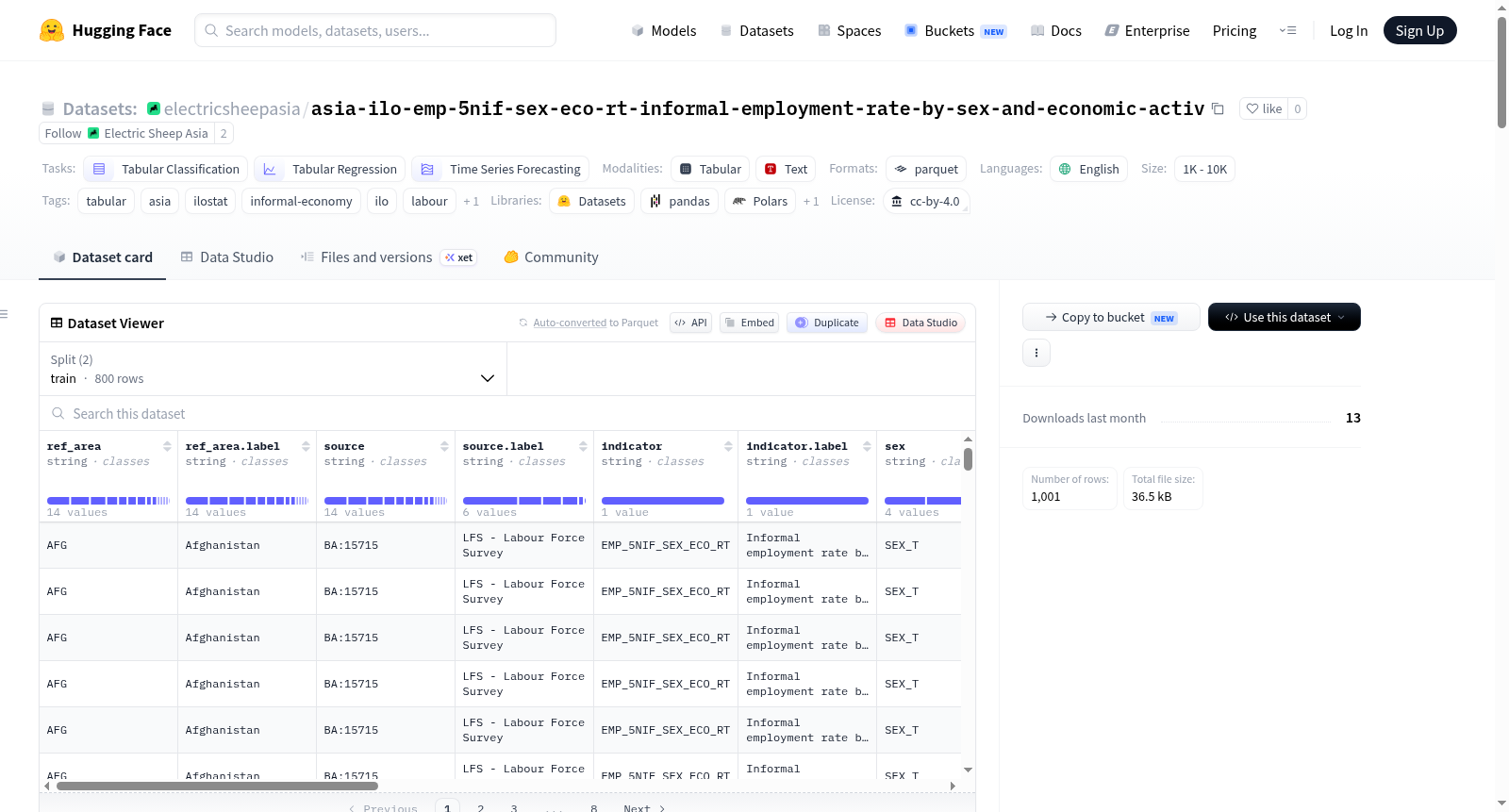
该数据集是关于亚洲地区非正规就业率的统计数据集,具体指标为按性别和经济活动划分的非正规就业率——基于第19届国际劳工统计学家会议(ICLS)定义(百分比)。数据集包含1,001个观测值,覆盖18个亚洲国家(包括阿富汗、孟加拉国、文莱、塞浦路斯、格鲁吉亚、约旦、韩国、老挝、黎巴嫩、蒙古、缅甸、马尔代夫、巴基斯坦、越南等),时间跨度为2014年至2025年。数据来源于国际劳工组织(ILO)的ILOSTAT数据库,通过ILOSTAT REST API获取,并经过处理和过滤以仅包含亚洲国家。数据集采用表格形式,包含多个列,如国家代码(ref_area)、国家名称(ref_area.label)、数据来源代码和标签(source, source.label)、指标代码和标签(indicator, indicator.label)、性别分类(sex, sex.label)、经济活动分类(classif1, classif1.label)、观测年份(time)、观测值(obs_value)、观测状态(obs_status, obs_status.label)以及相关注释列。数据按年度频率提供,并包含数据质量说明,如当同一国家×年份有多个数据来源时,使用ILO选择的最佳来源。数据集适用于表格分类、回归和时间序列预测等任务,主要用于劳动经济学、就业政策分析和非正规经济研究。
This dataset contains statistical data on the informal employment rate in Asia, specifically the indicator Informal employment rate by sex and economic activity -- 19th International Conference of Labour Statisticians (ICLS) definition (%). It includes 1,001 observations across 18 Asian countries (such as Afghanistan, Bangladesh, Brunei, Cyprus, Georgia, Jordan, Korea, Lao Peoples Democratic Republic, Lebanon, Mongolia, Myanmar, Maldives, Pakistan, Vietnam, etc.), spanning the years 2014 to 2025. The data is sourced from the International Labour Organization (ILO) ILOSTAT database, retrieved via the ILOSTAT REST API, and processed and filtered to include only Asian countries. The dataset is in tabular format with multiple columns, including country code (ref_area), country name (ref_area.label), source code and label (source, source.label), indicator code and label (indicator, indicator.label), sex disaggregation (sex, sex.label), economic activity classification (classif1, classif1.label), observation year (time), observed value (obs_value), observation status (obs_status, obs_status.label), and related note columns. Data is provided at an annual frequency and includes data quality caveats, such as the use of the ILO-selected best source when multiple sources exist for the same country×year. The dataset is suitable for tasks like tabular classification, regression, and time-series forecasting, primarily for labor economics, employment policy analysis, and informal economy research.