
treadon/fma-mert-embeddings
收藏Hugging Face2026-03-26 更新2026-03-29 收录
下载链接:
https://hf-mirror.com/datasets/treadon/fma-mert-embeddings
下载链接
链接失效反馈官方服务:
资源简介:
---
license: apache-2.0
tags:
- music
- audio
- embeddings
- mert
- fma
- music-information-retrieval
task_categories:
- audio-classification
- feature-extraction
size_categories:
- 1K<n<10K
language:
- en
---
# FMA-MERT Embeddings
Pre-computed [MERT-v1-330M](https://huggingface.co/m-a-p/MERT-v1-330M) embeddings for the [FMA-Small](https://github.com/mdeff/fma) dataset. 7,997 tracks, each represented as a 1024-dimensional vector, with banger scores (0-10) derived from log-normalized play counts.
Use this dataset to train music quality scorers, explore music similarity, or experiment with audio representation learning -- without needing to download 7.2 GB of audio or run MERT yourself.
## Dataset Description
Each row represents one track from FMA-Small, encoded through MERT-v1-330M and annotated with popularity-based quality labels.
### Fields
| Field | Type | Description |
|-------|------|-------------|
| `track_id` | int | FMA track identifier |
| `embedding` | list[float] (1024) | Mean-pooled MERT-v1-330M embedding |
| `banger_score` | float (0-10) | Log-normalized play count, scaled to 0-10 |
| `genre` | string | Top-level genre from FMA metadata |
| `listens` | int | Raw play count from FMA |
### Size
- **7,997 tracks** (3 corrupt MP3s out of 8,000 failed during embedding extraction -- 99.96% success rate)
- **1024 dimensions** per embedding
- **~31 MB** as a NumPy array on disk
### Genre Breakdown
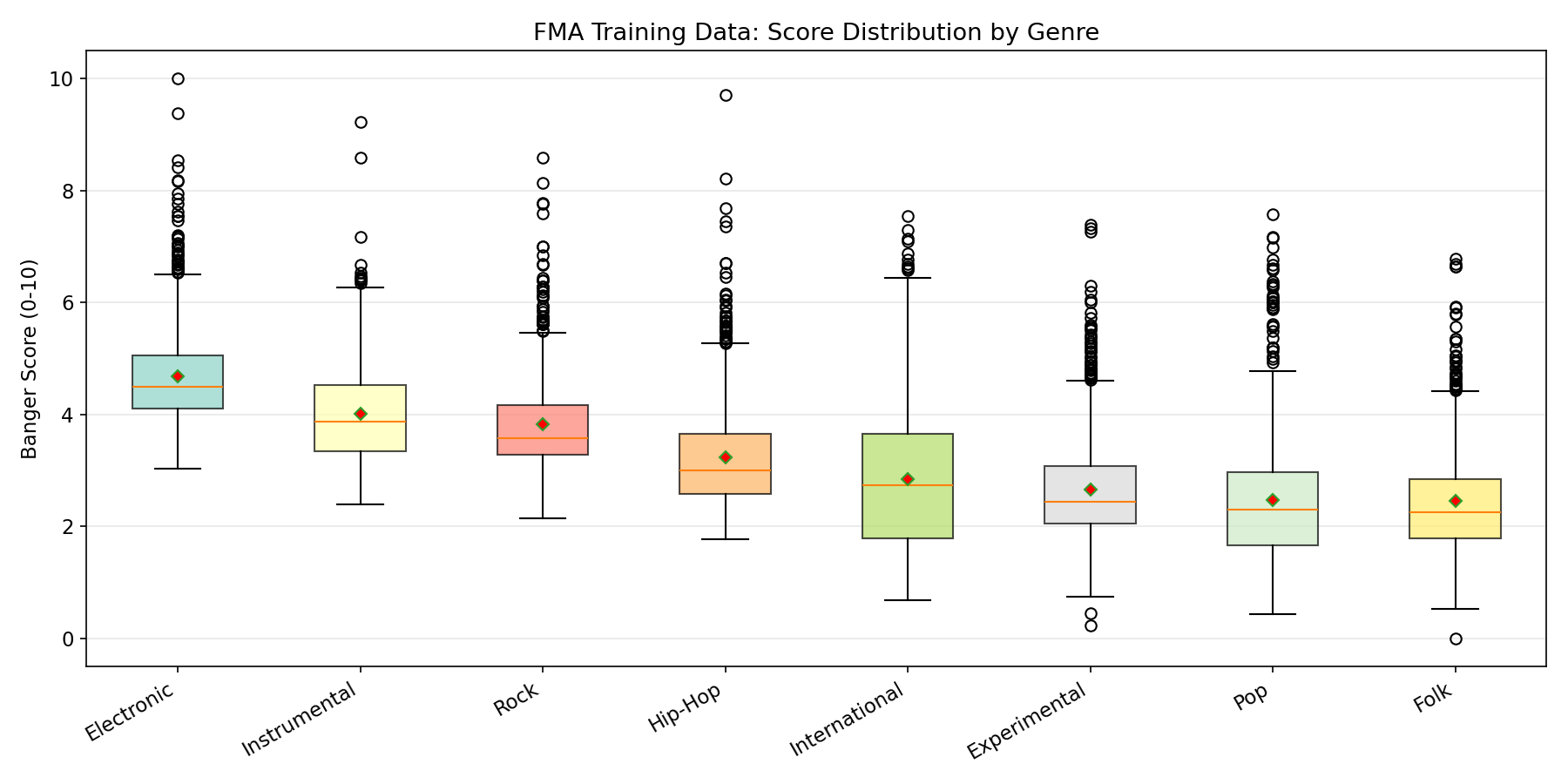
FMA-Small is perfectly balanced across 8 genres (~1,000 tracks each):
| Genre | Count |
|-------|-------|
| Hip-Hop | ~1,000 |
| Pop | ~1,000 |
| Folk | ~1,000 |
| Experimental | ~1,000 |
| Rock | ~1,000 |
| International | ~1,000 |
| Electronic | ~1,000 |
| Instrumental | ~1,000 |
### Score Distribution
Banger scores are derived from FMA play counts via log-normalization:
```python
log_listens = np.log1p(df["listens"])
banger_score = (log_listens - log_listens.min()) / (log_listens.max() - log_listens.min()) * 10.0
```
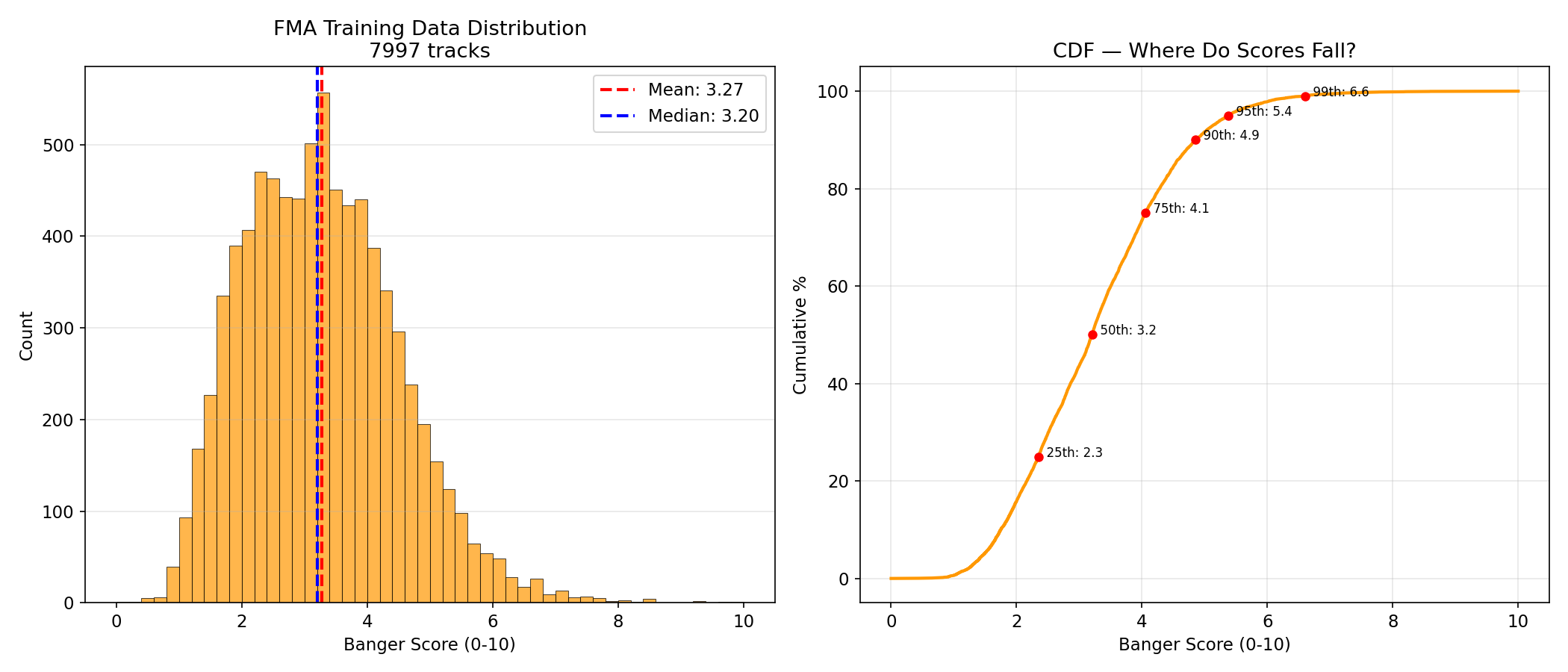
| Statistic | Value |
|-----------|-------|
| Mean | 3.27 |
| Median | 3.20 |
| Std | 1.37 |
| Min | 0.00 |
| Max | 10.00 |
| Tracks >= 5.0 | 668 (8.4%) |
| Tracks >= 7.0 | 45 (0.6%) |
| Tracks >= 9.0 | 4 (0.1%) |
The distribution is concentrated in the 1-5 range. Very few tracks have high scores, which reflects the heavy-tailed nature of music popularity (a few hits, many average tracks).
## Source Data
### Audio Source
[FMA (Free Music Archive)](https://github.com/mdeff/fma) -- a large-scale, freely available dataset of audio tracks. FMA-Small contains 8,000 tracks of 30-second clips (7.2 GB), Creative Commons licensed.
**Play count range:** 196 to 543,252 (mean 4,730, median 2,492). The massive gap between mean and median reflects the power-law distribution typical of music popularity.
### How Embeddings Were Generated
**Model:** [m-a-p/MERT-v1-330M](https://huggingface.co/m-a-p/MERT-v1-330M) -- a 330M parameter, 24-layer self-supervised music understanding model trained on 160,000 hours of audio.
**Process:**
1. Load each MP3 track and resample to 24kHz mono (MERT's expected input rate) using librosa
2. Truncate to 30 seconds maximum
3. Run through MERT's feature extractor and forward pass
4. Mean-pool the last hidden state across the time dimension: `outputs.last_hidden_state.mean(dim=1)` to produce a single 1024-dim vector per track
5. Save as NumPy array
```python
# Core embedding logic
waveform, _ = librosa.load("track.mp3", sr=24000, mono=True)
waveform = waveform[:24000 * 30] # 30s max
inputs = feature_extractor(waveform, sampling_rate=24000, return_tensors="pt")
with torch.no_grad():
outputs = mert(**inputs)
embedding = outputs.last_hidden_state.mean(dim=1).squeeze(0).cpu().numpy() # (1024,)
```
**Compute:**
- Device: Apple M4 Pro, Metal Performance Shaders (MPS)
- Processing rate: 1.3 tracks/second
- Total time: **101 minutes** for 7,997 tracks
- Peak memory: ~1.7 GB (MERT model + one audio buffer)
- Failures: 3 out of 8,000 (corrupt MP3s)
**Why mean pooling?** MERT produces ~1,200 time frames (one per ~25ms) for a 30-second clip, each with a 1024-dim vector. Mean pooling collapses these into a single vector that captures the overall "essence" of the track -- rhythm patterns, harmonic content, timbral quality, melodic structure -- while discarding temporal ordering. Simple and effective as a baseline; attention pooling could be explored for improvements.
## How to Use
```python
from datasets import load_dataset
import numpy as np
# Load the dataset
ds = load_dataset("treadon/fma-mert-embeddings", split="train")
# Access a single track
track = ds[0]
embedding = np.array(track["embedding"]) # (1024,)
score = track["banger_score"] # float 0-10
genre = track["genre"] # e.g., "Electronic"
listens = track["listens"] # raw play count
print(f"Track {track['track_id']}: {genre}, score={score:.2f}, listens={listens}")
print(f"Embedding shape: {embedding.shape}")
# Filter by genre
electronic = ds.filter(lambda x: x["genre"] == "Electronic")
print(f"Electronic tracks: {len(electronic)}")
# Get all embeddings as a matrix for training
all_embeddings = np.array(ds["embedding"]) # (7997, 1024)
all_scores = np.array(ds["banger_score"]) # (7997,)
```
### Train a scorer on these embeddings
```python
import torch
import torch.nn as nn
from sklearn.model_selection import train_test_split
# Load embeddings
ds = load_dataset("treadon/fma-mert-embeddings", split="train")
X = np.array(ds["embedding"]) # (7997, 1024)
y = np.array(ds["banger_score"]) # (7997,)
X_train, X_test, y_train, y_test = train_test_split(X, y, test_size=0.2, random_state=42)
# Define a simple MLP
scorer = nn.Sequential(
nn.Linear(1024, 512), nn.BatchNorm1d(512), nn.ReLU(), nn.Dropout(0.3),
nn.Linear(512, 256), nn.BatchNorm1d(256), nn.ReLU(), nn.Dropout(0.3),
nn.Linear(256, 128), nn.BatchNorm1d(128), nn.ReLU(), nn.Dropout(0.15),
nn.Linear(128, 1),
)
# Train... (see treadon/banger-scorer for full training code)
```
The trained model that ships with [treadon/banger-scorer](https://huggingface.co/treadon/banger-scorer) achieved **MAE 0.858** and **Spearman 0.468** on this data, training in ~30 seconds on M4 Pro.
## Use Cases
- **Train music quality scorers** without downloading 7.2 GB of FMA audio or running MERT (which takes ~100 minutes on GPU)
- **Music similarity search** -- compute cosine similarity between embeddings to find similar-sounding tracks
- **Genre classification** -- train a classifier on the embeddings using the genre labels
- **Explore MERT's representation space** -- visualize with t-SNE/UMAP, analyze what musical features each dimension captures
- **Baseline for music understanding tasks** -- compare against fine-tuned or alternative audio models
## Limitations
- **FMA-Small only.** 8,000 tracks is relatively small. FMA-Medium (25K) or FMA-Large (106K) would provide more diverse representations.
- **Popularity labels are noisy.** Play counts reflect many factors beyond musical quality: playlist placement, artist following, upload timing. They are a useful but imperfect proxy.
- **Mean pooling discards temporal info.** The embeddings capture "what happens" but not "when it happens." Songs with identical frequency content but different temporal structures will have similar embeddings.
- **30-second clips.** FMA-Small contains 30-second excerpts, not full tracks. The embedding represents only part of each song.
- **Fixed MERT version.** These embeddings are from MERT-v1-330M specifically. They are not compatible with other audio encoders or MERT versions.
## Citation
```bibtex
@article{li2023mert,
title={MERT: Acoustic Music Understanding Model with Large-Scale Self-supervised Training},
author={Li, Yizhi and Yuan, Ruibin and Zhang, Ge and Ma, Yinghao and others},
journal={arXiv preprint arXiv:2306.00107},
year={2023}
}
@inproceedings{defferrard2017fma,
title={FMA: A Dataset For Music Analysis},
author={Defferrard, Micha{\"e}l and Benzi, Kirell and Vandergheynst, Pierre and Bresson, Xavier},
booktitle={ISMIR},
year={2017}
}
```
## Dataset Card Contact
[treadon](https://huggingface.co/treadon) on HuggingFace
提供机构:
treadon



