
<b>Nestling retrieval behavior in two bunting hosts of the common cuckoo</b>
收藏DataCite Commons2024-09-22 更新2024-11-05 收录
下载链接:
https://figshare.com/articles/dataset/_b_Nestling_retrieval_behavior_in_two_bunting_hosts_of_the_common_cuckoo_b_/27080647
下载链接
链接失效反馈官方服务:
资源简介:
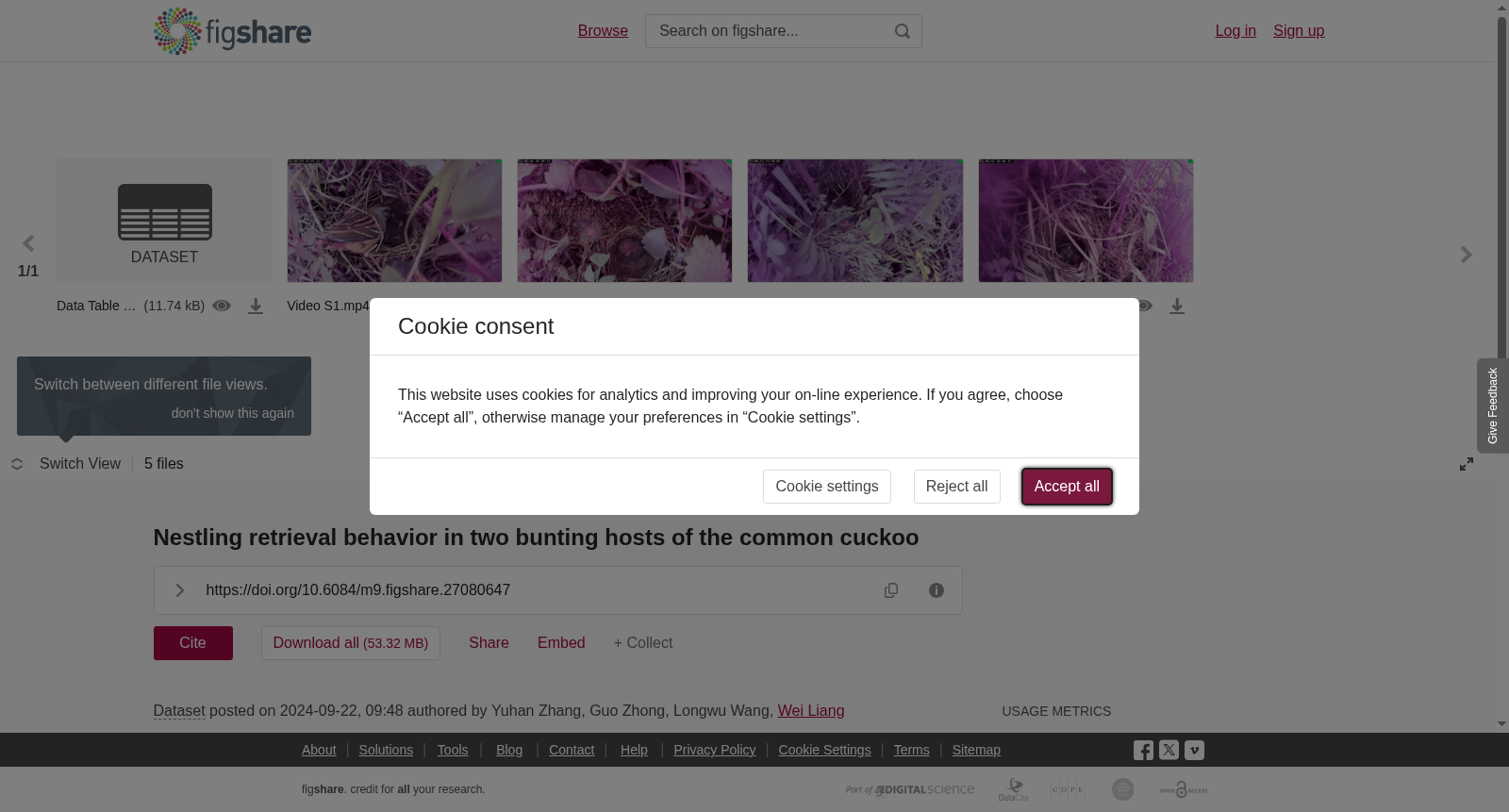
The experimental study was conducted in the Liuzhi area of Guizhou, southwestern China (26°10′-14′ N, 105°13′-24′ E). This area is characterized by a karst mountain landscape consisting of rivers, farmlands, villages and second forests (Zhang et al. 2023). From April to August in 2022 and 2024, we searched for bird nests in this area to carry out our experiments.In this study, two species of ground-nesting bunting hosts of the common cuckoo (<i>Cuculus canorus</i>) that breed sympatrically within the same area, namely the south rock bunting (<i>Emberiza yunnanensis</i>) and yellow-throated bunting (<i>E. elegans</i>), were studied. By placing their own nestlings next to the host nests and video recording the parental behavioral response, we aimed to explore the retrieval behavior of these two bunting hosts towards nestlings beside the nest. The results showed that neither species exhibited retrieval or rejection behavior towards the nestlings; the yellow-throated bunting ignored its own nestlings beside the nest in most cases, while the south rock bunting showed a moderate proportion of ignoring nestlings. Compared to the yellow-throated bunting, the south rock bunting had a higher feeding rate (43.75% vs. 15.38%) and a lower ignoring rate (56.25% vs. 84.62%) towards the nestlings beside the nest. Our study showed that no nestling retrieval behavior in two bunting hosts of the common cuckoo and the location of the nestlings may be an important factor affecting parental recognition. The hosts' behavior of not retrieving nestlings benefits the survival of parasitic chicks, which is advantageous for avian obligate brood parasites.
本实验在中国西南贵州六枝地区(北纬26°10′-14′,东经105°13′-24′)开展。该区域以喀斯特山地景观为典型特征,分布有河流、农田、村落与次生林(Zhang等,2023)。2022年与2024年的4-8月,研究团队在该区域搜寻鸟巢以开展实验。本研究针对同域分布于该区域的大杜鹃(*Cuculus canorus*)的两种地面筑巢寄主鵐类展开探究,分别为南岩鹀(*Emberiza yunnanensis*)与黄喉鹀(*E. elegans*)。实验通过将寄主雏鸟放置于寄主巢旁,并通过录像记录亲鸟的行为响应,旨在探讨这两种鵐类寄主对巢旁雏鸟的取回行为。研究结果显示,两个物种均未表现出对巢旁雏鸟的取回或拒斥行为;黄喉鹀在多数情况下会忽略巢旁的自身雏鸟,而南岩鹀忽略雏鸟的比例处于中等水平。相较于黄喉鹀,南岩鹀对巢旁雏鸟的喂食率更高(43.75% vs. 15.38%),忽略率更低(56.25% vs. 84.62%)。本研究表明,大杜鹃的两种鵐类寄主均未表现出雏鸟取回行为,雏鸟的所处位置可能是影响亲鸟识别的重要因素。寄主不取回雏鸟的行为有利于寄生雏鸟的存活,这对专性育雏寄生鸟类而言具有演化优势。
提供机构:
figshare创建时间:
2024-09-22
搜集汇总
数据集介绍
背景与挑战
背景概述
该数据集聚焦于两种鹀科鸟类(南岩鹀和黄喉鹀)作为大杜鹃宿主的雏鸟检索行为实验研究,通过2022年和2024年在中国贵州的野外实验视频记录,发现两种鸟类均未表现出检索行为,且南岩鹀的喂食率高于黄喉鹀。数据集包含原始数据表格和视频文件,支持行为生态学和宿主-寄生虫相互作用领域的研究。
以上内容由遇见数据集搜集并总结生成


