
October 2023 data-update for "Updated science-wide author databases of standardized citation indicators"
收藏Mendeley Data2024-03-27 更新2024-06-30 收录
下载链接:
https://elsevier.digitalcommonsdata.com/datasets/btchxktzyw
下载链接
链接失效反馈官方服务:
资源简介:
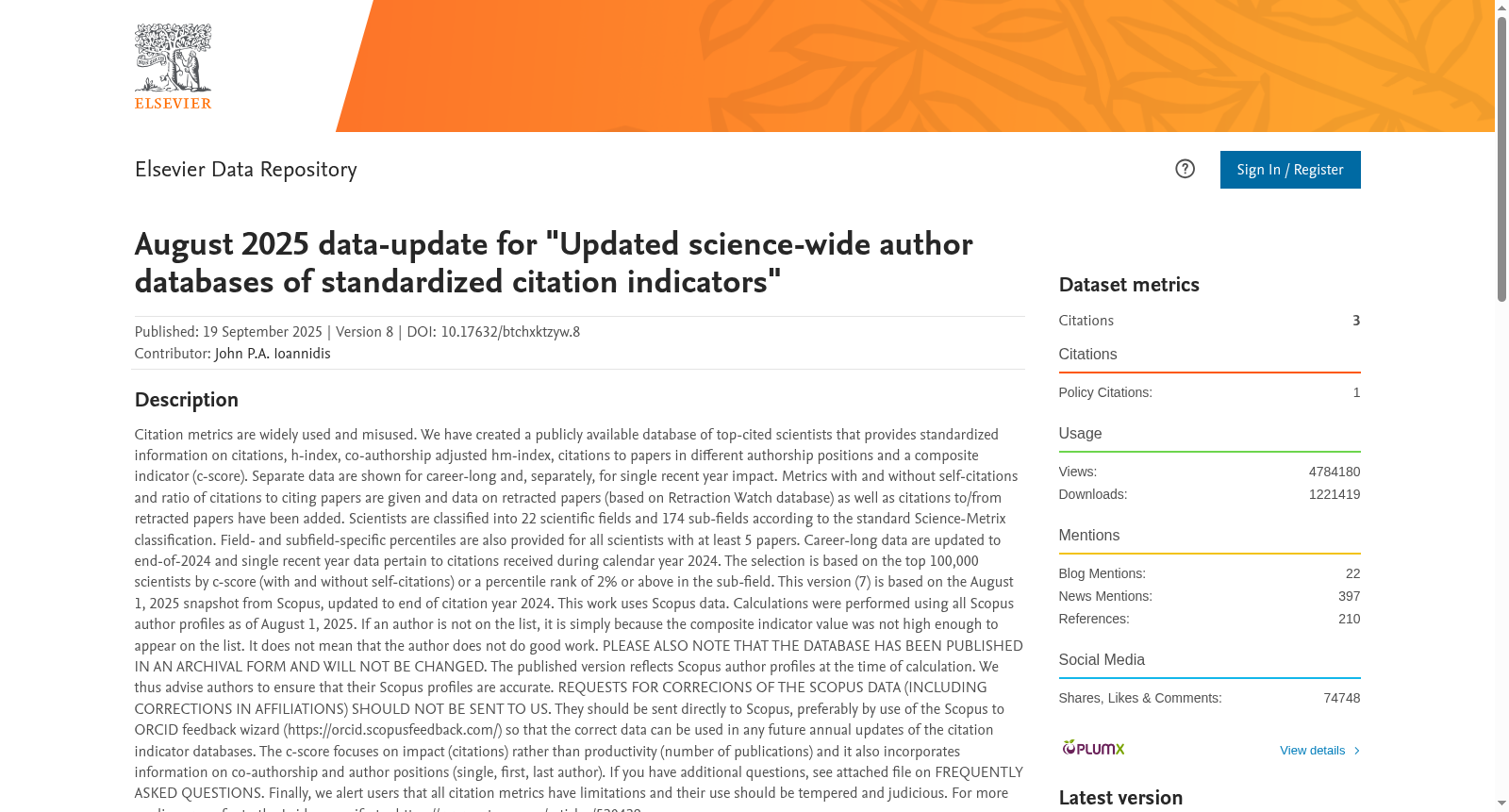
Citation metrics are widely used and misused. We have created a publicly available database of top-cited scientists that provides standardized information on citations, h-index, co-authorship adjusted hm-index, citations to papers in different authorship positions and a composite indicator (c-score). Separate data are shown for career-long and, separately, for single recent year impact. Metrics with and without self-citations and ratio of citations to citing papers are given. Scientists are classified into 22 scientific fields and 174 sub-fields according to the standard Science-Metrix classification. Field- and subfield-specific percentiles are also provided for all scientists with at least 5 papers. Career-long data are updated to end-of-2022 and single recent year data pertain to citations received during calendar year 2022. The selection is based on the top 100,000 scientists by c-score (with and without self-citations) or a percentile rank of 2% or above in the sub-field. This version (6) is based on the October 1, 2023 snapshot from Scopus, updated to end of citation year 2022. This work uses Scopus data provided by Elsevier through ICSR Lab (https://www.elsevier.com/icsr/icsrlab). Calculations were performed using all Scopus author profiles as of October 1, 2023. If an author is not on the list it is simply because the composite indicator value was not high enough to appear on the list. It does not mean that the author does not do good work. PLEASE ALSO NOTE THAT THE DATABASE HAS BEEN PUBLISHED IN AN ARCHIVAL FORM AND WILL NOT BE CHANGED. The published version reflects Scopus author profiles at the time of calculation. We thus advise authors to ensure that their Scopus profiles are accurate. REQUESTS FOR CORRECIONS OF THE SCOPUS DATA (INCLUDING CORRECTIONS IN AFFILIATIONS) SHOULD NOT BE SENT TO US. They should be sent directly to Scopus, preferably by use of the Scopus to ORCID feedback wizard (https://orcid.scopusfeedback.com/) so that the correct data can be used in any future annual updates of the citation indicator databases. The c-score focuses on impact (citations) rather than productivity (number of publications) and it also incorporates information on co-authorship and author positions (single, first, last author). If you have additional questions, please read the 3 associated PLoS Biology papers that explain the development, validation and use of these metrics and databases. (https://doi.org/10.1371/journal.pbio.1002501, https://doi.org/10.1371/journal.pbio.3000384 and https://doi.org/10.1371/journal.pbio.3000918). Finally, we alert users that all citation metrics have limitations and their use should be tempered and judicious. For more reading, we refer to the Leiden manifesto: https://www.nature.com/articles/520429a
创建时间:
2024-01-23
搜集汇总
数据集介绍
背景与挑战
背景概述
该数据集是一个公开的科学家标准化引文指标数据库,提供职业长期和单年影响的引文数据,包括h指数、合著调整指标和撤稿论文信息。数据基于Scopus更新至2024年底,使用Science-Metrix分类覆盖22个科学领域和174个子领域,旨在评估科学家的研究影响力。
以上内容由遇见数据集搜集并总结生成



