ABACUS原子轨道基组数据
收藏资源简介:
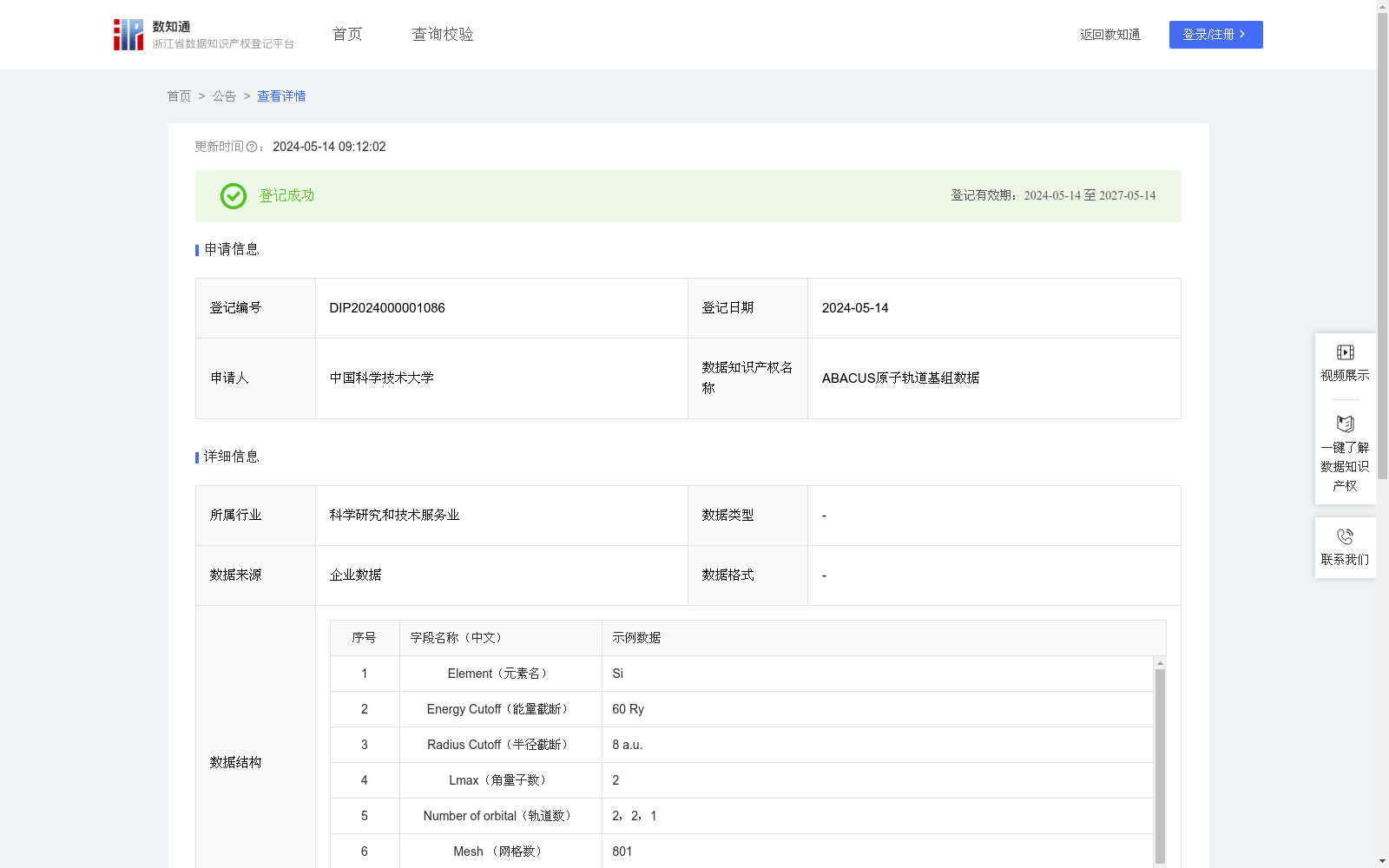
当需要高效率地模拟原子结构中的电子性质时,基于原子轨道的第一性原理计算算法能够提供高精度且快速的量子结构模拟。具体实施计算时,需要准确且普适的原子轨道数据作为模拟的必要输入数据。本申请所登记的原子轨道数据具有多种精度登记且适用于68种元素周期表元素,能够满足 ABACUS等基于原子轨道的计算软件的量子材料模拟需求。针对每一个元素类型,以双原子、三原子、四原子等局部小结构为对象,使用数据结构中设定的能量截断的平面波基组,来计算高精度的波函数作为参照数据。然后,以具有设定的半径截断的球贝塞尔函数作为空间基组,以设定的角量子数作为角动量上限遍历不同角动量的球谐函数,为不同的角动量分配轨道数量(即数据结构中的轨道数)以满足高低多种精度需求,构建基于原子轨道的波函数表示空间,用以拟合参照数据。拟合优化目标为平面波与原子轨道两种基组下的波函数差异,并限制拟合波函数的动量最大值,防止非物理的高频振荡部分。拟合过程中,使用退火算法生成球贝塞尔函数的拟合系数,然后根据设定的网格数、网格间距,计算轨道的数据组列表,保存在数据结构的轨道离散值位置。当完成数据生成后,还需应用于物态方程等标准计算中,检验轨道基组数据的准确性与普适性,在出现计算精度问题时,调整优化算法,改变设定参数值,直到完成一套包括多种精度级别(不同能量截断、半径截断等)的原子轨道数据。
When high-efficiency simulation of electronic properties in atomic structures is required, first-principles calculation algorithms based on atomic orbitals can provide high-precision and fast quantum structure simulation. Accurate and universal atomic orbital data is required as necessary input for the specific implementation of such calculations. The atomic orbital data registered in this application have multiple accuracy levels and are applicable to 68 elements in the periodic table, meeting the quantum material simulation requirements of atomic orbital-based computational software such as ABACUS. For each element, take local small structures such as diatomic, triatomic, and tetraatomic systems as objects, use the plane-wave basis set with a specified energy cutoff defined in the data structure to calculate high-precision wave functions as reference data. Then, use spherical Bessel functions with a set radius cutoff as the spatial basis set, traverse spherical harmonics of different angular momenta with the set azimuthal quantum number as the upper limit of angular momentum, allocate the number of orbitals (i.e., the orbital count in the data structure) for different angular momenta to meet various high and low accuracy requirements, and construct the atomic orbital-based wave function representation space to fit the reference data. The fitting optimization objective is the difference between wave functions under the plane-wave and atomic orbital basis sets, and the maximum momentum of the fitted wave functions is restricted to prevent non-physical high-frequency oscillations. During the fitting process, the simulated annealing algorithm is used to generate the fitting coefficients of the spherical Bessel functions. Then, calculate the list of orbital data groups according to the set number of grids and grid spacing, and store them in the orbital discrete value positions of the data structure. After the data generation is completed, it is also applied to standard calculations such as the equation of state to verify the accuracy and universality of the orbital basis set data. If calculation accuracy issues occur, adjust the optimization algorithm and change the set parameter values until a complete set of atomic orbital data including multiple accuracy levels (different energy cutoffs, radius cutoffs, etc.) is finalized.