P3D-Dataset
收藏资源简介:
P3D-Dataset是由南京大学与Envision联合构建的用于参数化三维生成与结构推理的基准数据集。该数据集包含1003个案例,涵盖400个文本到3D、400个图像到3D以及203个标注装配体任务,数据来源于Text2CAD v1.1和Fusion 360 Gallery,经过筛选、去重和平衡处理,确保几何可执行性与视觉清晰度。数据集通过多阶段流程构建,包括过滤不可靠案例、使用MLLM进行语义标注与验证,并生成描述性、参数化及部件级文本规范。其核心应用在于评估多模态大语言模型在生成精确参数化几何与部件级结构方面的能力,旨在推动三维建模中代码生成与空间推理的研究进展。
The P3D-Dataset is a benchmark dataset jointly developed by Nanjing University and Envision for parametric 3D generation and structural reasoning. It contains 1003 instances, covering 400 text-to-3D, 400 image-to-3D, and 203 annotated assembly tasks. Sourced from Text2CAD v1.1 and Fusion 360 Gallery, the dataset has undergone filtering, deduplication, and balancing procedures to guarantee geometric executability and visual clarity. Constructed through a multi-stage workflow, it includes filtering unreliable instances, conducting semantic annotation and validation with MLLMs, and generating descriptive, parametric, and part-level textual specifications. Its core application is to evaluate the capabilities of multimodal large language models (LLMs) to generate precise parametric geometry and part-level structures, aiming to advance research on code generation and spatial reasoning for 3D modeling.
P3D-Bench 数据集详情
数据集简介
P3D-Bench 是一个用于评估多模态大语言模型(MLLMs)在参数化 3D 生成与结构推理能力上的基准测试。与传统的 3D 网格不同,参数化 3D 程序能够暴露明确的尺寸、构造操作和零件关系,从而揭示模型是否真正恢复设计结构,而不仅仅是外观。
任务类型
P3D-Bench 在统一协议下涵盖三大任务:
- Text-to-3D(文本到3D):基于文本描述生成参数化3D程序
- Image-to-3D(图像到3D):基于图像输入生成参数化3D程序
- Assembly-3D(装配到3D):涉及多部件组合成连贯结构的装配任务
代码格式
支持四种输出格式:JSON、OpenSCAD、CadQuery、Three.js
评估指标
对每个输出从以下维度进行评分:
- Executability(可执行性)
- Geometric fidelity(几何保真度)
- Topology(拓扑结构)
- Text-grounded constraints(文本约束对齐)
- Multiview semantic alignment(多视图语义对齐)
- Part-level structure(零件级结构)
数据集规模
- 400 个文本测试用例
- 400 个图像测试用例
- 203 个带标注的装配体
排行榜摘要
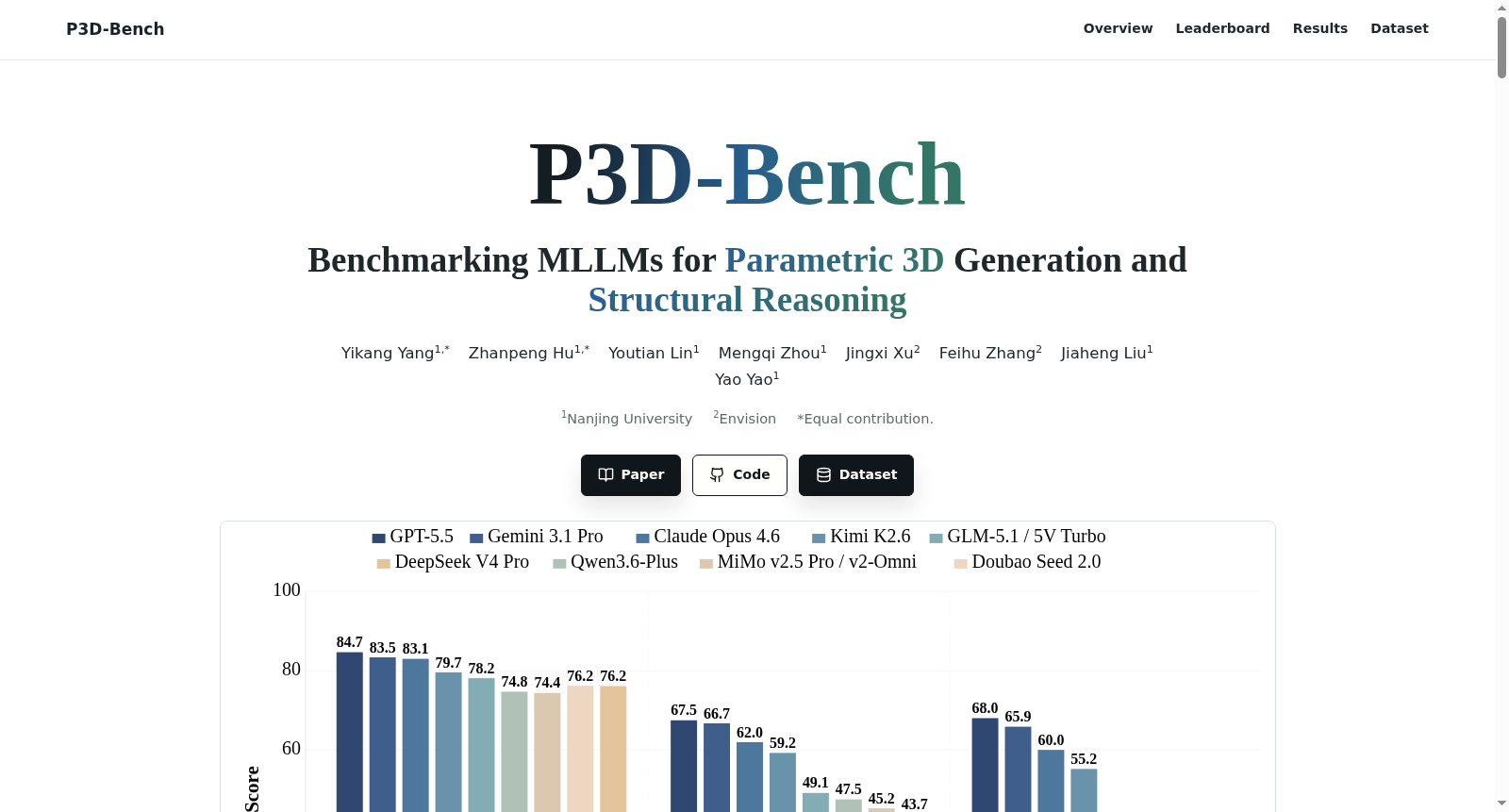
Text-to-3D 任务(Top模型,平均分)
| 模型 | Judge(描述性) | Valid(描述性) | Judge(参数化) | Valid(参数化) |
|---|---|---|---|---|
| GPT-5.5 | 0.875 | 0.998 | 0.812 | 0.999 |
| Gemini 3.1 Pro | 0.865 | 0.999 | 0.776 | 1.000 |
| Claude Opus 4.6 | 0.850 | 0.995 | 0.788 | 0.995 |
| Kimi K2.6 | 0.804 | 0.949 | 0.716 | 0.988 |
| GLM-5.1 | 0.810 | 0.941 | 0.687 | 0.966 |
Image-to-3D 任务(平均分)
| 模型 | Geo(几何) | Topo(拓扑) | Judge | Valid(有效) |
|---|---|---|---|---|
| GPT-5.5 | 0.549 | 0.914 | 0.562 | 0.979 |
| Gemini 3.1 Pro | 0.552 | 0.910 | 0.540 | 0.970 |
| Claude Opus 4.6 | 0.525 | 0.903 | 0.431 | 0.975 |
| Kimi K2.6 | 0.497 | 0.898 | 0.382 | 0.960 |
Assembly-3D 任务(平均分)
| 模型 | Geo(几何) | Topo(拓扑) | Judge | Part(零件) | Valid(有效) |
|---|---|---|---|---|---|
| GPT-5.5 | 0.586 | 0.966 | 0.541 | 0.629 | 0.985 |
| Gemini 3.1 Pro | 0.566 | 0.944 | 0.507 | 0.618 | 0.960 |
| Claude Opus 4.6 | 0.525 | 0.926 | 0.376 | 0.573 | 0.944 |
主要发现
- 装配任务最具挑战性:模型仍无法将多个部件组合成连贯结构
- 全局形状与语义识别较好:模型能恢复目标物体的整体形状和语义,但难以复现输入指定的精确参数化几何
- 零件级建模薄弱:在装配任务中,模型既无法恢复每个零件的几何形状,也无法恢复正确数量的零件
数据集来源
- 基于 Text2CAD 和 Fusion 360 Gallery 进行过滤与标注
引用
@misc{yang2026p3dbenchbenchmarkingmllmsparametric, title={P3D-Bench: Benchmarking MLLMs for Parametric 3D Generation and Structural Reasoning}, author={Yikang Yang and Zhanpeng Hu and Youtian Lin and Mengqi Zhou and Jingxi Xu and Feihu Zhang and Jiaheng Liu and Yao Yao}, year={2026}, eprint={2606.11152}, archivePrefix={arXiv}, primaryClass={cs.CV}, url={https://arxiv.org/abs/2606.11152}, }