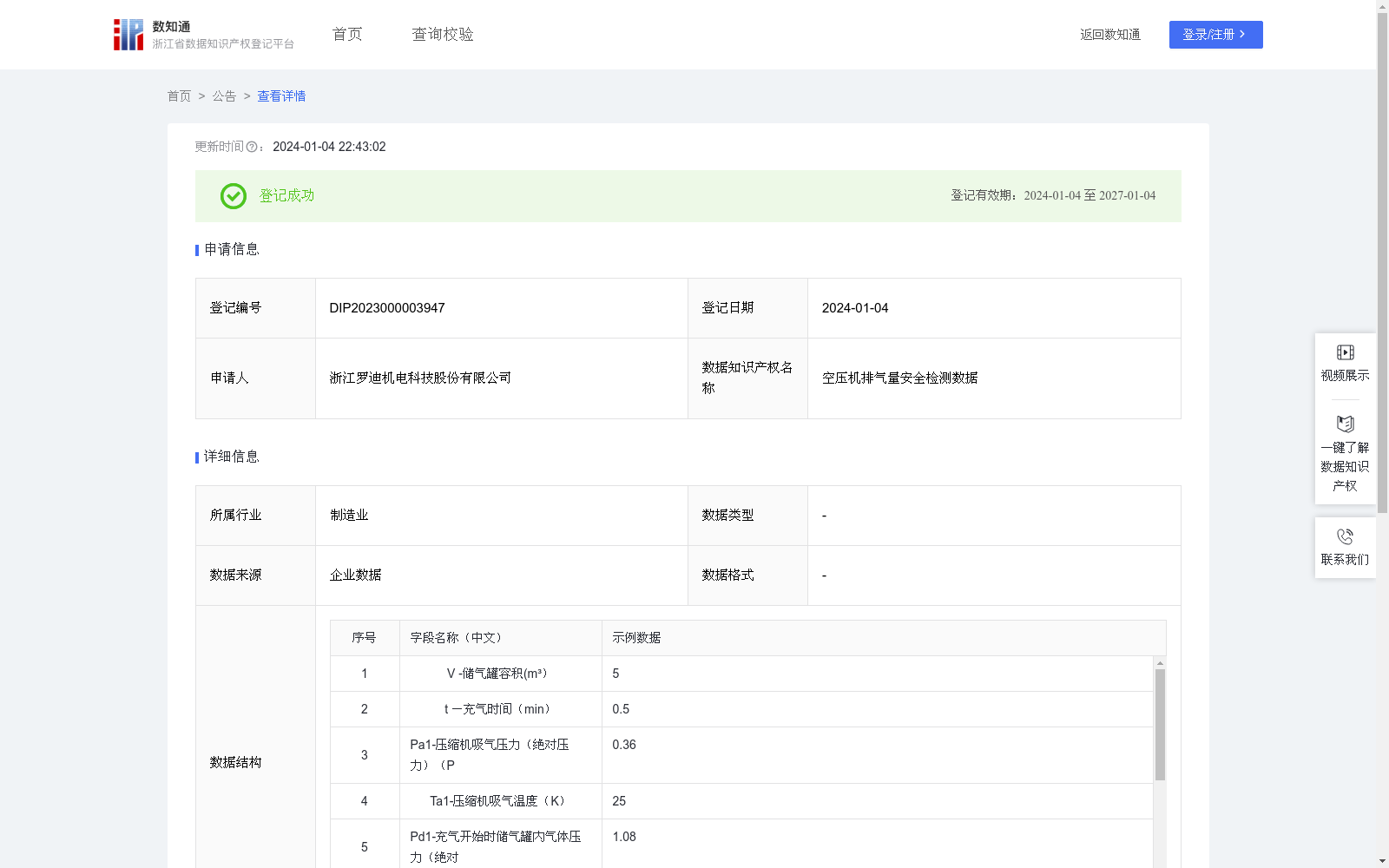
空压机排气量安全检测数据
收藏资源简介:
排气量是空压机的一个重要参数,它在一定程度上决定了空压机的供气量,直接影响了空压机在工业生产中的应用范围和效率。该数据的检测可以为企业的研发和生产提供参考价值,降低不合格率。1.数据采集:通过采集企业内部空压机样品,并对这些样品进行编号。 2.数据处理:在测量前对全部管路、阀门及附件进行密封性检查,未出现泄露情况。依据《GB/T 1853-1998容积式压缩机验收试验》),根据公式Q=(V*Ta1)/(t*Pa1)*(pd2/Td2-Pd1/Td1)计算得出排气量。 V -储气罐容积(m³);t -充气时间(min);Pa1-压缩机吸气压力(绝对压力)(Pa);Pd1-充气开始时储气罐内气体压力(绝对压力)(Pa); Pd2-充气终止时储气罐内气体压力(绝对压力)(Pa);Td1-充气开始时储气罐内气体温度(K);Td2-充气终止时储气罐内气体温度(K);并结合排气量要求进行判定是否合格。 3.数据应用:该数据的检测可以为企业的研发和生产提供参考价值,降低不合格率。
Displacement is a critical parameter for air compressors. It largely determines the air supply capacity of the compressor, and directly affects its application scope and efficiency in industrial production. Testing this dataset provides reference values for enterprise R&D and production, and reduces the defective product rate. 1. Data Collection: Collect air compressor samples from within the enterprise and number these samples. 2. Data Processing: Conduct a sealing inspection on all pipelines, valves and accessories before measurement, ensuring no leakage occurs. In accordance with GB/T 1853-1998 *Acceptance Tests for Positive Displacement Compressors*, calculate the displacement using the formula: $$Q = frac{V imes T_{a1}}{t imes P_{a1}} imes left( frac{p_{d2}}{T_{d2}} - frac{p_{d1}}{T_{d1}} ight)$$ Each variable is defined as follows: - $V$: Volume of the air storage tank (m³); - $t$: Inflation time (min); - $P_{a1}$: Compressor suction pressure (absolute pressure) (Pa); - $T_{a1}$: Compressor suction temperature (K); - $p_{d1}$: Gas pressure inside the air storage tank at the start of inflation (absolute pressure) (Pa); - $p_{d2}$: Gas pressure inside the air storage tank at the end of inflation (absolute pressure) (Pa); - $T_{d1}$: Gas temperature inside the air storage tank at the start of inflation (K); - $T_{d2}$: Gas temperature inside the air storage tank at the end of inflation (K). Then determine whether the product is qualified based on the preset displacement requirements. 3. Data Application: The testing data of this dataset provides reference values for enterprise R&D and production, and effectively reduces the defective product rate.