
Data from: Pawsitively sad: pet-owners are more sensitive to negative emotion in animal distress vocalisations
收藏Mendeley Data2024-06-25 更新2024-06-27 收录
下载链接:
https://datadryad.org/stash/dataset/doi:10.5061/dryad.ss27j10
下载链接
链接失效反馈官方服务:
资源简介:
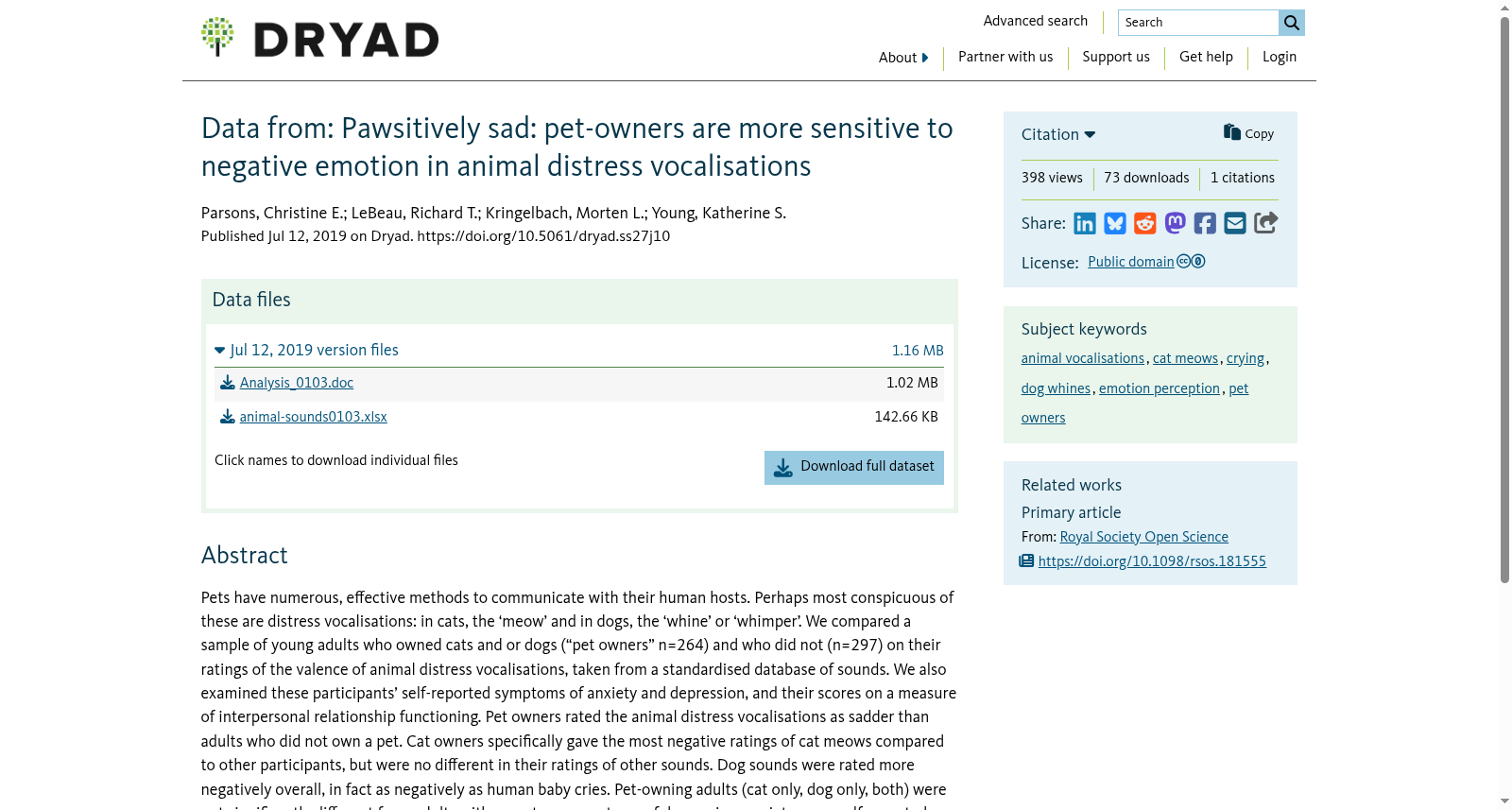
Pets have numerous, effective methods to communicate with their human hosts. Perhaps most conspicuous of these are distress vocalisations: in cats, the ‘meow’ and in dogs, the ‘whine’ or ‘whimper’. We compared a sample of young adults who owned cats and or dogs (“pet owners” n=264) and who did not (n=297) on their ratings of the valence of animal distress vocalisations, taken from a standardised database of sounds. We also examined these participants’ self-reported symptoms of anxiety and depression, and their scores on a measure of interpersonal relationship functioning. Pet owners rated the animal distress vocalisations as sadder than adults who did not own a pet. Cat owners specifically gave the most negative ratings of cat meows compared to other participants, but were no different in their ratings of other sounds. Dog sounds were rated more negatively overall, in fact as negatively as human baby cries. Pet-owning adults (cat only, dog only, both) were not significantly different from adults with no pets on symptoms of depression, anxiety or on self-reported interpersonal relationship functioning. We suggest that pet ownership is associated with greater sensitivity to negative emotion in cat and dog distress vocalisations.
宠物具备多种高效的与人类主人进行交流的途径,其中最为显著的当属痛苦发声(distress vocalisations):猫的“喵叫”与狗的“呜咽”或“啜泣”。本研究招募了两组年轻成年人样本:养猫或/和养狗的“宠物主人”组(n=264),以及无宠物对照组(n=297),让被试对取自标准化声音数据库的动物痛苦发声的情绪效价(valence)进行评分,并对两组评分展开比较。此外,本研究还评估了被试自我报告的焦虑与抑郁症状,以及其在人际关系功能量表上的得分。结果显示,宠物主人对动物痛苦发声的悲伤程度评分显著高于无宠物成年人。具体而言,与其他被试相比,养猫人群对猫叫的负面评分最高,但针对其他声音的评分则无显著差异。整体来看,狗的叫声被评为更具负面情绪,其负面程度与人类婴儿的啼哭相当。无论仅养猫、仅养狗还是同时饲养两类宠物的成年被试,其在抑郁、焦虑症状评分以及自我报告的人际关系功能方面,与无宠物成年人均无显著差异。本研究表明,饲养宠物与个体对猫、狗痛苦发声中负面情绪的更高敏感性存在关联。
创建时间:
2023-06-28
搜集汇总
数据集介绍
背景与挑战
背景概述
该数据集包含一项研究数据,比较了宠物主人与非宠物主人对猫狗痛苦叫声的情绪感知差异。研究发现宠物主人(特别是猫主人)对动物痛苦叫声的负面情绪更敏感,且狗叫声的负面评分与人类婴儿哭声相似。数据集包括实验参与者的评分数据、音频属性分析以及相关统计分析结果。
以上内容由遇见数据集搜集并总结生成


