music-reasoning-benchmark
收藏资源简介:
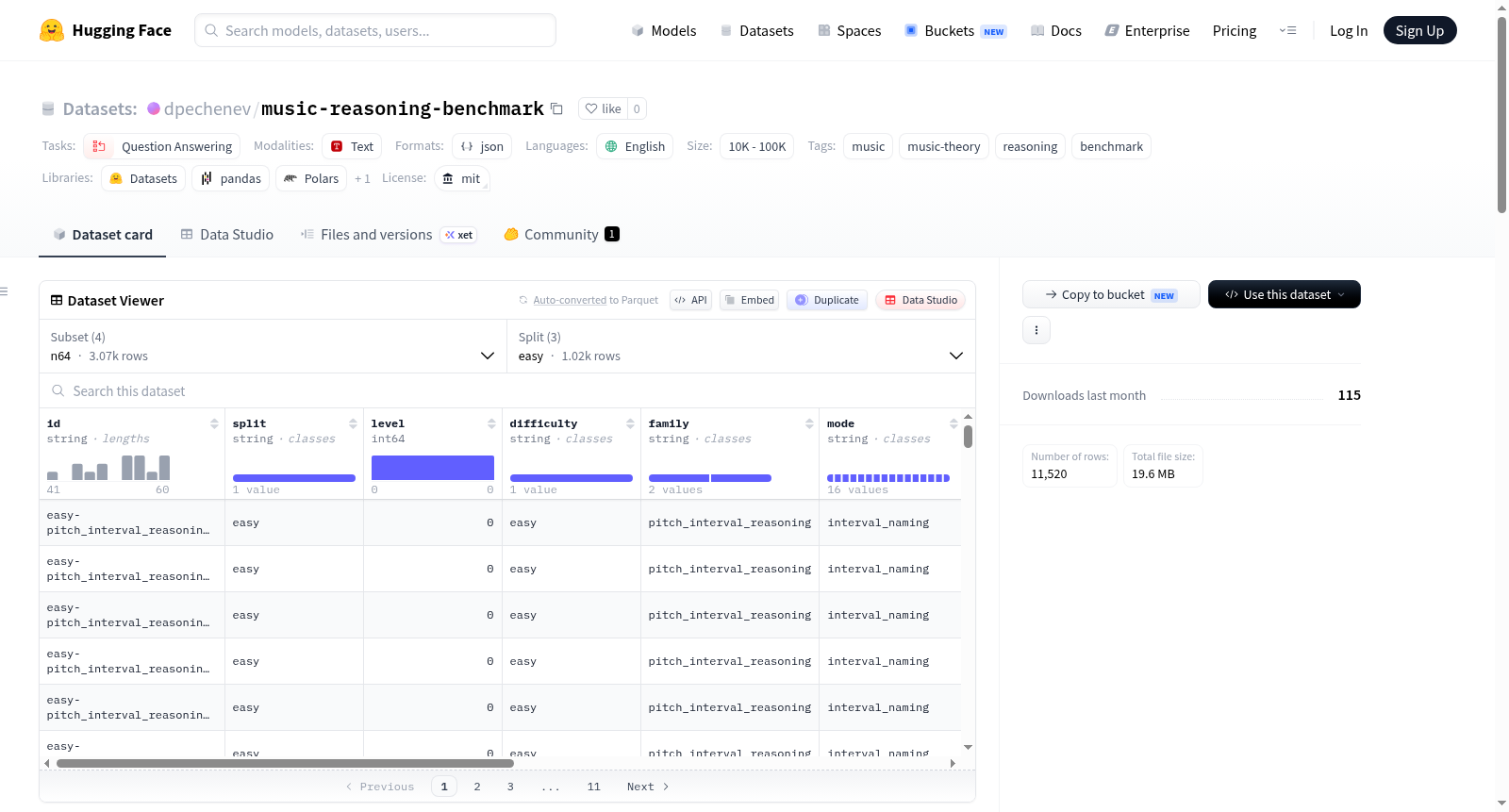
Procedural Music Reasoning Benchmark是一个用于评估音乐推理能力的基准数据集,通过程序化方法生成。它包含两个核心音乐推理任务家族:音高间隔推理(pitch_interval_reasoning)和和弦罗马数字推理(chord_roman_reasoning)。数据集提供四种不同规模的配置(n16, n32, n64默认配置, n128),每种配置均包含三个难度级别:简单(easy)、中等(moderate)和困难(hard)。配置之间呈确定性嵌套子集关系(n16⊂n32⊂n64⊂n128),使得不同规模下的评估结果可直接比较。数据规模从n16的768个示例到n128的6144个示例不等。每个数据样本包含11个字段:唯一标识符(id)、分割名称(split)、生成器难度等级(level)、人类可读难度名称(difficulty)、任务家族(family)、任务模式(mode)、模型输入提示(prompt)、标准预期答案(answer)、答案归一化类型(answer_kind)、生成器产生的推理轨迹(cot)以及包含符号生成元数据的JSON字符串(metadata)。评估时,模型仅接收prompt字段,其输出需与answer字段进行比较。cot字段供检查、监督训练和错误分析使用,但不应用于基准评估的模型输入中。所有提示均以Return only the requested answer.结尾,这是基准评估特有的指令。难度级别具有分布性特征,即使在困难分割中也可能出现简单示例,但更复杂的音乐特征会被更频繁地采样或来自更大的空间。
The Procedural Music Reasoning Benchmark is a benchmark dataset for evaluating music reasoning capabilities, generated procedurally. It includes two core music reasoning task families: pitch_interval_reasoning and chord_roman_reasoning. The dataset provides four configurations of different scales (n16, n32, n64 default, n128), each containing three difficulty levels: easy, moderate, and hard. The configurations have a deterministic nested subset relationship (n16⊂n32⊂n64⊂n128), allowing direct comparison of evaluation results across different scales. The data scale ranges from 768 examples for n16 to 6144 examples for n128. Each data sample contains 11 fields: unique identifier (id), split name (split), generator difficulty level (level), human-readable difficulty name (difficulty), task family (family), task mode (mode), model input prompt (prompt), standard expected answer (answer), answer normalization type (answer_kind), reasoning trajectory generated by the generator (cot), and a JSON string containing symbolic generation metadata (metadata). During evaluation, the model only receives the prompt field, and its output is compared with the answer field. The cot field is used for inspection, supervised training, and error analysis but should not be used as model input for benchmark evaluation. All prompts end with Return only the requested answer., which is a specific instruction for benchmark evaluation. Difficulty levels have distributional characteristics, where even the hard split may include easy examples, but more complex musical features are sampled more frequently or from a larger space.