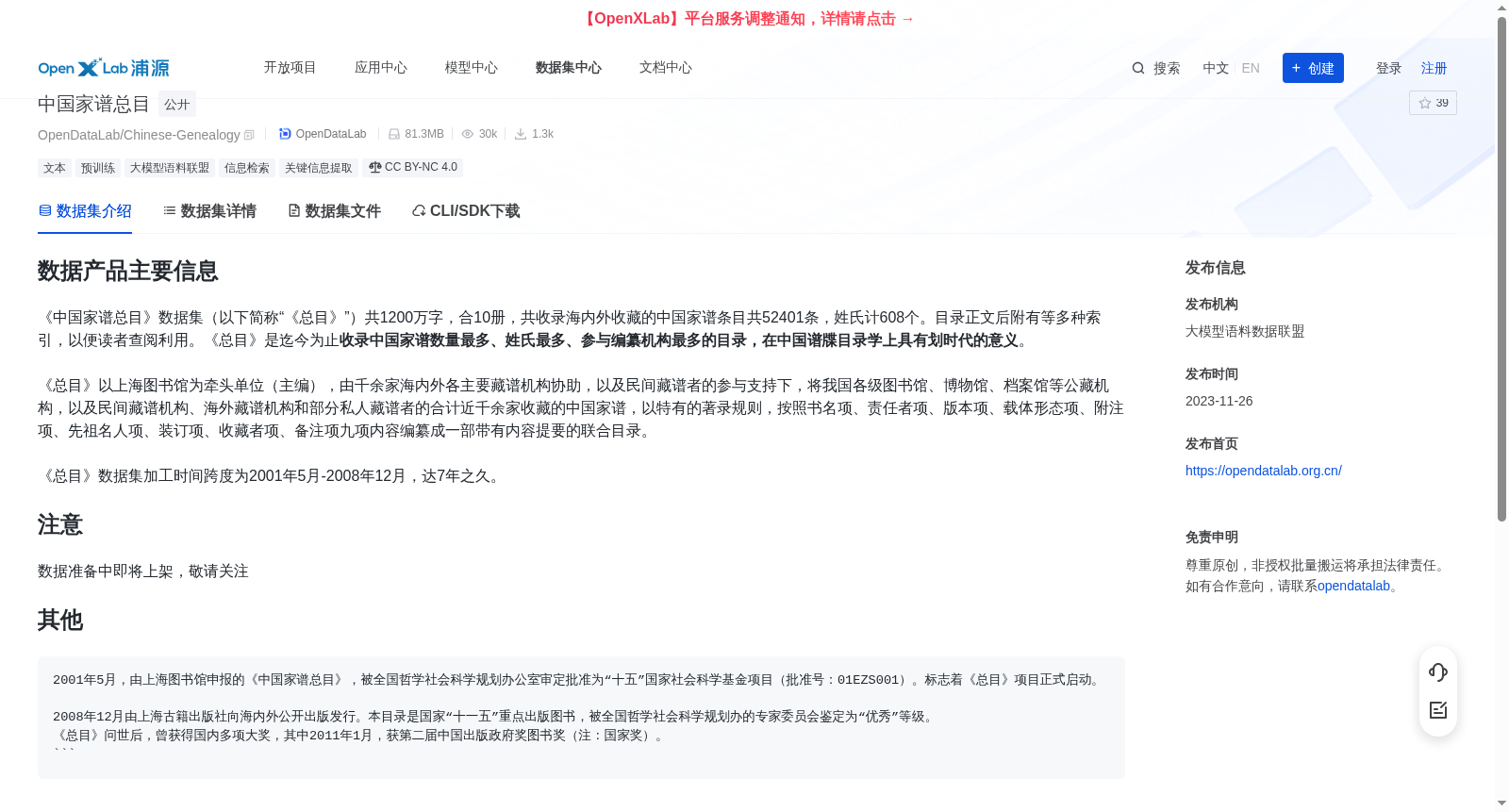
中国家谱总目
收藏资源简介:
数据产品主要信息 《中国家谱总目》数据集(以下简称“《总目》”)共1200万字,合10册,共收录海内外收藏的中国家谱条目共52401条,姓氏计608个。目录正文后附有等多种索引,以便读者查阅利用。《总目》是迄今为止收录中国家谱数量最多、姓氏最多、参与编纂机构最多的目录,在中国谱牒目录学上具有划时代的意义。 《总目》以上海图书馆为牵头单位(主编),由千余家海内外各主要藏谱机构协助,以及民间藏谱者的参与支持下,将我国各级图书馆、博物馆、档案馆等公藏机构,以及民间藏谱机构、海外藏谱机构和部分私人藏谱者的合计近千余家收藏的中国家谱,以特有的著录规则,按照书名项、责任者项、版本项、载体形态项、附注项、先祖名人项、装订项、收藏者项、备注项九项内容编纂成一部带有内容提要的联合目录。 《总目》数据集加工时间跨度为2001年5月-2008年12月,达7年之久。 数据产品的应用场景 《总目》数据集可供历史学、经济学、社会学、民族学、文化人类学、优生学等学科开发利用。如在历史学上,家谱记载的世系、传记、通考、义庄、祠堂等,能以点带面的折射出一个民族的家庭史、人口史、历史人物、下层社会史、妇女史、宗教史等等。在经济学上,它也能从一个家族的经济变迁与兴衰,审视到某个时代社会经济发展的一个侧面。如上海图书馆的馆藏特色徽州家谱里,蕴藏着的丰富明清时期的徽商经济史料,为研究明清时期占主体的徽商经济提供了研究资料。 数据产品的运用价值 《总目》数据集是一部集海内外现存中国家谱的总目录,它的主要特点在“全”上,因此它所反映的不仅是个谱的收藏状况,更重要的作用是体现了整个中国家谱的总体分布现状,直接决定了它较高的使用价值,改变了千百年来家谱不能轻易示外人等原因而造成家谱利用率低下的状况,结束了家谱资料的半封闭状态,满足了人们各自不同的需求。 《总目》的编纂,是对历史上特别是近半个世纪以来谱牒文献书目工作的继承、发展与创新;《总目》的编纂,也是海内外近600家谱牒文献收藏单位、千余名《总目》编纂人员和广大私人家谱收藏者,积极参与、共同协作、无私奉献的结果;《总目》具有数量众多、姓氏齐全、著录丰富、检索方便等多项特点,对于传承中华民族文化,增强海内外华人、华侨的寻根谒祖以及增强中华民族的凝聚力有着深远的意义,同时它又对社会科学和自然科学的研究起到了推动作用。 数据产品的其他内容 1)收录家谱最为完备,较完整地揭示了海内外各地区收藏中国家谱的基本情况,是迄今为止收藏中国家谱数量最多的专题性目录。就收藏地的分布来说,遍及包含港澳台等地的全国大部分省、市、自治区以及海外10余个国家。 2)收录家谱姓氏众多,较全面地反映了存世的中国家谱的姓氏状况。《总目》共计收录608个姓氏,涵盖了《百家姓》中绝大部分姓氏,且较之还多168个姓氏。 3)著录内容丰富,体例完备。《总目》是一部提要式的目录,不仅要著录家谱的谱名、责任者、版本年代、册数等基本著录项,且还需撰写家族的始祖、始迁祖、迁徙路线、历代名人等项内容,并揭示家谱的特色、谱中有价值的资料等,力求为读者提供更多有用的信息。 4)著录时间跨度长,收录家谱下限为2003年。《总目》打破了历年来家谱编目的惯例,将1949年以后出版的新修家谱收编入目,凡2003年出版的家谱皆予著录。不仅为研究人员和读者提供了大量新的家族资料信息,亦对促进海内外的文化交流,有着积极的意义。 5)编制多种索引,方便读者检索。《总目》后附有六个索引,分别是:分省地名索引、谱名索引、纂修者索引、堂号索引、先祖索引、名人索引。 其他 2001年5月,由上海图书馆申报的《中国家谱总目》,被全国哲学社会科学规划办公室审定批准为“十五”国家社会科学基金项目(批准号:01EZS001)。标志着《总目》项目正式启动。 2008年12月由上海古籍出版社向海内外公开出版发行。本目录是国家“十一五”重点出版图书,被全国哲学社会科学规划办的专家委员会鉴定为“优秀”等级。 《总目》问世后,曾获得国内多项大奖,其中2011年1月,获第二届中国出版政府奖图书奖(注:国家奖)。
Key Information of the Data Product The General Catalogue of Chinese Genealogies (hereinafter referred to as "the Catalogue") has a total of 12 million characters across 10 volumes, containing 52,401 entries of Chinese genealogies collected from home and abroad, covering 608 surnames. Multiple indexes are attached after the main catalogue to facilitate readers' access and utilization. To date, it is the catalogue with the largest number of collected Chinese genealogies, the most comprehensive surname coverage, and the most participating compiling institutions, marking a landmark achievement in Chinese genealogical bibliography. Led by the Shanghai Library (as the chief editor), with the assistance of over a thousand major domestic and overseas genealogical collection institutions and support from private collectors, the project compiled a union catalogue with content summaries by following a unique cataloging rule, which includes nine items: title, responsible person, edition, physical description, notes, notable ancestors, binding, collector, and remarks. The data compilation of the Catalogue spanned from May 2001 to December 2008, lasting 7 years. Application Scenarios of the Data Product The Catalogue can be utilized by disciplines such as history, economics, sociology, ethnology, cultural anthropology, and eugenics. For history, the lineages, biographies, general studies, charitable clan estates, ancestral halls, etc., recorded in genealogies can reflect a nation's family history, population history, historical figures, history of the lower social strata, women's history, religious history, etc., from a micro to macro perspective. In terms of economics, it can also reveal a side of social and economic development of an era through the economic changes and vicissitudes of a single family. For instance, the rich Huizhou merchant economic historical materials contained in the Huizhou genealogies in the collection of the Shanghai Library provide valuable research materials for studying the dominant Huizhou merchant economy during the Ming and Qing Dynasties. Application Value of the Data Product The General Catalogue of Chinese Genealogies is a comprehensive catalogue of existing Chinese genealogies collected both at home and abroad, with its core feature being "comprehensiveness". It not only reflects the collection status of individual genealogies but more importantly, shows the overall distribution of Chinese genealogies nationwide, which directly determines its high practical value. It has changed the situation of low utilization rate of genealogies caused by reasons such as the reluctance of genealogies to be easily shared with outsiders, ending the semi-closed state of genealogical materials and meeting the diverse needs of people. The compilation of the Catalogue inherits, develops, and innovates the genealogical bibliography work in history, especially in the past half century. It is the result of active participation, joint collaboration, and selfless dedication of nearly 600 genealogical collection institutions at home and abroad, more than 1,000 compilers, and a large number of private genealogical collectors. The Catalogue boasts multiple advantages including large number of collected genealogies, comprehensive surname coverage, rich cataloging content, and convenient retrieval. It has far-reaching significance for inheriting Chinese national culture, enhancing the sense of roots-seeking and ancestor-worshipping among overseas Chinese and compatriots in Hong Kong, Macao and Taiwan, and strengthening the cohesion of the Chinese nation. Meanwhile, it promotes research in both social sciences and natural sciences. Other Contents of the Data Product 1) Most comprehensive collection: It comprehensively reveals the basic status of Chinese genealogies collected in various regions at home and abroad, making it the thematic catalogue with the largest number of collected Chinese genealogies to date. In terms of collection distribution, it covers most provinces, municipalities and autonomous regions across China including Hong Kong, Macao and Taiwan, as well as more than 10 overseas countries. 2) Comprehensive surname coverage: It fully reflects the surname distribution of surviving Chinese genealogies. The Catalogue collects 608 surnames, covering most of the surnames in the Hundred Family Surnames, with an additional 168 surnames compared to the traditional version. 3) Rich cataloging content and complete system: As a summary catalogue, it not only records basic cataloging items such as the genealogy title, responsible person, edition year, number of volumes, but also compiles content like the family's founding ancestor, initial migrating ancestor, migration route, historical celebrities, and reveals the characteristics and valuable materials in the genealogies, striving to provide more useful information for readers. 4) Long time span of cataloging: The cut-off time for included genealogies is 2003. The Catalogue breaks the convention of previous genealogy cataloging by including newly compiled genealogies published after 1949, and all genealogies published in 2003 are cataloged. This not only provides a large amount of new family information for researchers and readers but also plays a positive role in promoting cultural exchanges at home and abroad. 5) Multiple indexes for convenient retrieval: Six indexes are attached after the Catalogue, namely: Provincial Place Name Index, Genealogy Title Index, Compiler Index, Hall Name Index, Ancestor Index, and Celebrity Index. Other Information In May 2001, the General Catalogue of Chinese Genealogies declared by the Shanghai Library was approved as the "10th Five-Year Plan" National Social Science Foundation Project by the National Office of Philosophy and Social Science Planning (Approval No.: 01EZS001), marking the official launch of the Catalogue project. In December 2008, it was officially published and distributed at home and abroad by Shanghai Ancient Books Publishing House. This catalogue is a key publication project of the "11th Five-Year Plan" of the country, and was rated as "Excellent" by the Expert Committee of the National Office of Philosophy and Social Science Planning. After its release, the Catalogue won multiple domestic awards, including the Second China Publishing Government Award for Books (a national award) in January 2011.