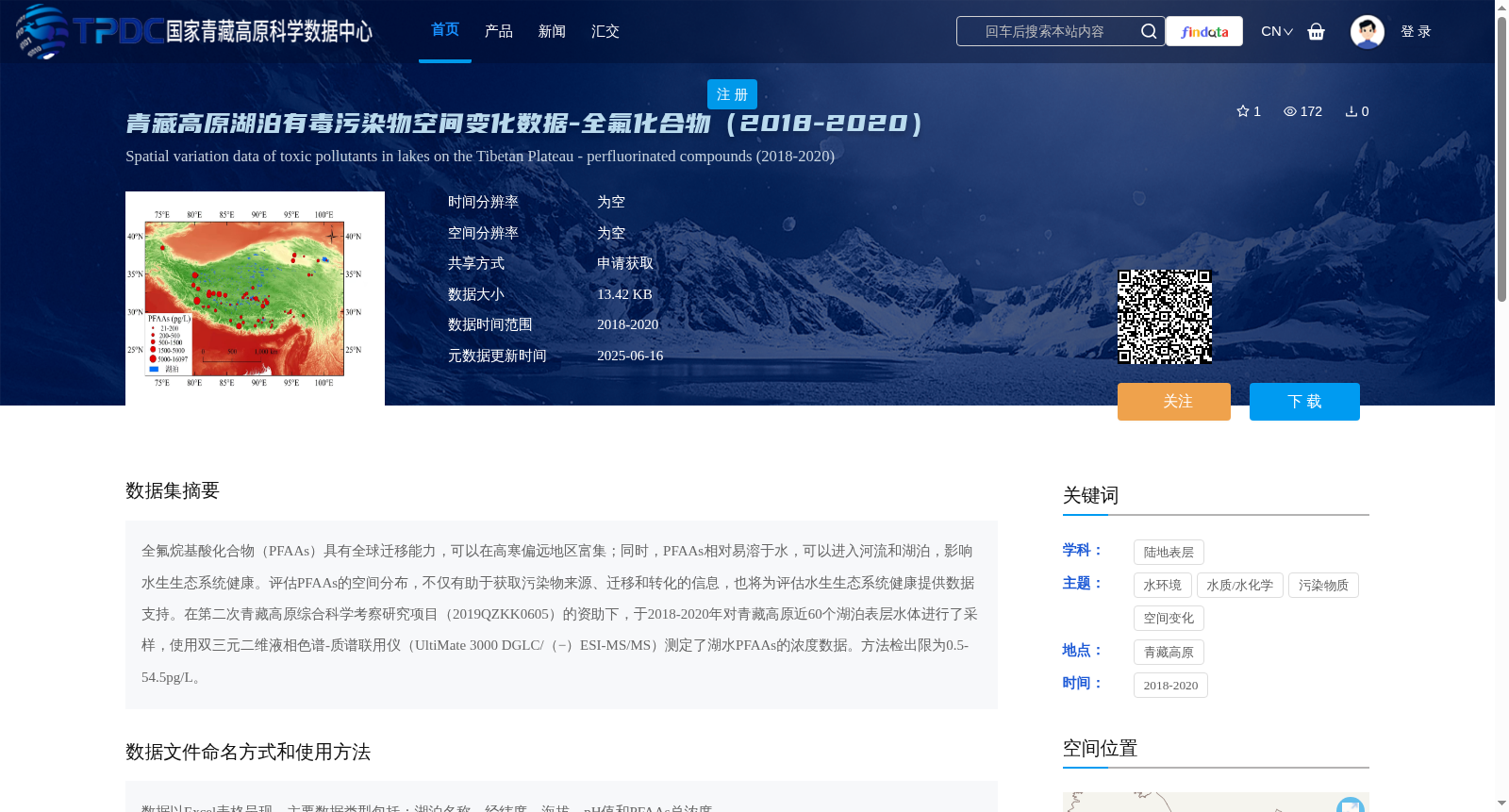
青藏高原湖泊有毒污染物空间变化数据-全氟化合物(2018-2020)
收藏资源简介:
全氟烷基酸化合物(PFAAs)具有全球迁移能力,可以在高寒偏远地区富集;同时,PFAAs相对易溶于水,可以进入河流和湖泊,影响水生生态系统健康。评估PFAAs的空间分布,不仅有助于获取污染物来源、迁移和转化的信息,也将为评估水生生态系统健康提供数据支持。在第二次青藏高原综合科学考察研究项目(2019QZKK0605)的资助下,于2018-2020年对青藏高原近60个湖泊表层水体进行了采样,使用双三元二维液相色谱-质谱联用仪(UltiMate 3000 DGLC/(−)ESI-MS/MS)测定了湖水PFAAs的浓度数据。方法检出限为0.5-54.5pg/L。
Perfluoroalkyl acids (PFAAs) exhibit global transport potential and can accumulate in frigid, remote alpine regions. Meanwhile, PFAAs are relatively water-soluble, allowing them to enter rivers and lakes and impair aquatic ecosystem health. Assessing the spatial distribution of PFAAs not only helps obtain critical information on pollutant sources, transport and transformation, but also provides data support for evaluating aquatic ecosystem health. Supported by the Second Tibetan Plateau Scientific Expedition and Research Program (2019QZKK0605), surface water samples were collected from nearly 60 lakes across the Tibetan Plateau between 2018 and 2020. Concentrations of PFAAs in these lake water samples were measured using a dual ternary two-dimensional liquid chromatography-tandem mass spectrometry system (UltiMate 3000 DGLC/(-)ESI-MS/MS), with method detection limits ranging from 0.5 to 54.5 pg/L.