
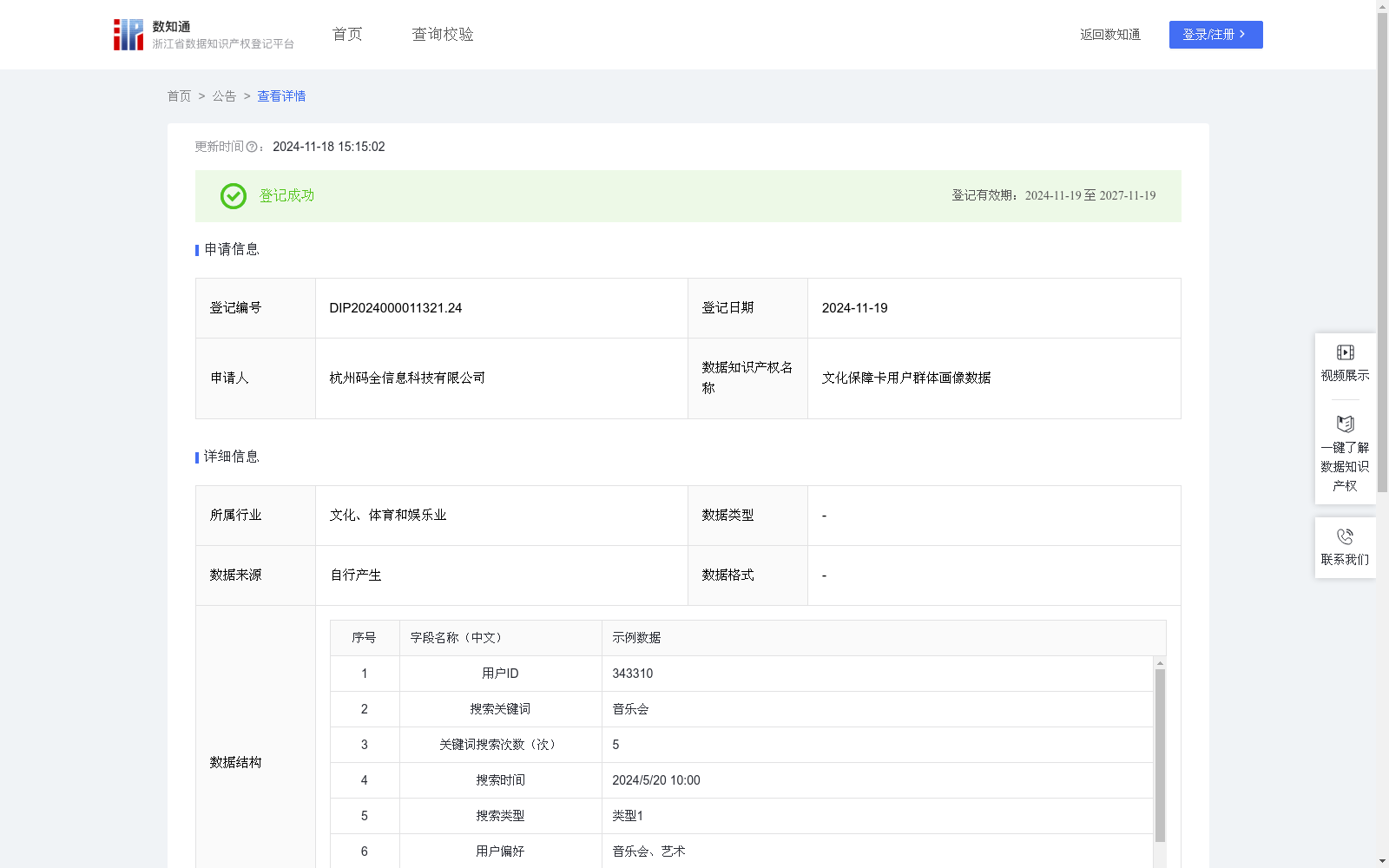
文化保障卡用户群体画像数据
收藏浙江省数据知识产权登记平台2024-11-18 更新2024-11-19 收录
下载链接:
https://www.zjip.org.cn/home/announce/trends/85920
下载链接
链接失效反馈官方服务:
资源简介:
本数据可以为相关文化活动线上平台的群体分类和个性化推荐提供数据支持,依据用户偏好和用户活动趋势智能推荐活动,依据聚类标签和群体偏好进行群体分类。有助于文化服务机构和文化管理部门利用群体偏好数据,分析不同用户群体的文化活动偏好,识别市场趋势。有助于文化服务商针对不同用户个性化定制营销策略,提升营销效果。步骤1,数据收集和预处理:从公司文化保障卡服务系统中自动抽取关键字段,包括用户ID、搜索关键词、关键词搜索次数、搜索时间、搜索类型。通过数据清洗去除无效或错误记录,确保数据质量。
步骤2,用户行为分析:基于用户的历史关键词搜索数据和搜索类型,训练随机森林模型(一种基于决策树构建的集成学习方法)预测用户偏好。
步骤3,聚类分析:选择关键词搜索次数和用户偏好作为聚类特征,使用K-means算法(一种将数据点分成K个簇的无监督学习算法)对用户进行聚类,将用户基于搜索行为分为不同的群体作为聚类标签。
步骤4,群体偏好分析:对于每个聚类群体,基于群组内用户的历史关键词搜索数据和搜索类型,利用随机森林模型确定群体的共同偏好,并输出群体偏好。
步骤5,趋势分析:对用户关键词搜索次数进行时间序列分析,使用ARIMA模型(一种时间序列预测方法)预测未来趋势。
This dataset provides data support for group classification and personalized recommendation on online platforms for cultural activities. It intelligently recommends activities based on user preferences and user activity trends, and performs group classification according to clustering labels and group preferences. This helps cultural service institutions and cultural management departments analyze the cultural activity preferences of different user groups and identify market trends by leveraging group preference data. It also assists cultural service providers in customizing targeted marketing strategies for individual users to enhance marketing effectiveness.
Step 1: Data Collection and Preprocessing. Automatically extract key fields including user ID, search keywords, keyword search frequency, search time, and search type from the company's cultural security card service system. Conduct data cleaning to remove invalid or erroneous records and ensure data quality.
Step 2: User Behavior Analysis. Train a Random Forest model (an ensemble learning method constructed based on decision trees) to predict user preferences based on the user's historical keyword search data and search types.
Step 3: Clustering Analysis. Select keyword search frequency and user preferences as clustering features, and apply the K-means algorithm (an unsupervised learning algorithm that partitions data points into K clusters) to cluster users, classifying users into distinct groups based on their search behaviors as clustering labels.
Step 4: Group Preference Analysis. For each clustered group, use the Random Forest model to determine the common preferences of the group based on the historical keyword search data and search types of users within the group, and output the group's preferences.
Step 5: Trend Analysis. Perform time series analysis on users' keyword search frequency, and employ the ARIMA model (a time series prediction method) to forecast future trends.
提供机构:
杭州码全信息科技有限公司
创建时间:
2024-10-15
搜集汇总
数据集介绍
特点
该数据集为文化保障卡用户群体画像数据,包含558条记录,涵盖用户ID、搜索关键词、搜索次数、搜索时间、用户偏好等信息,适用于文化活动平台的个性化推荐和群体分类。数据通过随机森林模型和K-means算法进行用户行为分析和聚类,帮助文化服务机构分析用户偏好和市场趋势。
以上内容由遇见数据集搜集并总结生成


