
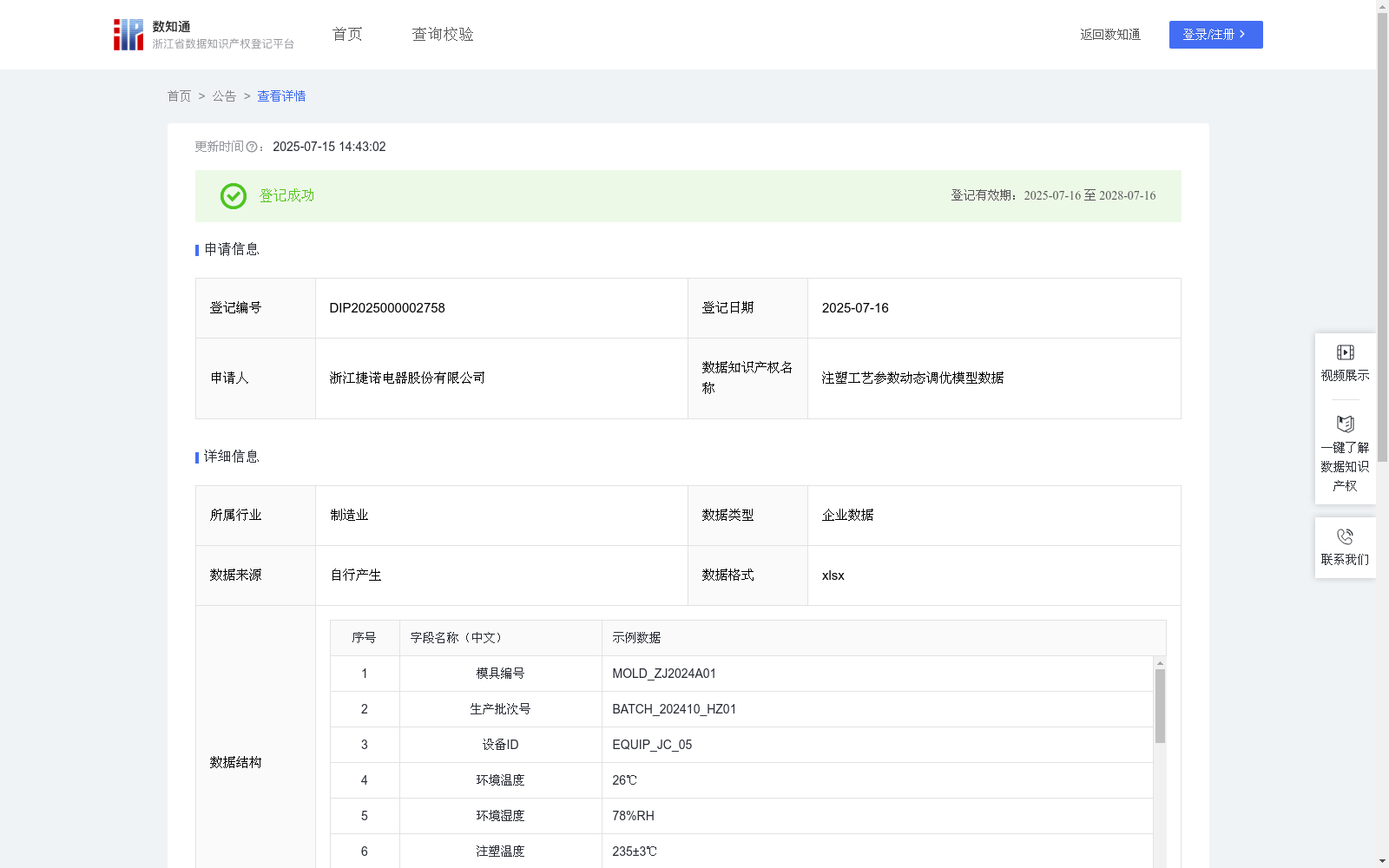
注塑工艺参数动态调优模型数据
收藏浙江省数据知识产权登记平台2025-07-15 更新2025-07-16 收录
下载链接:
https://www.zjip.org.cn/home/announce/trends/149057
下载链接
链接失效反馈官方服务:
资源简介:
通过实时采集传感器数据并融合强化学习(PPO算法),实现工艺参数的自适应优化。其核心应用包括:在环境波动(如温湿度变化)下动态补偿注塑温度与保压时间,消除材料吸湿导致的表面缺陷;基于多材质物性(PC/ABS/再生塑料)智能匹配最佳工艺窗口,支持绿色制造需求;通过时序数据分析预测模具磨损或设备故障,触发预警机制以减少非计划停机;结合数字孪生技术,为定制化产品(如异形结构件)提供虚拟工艺验证,压缩试模周期压缩;同时,通过能耗优化算法联动电网分时电价策略,降低单批次电费。该模型进一步赋能快速迭代研发,输入PLM设计参数即可自动生成适配工艺包,缩短新品上市周期。1.数据采集与清洗
通过传感器实时采集环境温度、环境湿度、注塑温度、注塑压力、材料流速、保压时间、模具编号、生产批次号、设备ID。
清洗规则:剔除注塑温度超量程值,填补材料流速缺失值,标准化数据格式。
2.强化学习模型构建
状态空间输入:
静态参数:模具结构参数、材料类型;
动态参数:注塑温度、注塑压力、环境温湿度、设备健康度评分。
动作空间输出:调整注塑温度、注塑压力、保压时间。
奖励函数:基于实时良品率、能耗优化比例、参数波动惩罚值计算:
R=0.6⋅Δ良品率+0.3⋅(−Δ能耗)−0.1⋅参数波动
3.模型训练与优化
训练数据:历史高实时良品率批次数据,验证充填率后用于预训练。
在线更新:每批次生产后,根据实时良品率更新策略网络,记录模型调优建议。
迁移适配:复用模型参数适配新材料类型(如再生塑料)。
4.系统验证与异常管控
数字孪生验证:输入模具结构参数与模型调优建议,计算充填率,达标后投产。
偏差监控:对比实际-仿真偏差率,若>2%则回退参数。
异常拦截:检测压力曲线异常标记(标准差>3MPa),冻结调整。
5.部署与迭代
边缘部署:运行模型于工厂边缘服务器,记录模型版本号。
动态迭代:通过A/B测试结果标记选择高良品率版本(如版本B+1.2%)。
This dataset realizes adaptive optimization of process parameters through real-time sensor data collection and fusion with reinforcement learning (Proximal Policy Optimization, PPO algorithm). Its core applications include: dynamically compensating injection temperature and holding time under environmental fluctuations (such as changes in temperature and humidity) to eliminate surface defects caused by material moisture absorption; intelligently matching the optimal process window based on the physical properties of multiple materials (PC/ABS/recycled plastics) to support green manufacturing needs; predicting mold wear or equipment faults through time-series data analysis and triggering early warning mechanisms to reduce unplanned downtime; combining digital twin technology to provide virtual process verification for customized products (such as special-shaped structural parts), shortening the mold trial cycle; meanwhile, linking the time-of-use electricity price strategy of the power grid through energy consumption optimization algorithms to reduce the electricity cost per batch. The model further enables rapid iterative R&D: inputting PLM design parameters can automatically generate adaptive process packages, shortening the new product launch cycle.
1. Data Collection and Cleaning
Collect environmental temperature, environmental humidity, injection temperature, injection pressure, material flow rate, holding time, mold number, production batch number, and equipment ID in real time via sensors.
Cleaning rules: Eliminate out-of-range injection temperature values, fill missing material flow rate values, and standardize data formats.
2. Reinforcement Learning Model Construction
State space inputs:
Static parameters: mold structure parameters, material type;
Dynamic parameters: injection temperature, injection pressure, ambient temperature and humidity, equipment health score.
Action space outputs: adjust injection temperature, injection pressure, holding time.
Reward function: calculated based on real-time qualified product rate, energy consumption optimization ratio, and parameter fluctuation penalty:
R=0.6⋅ΔQualified Product Rate + 0.3⋅(−ΔEnergy Consumption) −0.1⋅Parameter Fluctuation
3. Model Training and Optimization
Training data: Historical batch data with high real-time qualified product rates, verified for filling rate before pre-training.
Online update: Update the policy network based on real-time qualified product rate after each production batch, and record model tuning suggestions.
Migration adaptation: Reuse model parameters to adapt to new material types (such as recycled plastics).
4. System Verification and Anomaly Management
Digital twin verification: Input mold structure parameters and model tuning suggestions to calculate the filling rate, and put into production after reaching the standard.
Deviation monitoring: Compare the actual-simulation deviation rate, roll back parameters if it exceeds 2%.
Anomaly interception: Detect abnormal markings on pressure curves (standard deviation > 3 MPa) and freeze adjustments.
5. Deployment and Iteration
Edge deployment: Run the model on the factory edge server, record the model version number.
Dynamic iteration: Select high-qualified-rate versions through A/B test results (e.g., version B with a 1.2% increase in qualified rate).
提供机构:
浙江捷诺电器股份有限公司
创建时间:
2025-04-15
搜集汇总
数据集介绍
背景与挑战
背景概述
该数据集为注塑工艺参数动态调优模型数据,包含764条记录,每日更新,涵盖模具编号、生产批次号、设备ID、环境参数、注塑工艺参数等21个字段。通过强化学习算法实现工艺参数的自适应优化,应用于制造业中的注塑工艺调优、能耗优化和设备故障预测等场景。
以上内容由遇见数据集搜集并总结生成



