
2015年34个关键节点高温热浪敏感性数据集
收藏地球大数据科学工程2024-04-21 收录
下载链接:
https://data.casearth.cn/sdo/detail/5feae826819aec33049b7c20
下载链接
链接失效反馈官方服务:
资源简介:
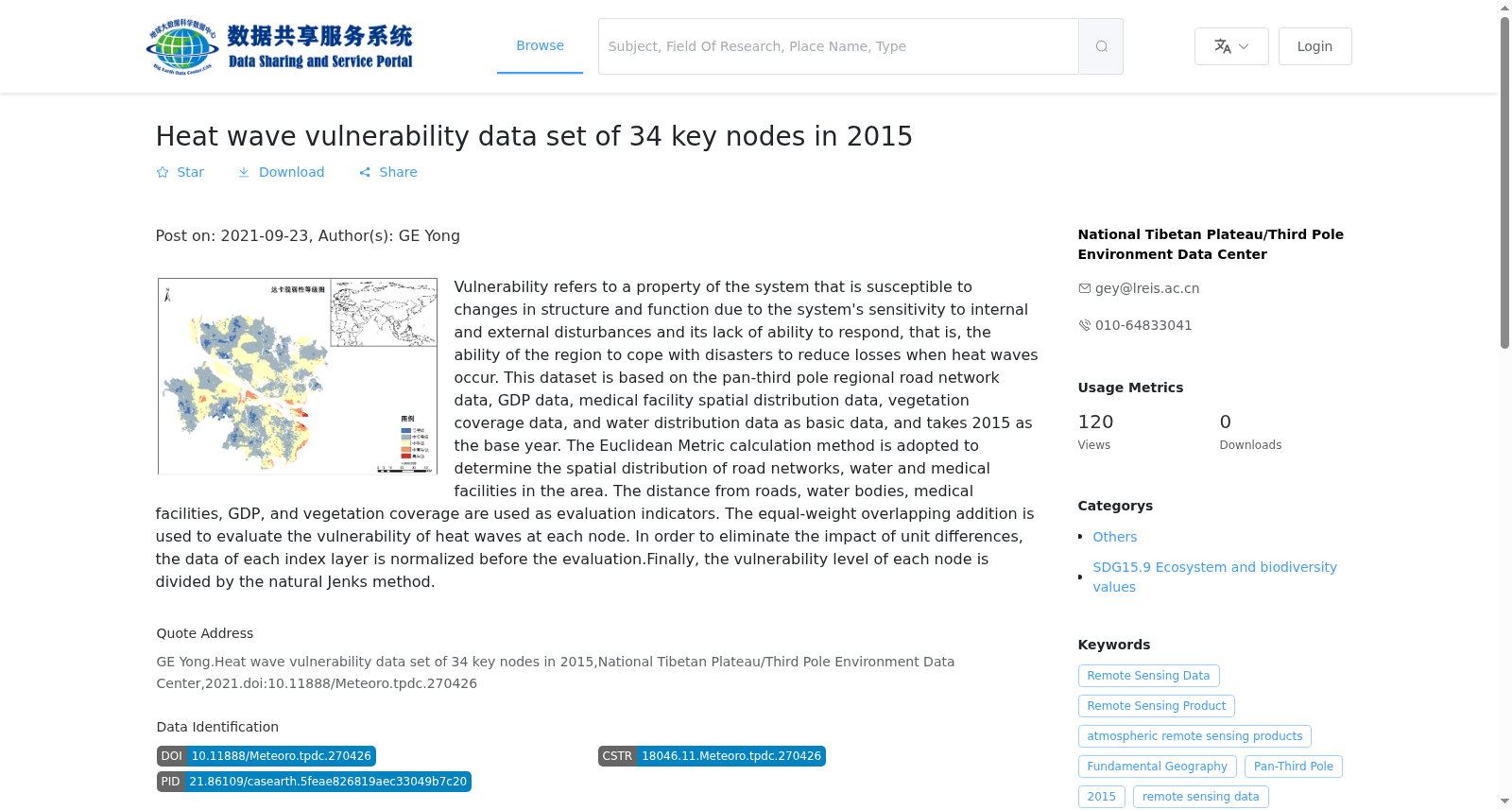
脆弱性是指由于系统对系统内外扰动的敏感性以及缺乏应对能力从而使系统的结构和功能容易发生改变的一种属性,即高温热浪发生时区域应对灾害以减少损失的能力。本数据集以2015年为基准年,泛第三极区域路网数据、GDP数据、医疗设施空间分布数据、植被覆盖度数据、水体分布数据为基础数据。采取欧式距离计算法明确区域内路网、水体及医疗设施的空间分布情况,并以距道路距离、距水体距离、距医疗设施距离、GDP及植被覆盖度为评价指标,采取等权重叠加法评估各节点高温热浪脆弱性。为消除单位差异性带来的影响,评估前对各指标层数据进行归一化处理,最后利用自然间断点法划分各节点脆弱性等级。
Vulnerability refers to the attribute that the structure and function of a system are prone to change due to its sensitivity to internal and external disturbances and lack of coping capacity, that is, the ability of a region to respond to disasters and reduce losses when a heatwave occurs. This dataset takes 2015 as the base year, and uses the road network data, GDP data, spatial distribution data of medical facilities, vegetation coverage data and water body distribution data of the Pan-Third Pole Region as the basic data. The Euclidean distance calculation method is adopted to clarify the spatial distribution of road networks, water bodies and medical facilities in the region. Taking distance to roads, distance to water bodies, distance to medical facilities, GDP and vegetation coverage as evaluation indicators, the equal-weight superposition method is used to evaluate the heatwave vulnerability of each node. To eliminate the impact caused by unit differences, the data of each indicator layer is normalized before evaluation. Finally, the natural breaks method is used to divide the vulnerability levels of each node.
提供机构:
国家青藏高原科学数据中心
搜集汇总
数据集介绍
背景与挑战
背景概述
该数据集基于2015年数据,评估了34个关键节点的高温热浪脆弱性,使用多源指标(如路网、GDP、医疗设施)通过欧几里得度量法和归一化处理进行计算,并采用自然Jenks方法划分脆弱等级。数据为网格格式,空间分辨率在10米至100米之间,覆盖广泛的地理范围(东经-165.0至12.0,南纬-12.0至北纬85.0),适用于区域灾害风险评估研究。
以上内容由遇见数据集搜集并总结生成


