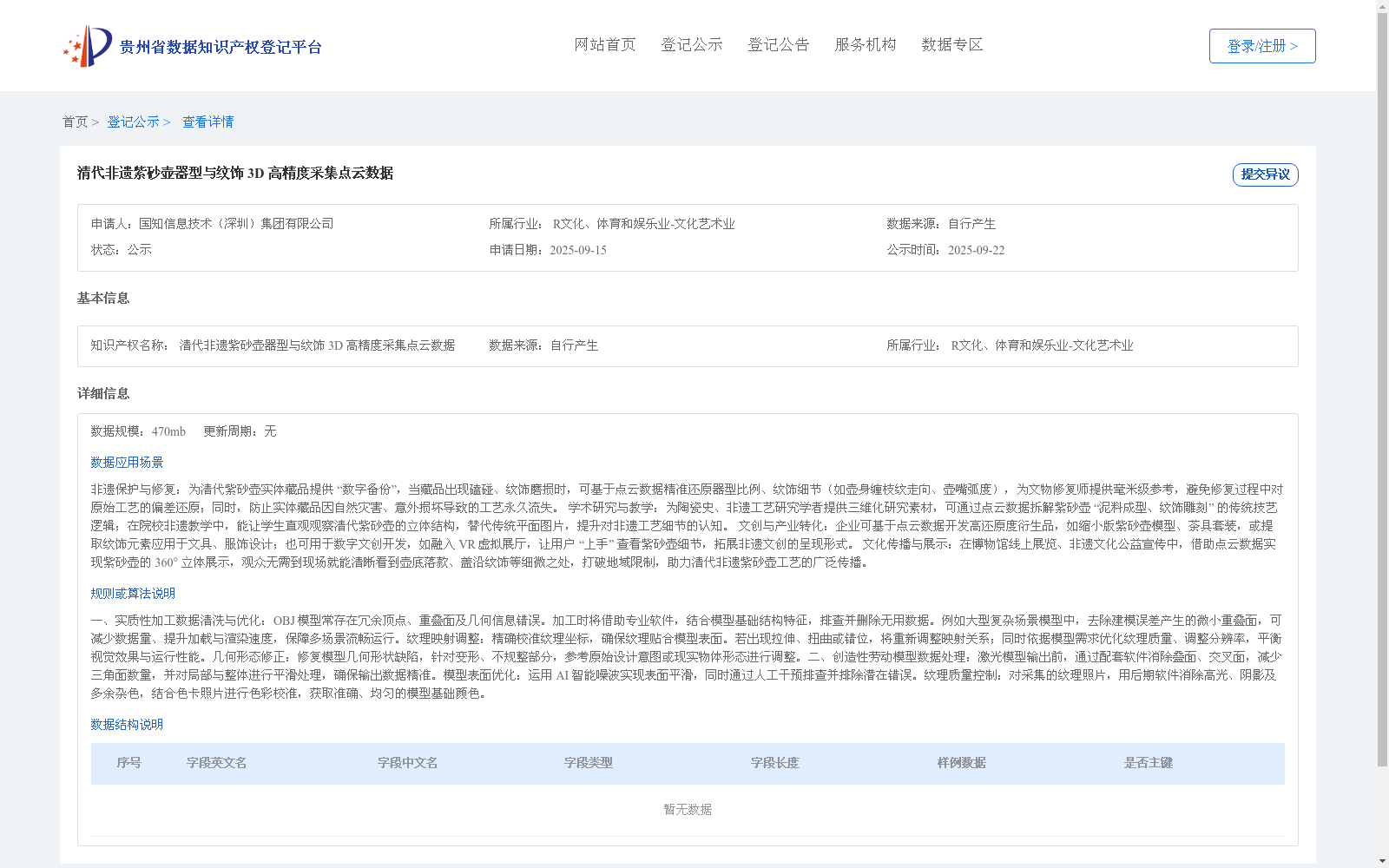
清代非遗紫砂壶器型与纹饰 3D 高精度采集点云数据
收藏资源简介:
一、实质性加工数据清洗与优化:OBJ 模型常存在冗余顶点、重叠面及几何信息错误。加工时将借助专业软件,结合模型基础结构特征,排查并删除无用数据。例如大型复杂场景模型中,去除建模误差产生的微小重叠面,可减少数据量、提升加载与渲染速度,保障多场景流畅运行。纹理映射调整:精确校准纹理坐标,确保纹理贴合模型表面。若出现拉伸、扭曲或错位,将重新调整映射关系;同时依据模型需求优化纹理质量、调整分辨率,平衡视觉效果与运行性能。几何形态修正:修复模型几何形状缺陷,针对变形、不规整部分,参考原始设计意图或现实物体形态进行调整。二、创造性劳动模型数据处理:激光模型输出前,通过配套软件消除叠面、交叉面,减少三角面数量,并对局部与整体进行平滑处理,确保输出数据精准。模型表面优化:运用 AI 智能噪波实现表面平滑,同时通过人工干预排查并排除潜在错误。纹理质量控制:对采集的纹理照片,用后期软件消除高光、阴影及多余杂色,结合色卡照片进行色彩校准,获取准确、均匀的模型基础颜色。
Substantive Processing 1. Data Cleaning and Optimization: OBJ models often suffer from redundant vertices, overlapping faces and geometric information errors. During processing, professional software will be utilized to identify and remove redundant data by leveraging the fundamental structural characteristics of the model. For example, in large and complex scene models, eliminating tiny overlapping faces induced by modeling errors can reduce data volume, improve loading and rendering speed, and ensure smooth operation across various scenarios. 2. Texture Mapping Adjustment: Precisely calibrate texture coordinates to ensure proper fitting of textures to the model surface. If stretching, distortion or misalignment occurs, the mapping configuration will be readjusted; meanwhile, optimize texture quality and adjust resolution according to model requirements to strike a balance between visual fidelity and operational performance. 3. Geometric Shape Correction: Repair geometric defects of the model, and adjust deformed or irregular components by referring to the original design intent or the physical morphology of real-world objects. Creative Labor 1. Model Data Processing: Prior to outputting the laser-fabricated model, supporting software will be employed to remove overlapping and intersecting faces, reduce the count of triangular faces, and conduct smoothing operations on both local and global parts to ensure the accuracy of the exported data. 2. Model Surface Optimization: Utilize AI Agent-driven noise smoothing to refine the model surface, while performing manual inspections to identify and eliminate potential errors. 3. Texture Quality Control: For collected texture photographs, post-processing software will be used to eliminate highlights, shadows and extraneous blemishes, and perform color calibration using color chart photos to obtain accurate and uniform base colors for the model.