
Gait Abnormality in Video Dataset (GAVD)
收藏arXiv2024-07-05 更新2024-07-30 收录
下载链接:
https://github.com/Rahmyyy/GAVD
下载链接
链接失效反馈官方服务:
资源简介:
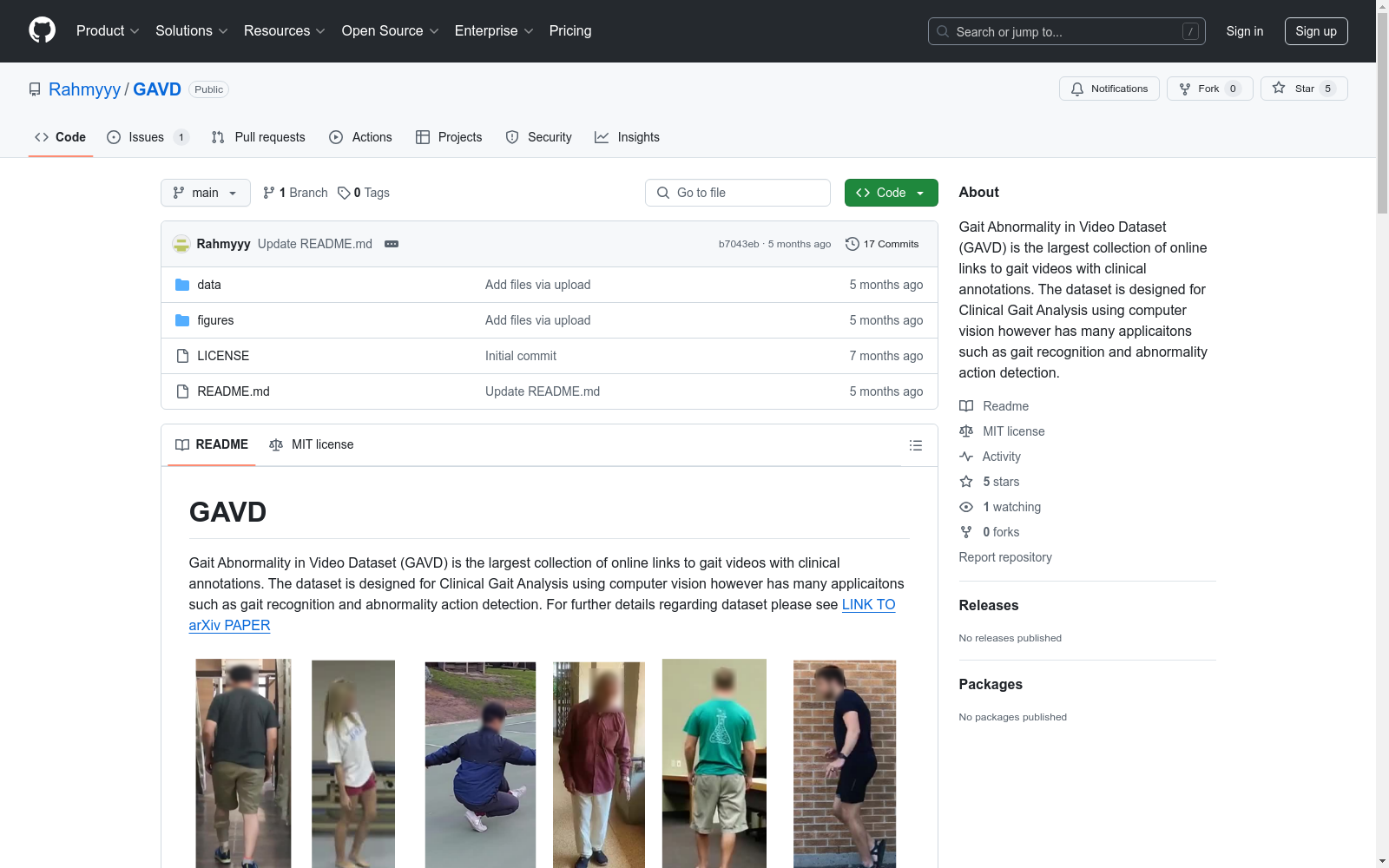
Gait Abnormality in Video Dataset (GAVD)是由数据61成像和计算机视觉小组创建的一个大型视频步态数据集,专门用于临床步态分析。该数据集包含1874个视频序列,涉及正常、异常和病理步态,数据来源于公开的在线平台,并由临床专业人员进行注释。数据集的创建旨在通过深度学习模型,如Temporal Segment Networks和SlowFast网络,提高步态异常检测的准确性,并支持远程医疗和自我监测等健康护理发展。GAVD的应用领域主要集中在通过计算机视觉技术辅助临床步态分析,以解决步态异常的识别和分类问题。
Gait Abnormality in Video Dataset (GAVD) is a large-scale video gait dataset developed by the Data61 Imaging and Computer Vision Group, specifically tailored for clinical gait analysis. This dataset contains 1874 video sequences covering normal, abnormal and pathological gaits. The source data are collected from public online platforms and annotated by clinical professionals. The creation of GAVD aims to improve the accuracy of gait abnormality detection via deep learning models such as Temporal Segment Networks and SlowFast Networks, and support the advancement of healthcare applications including telemedicine and self-monitoring. The primary application scope of GAVD lies in assisting clinical gait analysis through computer vision technologies, to tackle the tasks of gait abnormality identification and classification.
提供机构:
数据61成像和计算机视觉小组
创建时间:
2024-07-05
原始信息汇总
GAVD 数据集概述
数据集简介
Gait Abnormality in Video Dataset (GAVD) 是目前最大的带有临床标注的步态视频在线链接集合。该数据集旨在通过计算机视觉进行临床步态分析,但也适用于步态识别和异常动作检测等多种应用。
数据集特征
- 包含多个步态类别和子类别。
- 提供以人为中心的视角标注。
- 包含临床注释的步态事件。
数据结构
数据以 pkl 文件和 csv 文件的形式提供,分为五个部分。
数据列描述
| 数据列 | 描述 |
|---|---|
| seq | 步态片段的唯一序列 ID |
| frame_num | 视频对应的帧号 |
| cam_view | 标注的人为中心的视角 |
| gait_event | 临床标注的步态事件 |
| dataset | 正常和异常步态的分类 |
| gait_pat | 临床观察的步态分类 |
| bbox | 跟踪个体步态的边界框值 |
| vid_info | 视频相关元数据 |
| id | 视频的 YouTube ID |
| url | 访问视频的 URL |
搜集汇总
数据集介绍
构建方式
The Gait Abnormality in Video Dataset (GAVD) was meticulously constructed to address the critical need for a comprehensive and clinically annotated dataset in the field of clinical gait analysis. The dataset comprises 1,874 video sequences, meticulously categorized into normal, abnormal, and pathological gaits. These sequences were sourced from publicly available online platforms, ensuring a diverse range of subjects and environments. Expert clinicians were engaged to annotate the videos, focusing on clinically relevant gait classes and providing frame-by-frame annotations to ensure accuracy and reliability. The dataset also includes bounding box coordinates for each subject, enhancing the precision of the annotations and facilitating robust analysis.
特点
GAVD stands out for its extensive coverage and detailed clinical annotations, making it one of the largest and most comprehensive datasets available for gait analysis. The dataset includes over 400 subjects, each undergoing clinical-grade visual screening to ensure a wide representation of abnormal gait patterns. The inclusion of both indoor and outdoor settings, along with various covariates such as age, gender, and clothing, further enhances the dataset's versatility and applicability. Additionally, the dataset provides person-centric camera view labels, which are crucial for developing view-invariant identification and classification models.
使用方法
Researchers and practitioners can utilize GAVD to develop and validate models for gait abnormality detection, classification, and analysis. The dataset's detailed annotations and diverse subject profiles make it ideal for training deep learning models, particularly those focused on action recognition and human movement analysis. By leveraging the clinically annotated RGB data, users can explore the spatial and temporal aspects of gait abnormalities, contributing to advancements in clinical gait analysis. The dataset's structure also supports the evaluation of model performance across different camera views and environmental conditions, ensuring robustness and generalizability of the developed algorithms.
背景与挑战
背景概述
Gait Abnormality in Video Dataset (GAVD) was introduced in response to the growing need for accessible, real-world data in clinical gait analysis (CGA) using computer vision. Developed by researchers from CSIRO Data61 and the University of New South Wales, GAVD represents a significant advancement in the field, offering the largest video gait dataset to date. The dataset comprises 1874 sequences of normal, abnormal, and pathological gaits, clinically annotated by experts. GAVD's creation was motivated by the review of over 150 existing gait-related datasets, which highlighted the lack of a comprehensive, clinically annotated dataset suitable for CGA. The dataset's diverse range of abnormal gait patterns, captured in various settings, underscores its potential to enhance the development of computer vision methods for clinically validated gait analysis.
当前挑战
The primary challenge addressed by GAVD is the lack of large, clinically annotated datasets for gait abnormality detection. Existing datasets often suffer from limited representation of abnormal or pathological gaits, restricted availability of RGB data, and privacy concerns that hinder comprehensive analysis. The construction of GAVD involved significant challenges, including the need for expert clinical annotation to ensure accuracy and relevance. Additionally, capturing gait data in uncontrolled outdoor environments posed difficulties in maintaining data quality. The dataset's utility is further constrained by the need for view-invariant methods to improve abnormality detection, as current models struggle with side views and varying camera perspectives. These challenges highlight the ongoing need for advancements in computer vision techniques to effectively leverage GAVD for clinical gait analysis.
常用场景
经典使用场景
Gait Abnormality in Video Dataset (GAVD) 在临床步态分析中具有经典应用场景,主要用于通过视频数据识别和分类正常与异常步态。该数据集包含了1874个序列,涵盖了正常、异常和病理步态,适用于训练和测试基于计算机视觉的步态分析模型。通过使用预训练的模型如Temporal Segment Networks (TSN) 和 SlowFast network,GAVD能够实现高达94%和92%的异常步态检测准确率,为临床步态分析提供了强有力的工具。
解决学术问题
GAVD 解决了临床步态分析中常见的学术研究问题,包括缺乏大规模、多样化的步态数据集以及数据标注不准确的问题。该数据集通过包含400多名受试者的临床级视觉筛查数据,提供了丰富的异常步态模式,填补了现有数据集的空白。此外,GAVD的临床注释数据为研究人员提供了宝贵的资源,有助于开发和验证新的步态分析算法,从而推动该领域的发展。
衍生相关工作
GAVD 的发布催生了一系列相关研究工作,包括基于深度学习的步态异常检测、步态识别和步态病理分类等。例如,一些研究利用GAVD数据集开发了新的深度学习模型,以提高步态异常检测的准确性和鲁棒性。此外,GAVD还促进了跨学科研究,如结合计算机视觉和生物力学的步态分析方法,以及基于视频的步态数据在康复医学中的应用研究。
以上内容由遇见数据集搜集并总结生成



