ZurichNLP/romansh-backtranslated
收藏资源简介:
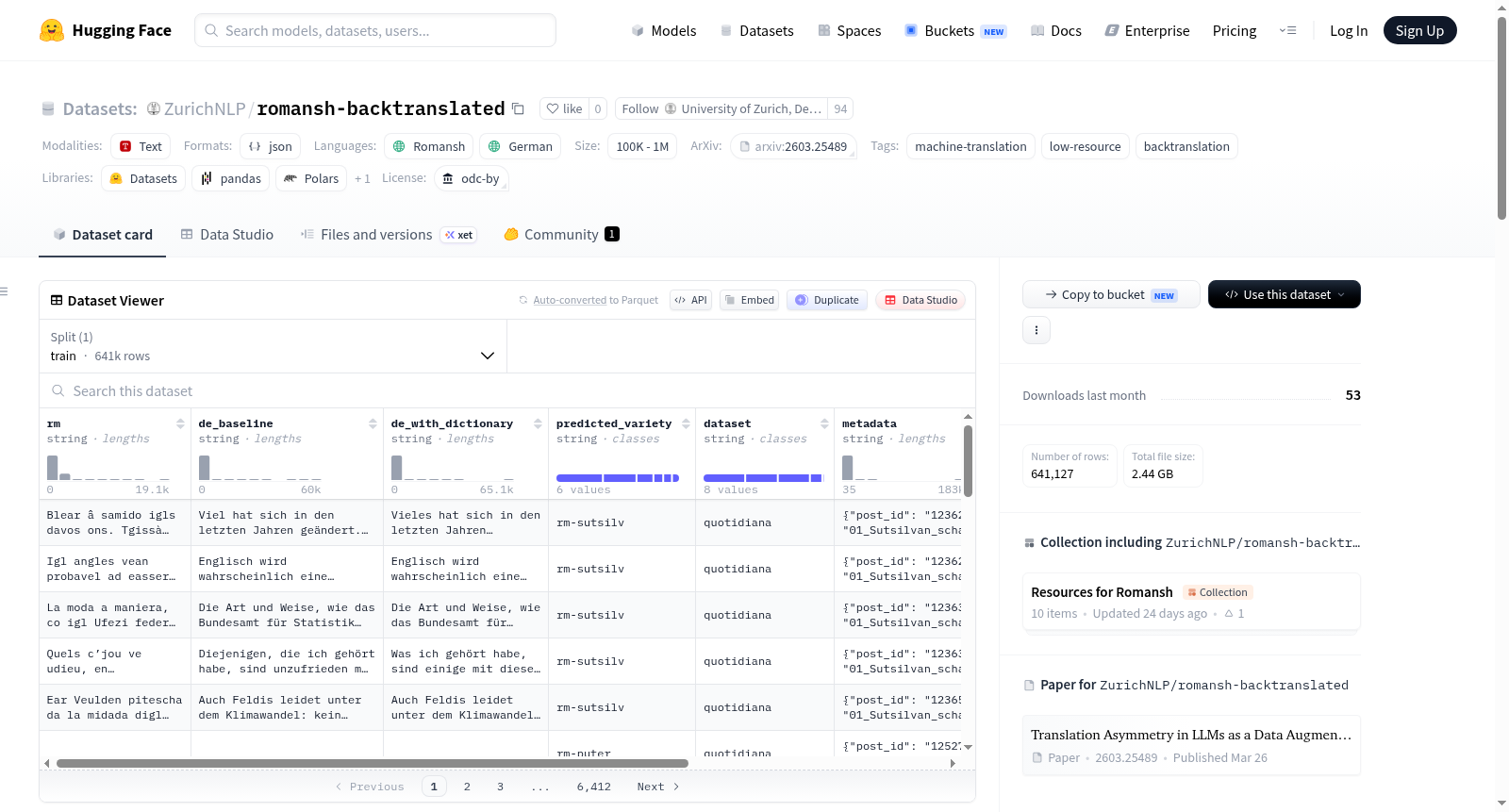
--- license: odc-by language: - rm - de tags: - machine-translation - low-resource - backtranslation --- # Romansh–German Back-Translation Dataset ## Background This dataset contains Romansh texts paired with German translations generated synthetically using **Gemini 2.5 Flash**. It was created as part of research on data augmentation for low-resource machine translation of Romansh, a language with 6 distinct written varieties (Rumantsch Grischun, Sursilvan, Sutsilvan, Surmiran, Puter, Vallader). LLMs tend to confuse Romansh varieties when translating *into* Romansh, but perform well translating *out of* Romansh into German. This asymmetry makes LR → HR augmentation (Romansh → German) the ideal strategy. Synthetic German translations produced this way allow models to surpass a Gemini 3 Pro baseline on German → Romansh translation by up to +23 BLEU in the lowest-resource variety. The language variety of each Romansh text was automatically predicted using [`ZurichNLP/romansh-lid`](https://github.com/ZurichNLP/romansh-lid). ## Usage ```python from datasets import load_dataset dataset = load_dataset("ZurichNLP/romansh-backtranslated") ``` This dataset is intended for NLP and machine translation research. The license of the individual rows is defined per-row. ## Paper > **Translation Asymmetry in LLMs as a Data Augmentation Factor: A Case Study for 6 Romansh Language Varieties** > Jannis Vamvas, Ignacio Pérez Prat, Angela Heldstab, Dominic P. Fischer, Sina Ahmadi, Rico Sennrich > arXiv:2603.25489 · https://arxiv.org/abs/2603.25489 ## Dataset Fields | Field | Description | |---|---| | `rm` | Source Romansh text | | `de_baseline` | German translation (baseline prompting) | | `de_with_dictionary` | German translation (dictionary-augmented prompting) | | `predicted_variety` | Automatically predicted Romansh variety | | `dataset` | Name of the source dataset | | `metadata` | Additional metadata from the source dataset | | `license` | License of the source dataset | ## Source Datasets This dataset contains backtranslations of the following publicly available Romansh sources: | Name | Varieties | URL | License | |---|---|---|---| | FineWeb2 | RG | [HuggingFace](https://huggingface.co/datasets/HuggingFaceFW/fineweb-2) | ODC-By 1.0 | | La Quotidiana (1997–2008, 2021–2025) | RG, Surs., Suts., Surm., Puter, Vall. | [HuggingFace](https://huggingface.co/datasets/ZurichNLP/quotidiana) | CC BY 4.0 | | FinePDFs | RG | [HuggingFace](https://huggingface.co/datasets/HuggingFaceFW/finepdfs) | ODC-By 1.0 | | Mediomatix (unaligned) | Surs., Suts., Surm., Puter, Vall. | [HuggingFace](https://huggingface.co/datasets/ZurichNLP/mediomatix-raw) | CC BY-NC-SA 4.0 | | FineWiki | RG | [HuggingFace](https://huggingface.co/datasets/HuggingFaceFW/finewiki) | CC BY-SA 4.0 | | Theater plays | RG, Surs., Suts., Surm., Puter, Vall. | [HuggingFace](https://huggingface.co/datasets/ZurichNLP/romansh_theater_plays) | CC0 1.0 | | Municipal documents | Surs., Suts., Surm., Vall. | [HuggingFace](https://huggingface.co/datasets/ZurichNLP/romansh-municipal-text-corpus) | CC0 1.0 | | Historical Dictionary of Switzerland | RG | [hls-dhs-dss.ch](https://hls-dhs-dss.ch/rm/) | CC BY-SA 4.0 | ## Citation If you use this dataset, please cite: ```bibtex @misc{vamvas2026translationasymmetryllmsdata, title={Translation Asymmetry in LLMs as a Data Augmentation Factor: A Case Study for 6 Romansh Language Varieties}, author={Jannis Vamvas and Ignacio Pérez Prat and Angela Heldstab and Dominic P. Fischer and Sina Ahmadi and Rico Sennrich}, year={2026}, eprint={2603.25489}, archivePrefix={arXiv}, primaryClass={cs.CL}, url={https://arxiv.org/abs/2603.25489} } ```
This dataset is a Romansh–German back-translation dataset designed for low-resource machine translation research. It contains Romansh texts paired with synthetic German translations generated using Gemini 2.5 Flash, aiming to improve German → Romansh translation through data augmentation. Romansh has 6 distinct written varieties (Rumantsch Grischun, Sursilvan, Sutsilvan, Surmiran, Puter, Vallader). Large language models perform well when translating out of Romansh into German but tend to confuse varieties when translating into Romansh, making Romansh → German augmentation the ideal strategy. Each Romansh text in the dataset has its language variety automatically predicted using ZurichNLP/romansh-lid. Dataset fields include: source Romansh text (rm), German translation with baseline prompting (de_baseline), German translation with dictionary-augmented prompting (de_with_dictionary), automatically predicted Romansh variety (predicted_variety), name of the source dataset (dataset), additional metadata from the source dataset (metadata), and license of the source dataset (license). The data is sourced from multiple publicly available datasets such as FineWeb2, La Quotidiana, FinePDFs, etc., covering various varieties and licenses.