
青藏高原0-30cm土壤微生物残体碳空间分布数据集
收藏国家青藏高原科学数据中心2025-08-27 更新2025-04-05 收录
下载链接:
https://data.tpdc.ac.cn/zh-hans/data/a556e7f0-403c-41e9-a0c1-cccf063e7dc1
下载链接
链接失效反馈官方服务:
资源简介:
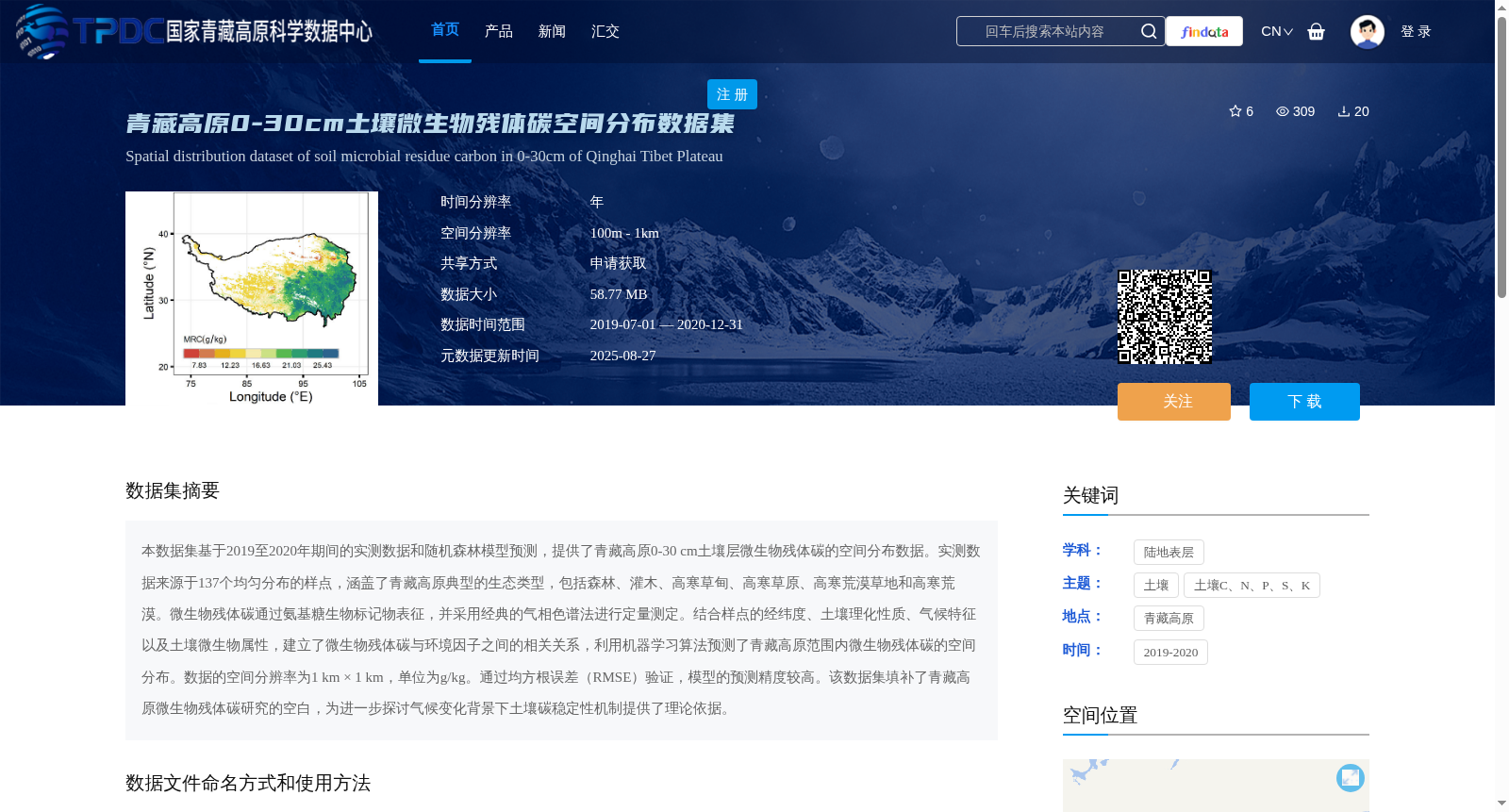
本数据集基于2019至2020年期间的实测数据和随机森林模型预测,提供了青藏高原0-30 cm土壤层微生物残体碳的空间分布数据。实测数据来源于137个均匀分布的样点,涵盖了青藏高原典型的生态类型,包括森林、灌木、高寒草甸、高寒草原、高寒荒漠草地和高寒荒漠。微生物残体碳通过氨基糖生物标记物表征,并采用经典的气相色谱法进行定量测定。结合样点的经纬度、土壤理化性质、气候特征以及土壤微生物属性,建立了微生物残体碳与环境因子之间的相关关系,利用机器学习算法预测了青藏高原范围内微生物残体碳的空间分布。数据的空间分辨率为1 km × 1 km,单位为g/kg。通过均方根误差(RMSE)验证,模型的预测精度较高。该数据集填补了青藏高原微生物残体碳研究的空白,为进一步探讨气候变化背景下土壤碳稳定性机制提供了理论依据。
This dataset provides spatially distributed data of microbial residue carbon (MRC) in the 0–30 cm soil layer of the Qinghai-Tibet Plateau, based on in-situ measured data from 2019 to 2020 and predictions using a random forest model. The in-situ measured data were collected from 137 evenly distributed sampling sites, which cover all typical ecosystem types on the Qinghai-Tibet Plateau, including forest, shrubland, alpine meadow, alpine steppe, alpine desert grassland, and alpine desert. Microbial residue carbon was characterized by amino sugar biomarkers and quantitatively determined using the classic gas chromatography method. Correlations between microbial residue carbon and environmental factors were established by combining the latitude and longitude of sampling sites, soil physicochemical properties, climatic characteristics, and soil microbial attributes, and the spatial distribution of MRC across the Qinghai-Tibet Plateau was predicted using machine learning algorithms. The spatial resolution of the dataset is 1 km × 1 km, with the unit of g/kg. The prediction accuracy of the model was verified to be high via root mean square error (RMSE) validation. This dataset fills the research gap in the study of microbial residue carbon on the Qinghai-Tibet Plateau, and provides a theoretical basis for further exploring the mechanism of soil carbon stability under the context of climate change.
提供机构:
汪涛
创建时间:
2025-01-17
搜集汇总
数据集介绍
背景与挑战
背景概述
该数据集提供了2019至2020年青藏高原0-30cm土壤层微生物残体碳的空间分布数据,基于137个样点的实测数据和随机森林模型预测,空间分辨率为1km × 1km。数据集填补了青藏高原微生物残体碳研究的空白,为研究土壤碳稳定性机制提供了重要依据。
以上内容由遇见数据集搜集并总结生成


