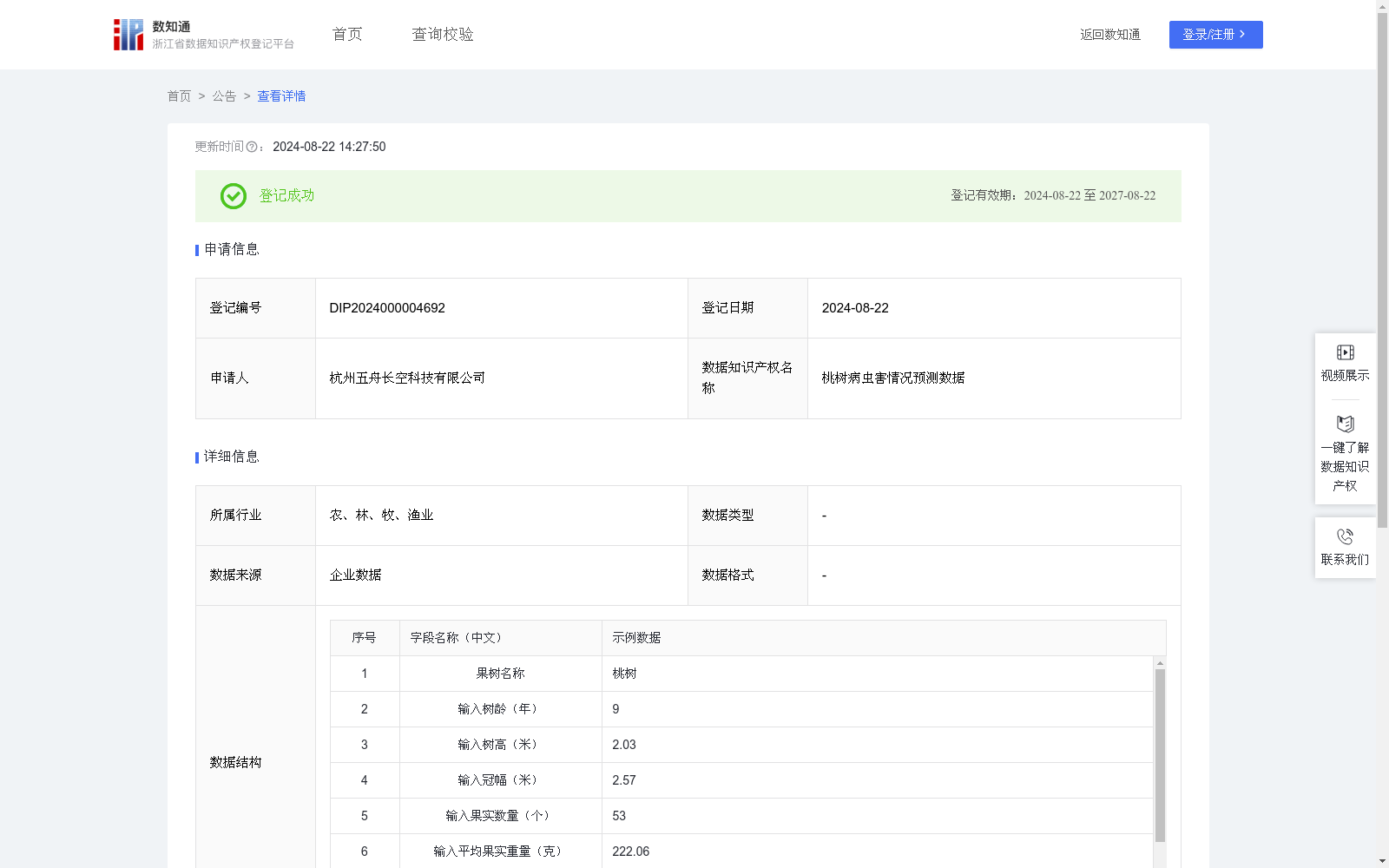
桃树病虫害情况预测数据
收藏资源简介:
可以用于桃树病虫害情况预测,输入为树龄(年),树高(米),冠幅(米),果实数量(个),平均果实重量(克),土壤pH值。输出为病虫害情况。该模型帮助解决了桃树病虫害情况和桃树状况的关系建模的问题。通过调查采集桃树数据,并使用传统算法和多元线性回归算法预测桃树病虫害情况。该模型的输入为树龄(年),树高(米),冠幅(米),果实数量(个),平均果实重量(克),土壤pH值。多元线性回归算法通过分析这些输入变量与桃树病虫害情况之间的线性关系,确定每个变量的权重系数。在模型训练过程中,算法会利用历史数据进行优化,调整权重系数以最小化预测误差。模型通过最小二乘法等技术,根据输入的数据计算预测的桃树病虫害情况,从而得出最终结果。通过这样的过程,模型能够将多个输入变量综合考虑,准确预测桃树病虫害情况。
This dataset can be used for peach tree pests and diseases prediction. Its input features include tree age (in years), tree height (in meters), crown width (in meters), number of fruits, average fruit weight (in grams), and soil pH value, with the output being the status of pests and diseases. This model addresses the challenge of modeling the correlation between peach tree pests and diseases and the overall growth status of peach trees. Data related to peach trees were collected via field surveys, and traditional algorithms and multiple linear regression were employed to predict the incidence of peach tree pests and diseases. The model accepts the following input variables: tree age (in years), tree height (in meters), crown width (in meters), number of fruits, average fruit weight (in grams), and soil pH value. The multiple linear regression algorithm analyzes the linear relationship between these input variables and the occurrence of peach tree pests and diseases, and determines the weight coefficient of each variable. During the model training phase, the algorithm uses historical data for optimization, adjusting the weight coefficients to minimize prediction errors. The model calculates the predicted peach tree pests and diseases status based on input data through techniques such as the least squares method, and thus obtains the final prediction result. Through this process, the model can comprehensively consider multiple input variables and accurately predict the occurrence of peach tree pests and diseases.