
评价和修复日发电量方案数据
收藏浙江省数据知识产权登记平台2023-11-04 更新2024-05-08 收录
下载链接:
https://www.zjip.org.cn/home/announce/trends/8588
下载链接
链接失效反馈官方服务:
资源简介:
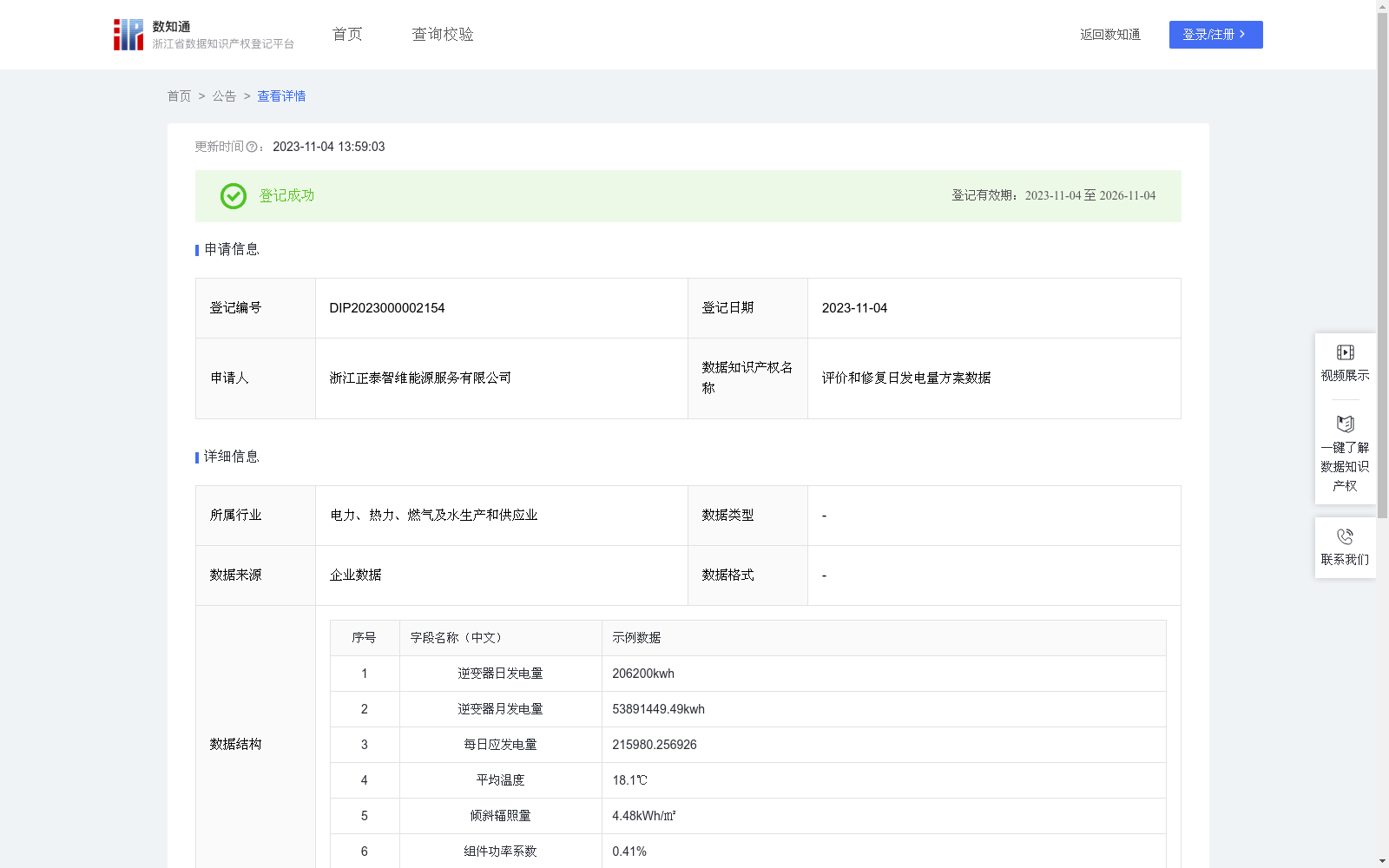
通过对电站历史发电量数据,结合辐照量和温度等环境参数,预测未来发电量趋势,及评估现阶段发电效率,为运维管理提供数据参考通过收集电站历史发电量数据,研究电站发电量和环境因素的趋势关系,建立数据模型,评估现阶段发电量是否符合其本身的数据变化趋势。 数据的具体使用方式,是通过BLS(Broad Learning System)宽度学习算法来拟合发电量和日累积辐照量、日平均温度及组件功率系数的关系,通过算法的不断学习,逐渐提高拟合优度,从数据方面评估每日发电量,评估结果和实际数据采集发电量结果的对比,分析数据采集质量,对于偏差较大的数据,进行算法结果填充修复, 最终得到每日应发电量。 宽度学习系统的数学模型: Y=[F1,F2,...,Fm,E]W=[F,E]W 式中:W表示从特征节点和增强节点连接到输出层的权重;Y是整个神经网络的输出。为了简化表达式,将BLS中间层(包括特征节点和增强节点)对应的矩阵记作M = [F, E]。
This dataset is designed to predict future power generation trends and evaluate current power generation efficiency by leveraging historical power generation data of power stations combined with environmental parameters such as solar irradiation and temperature, providing data references for operation and maintenance management. Specifically, by collecting historical power generation data of power stations, we analyze the trend correlation between power generation and environmental factors, establish a data model, and assess whether the current power generation conforms to its inherent data variation trend. The specific application of this dataset is to use the BLS (Broad Learning System) algorithm to fit the relationship between power generation and daily cumulative solar irradiation, daily average temperature, as well as module power coefficient. Through continuous iterative learning of the algorithm, the goodness of fit is gradually improved. The daily power generation is evaluated from the data perspective. By comparing the evaluation results with the actual collected power generation data, the quality of data collection is analyzed. For data with significant deviations, the algorithm-generated results are used for filling and correction, and finally the daily theoretical power generation is obtained. The mathematical model of the Broad Learning System is: $Y=[F_1,F_2,...,F_m,E]W=[F,E]W$. Where: $W$ represents the weight matrix connecting the feature nodes and enhancement nodes to the output layer; $Y$ is the output of the entire neural network. To simplify the expression, the matrix corresponding to the BLS intermediate layer (including feature nodes and enhancement nodes) is denoted as $M = [F, E].
提供机构:
浙江正泰智维能源服务有限公司
创建时间:
2023-10-20
搜集汇总
数据集介绍
特点
该数据集包含2001条每日更新的发电量相关数据,用于预测和评估发电效率,采用BLS宽度学习算法进行数据分析和修复。
以上内容由遇见数据集搜集并总结生成



