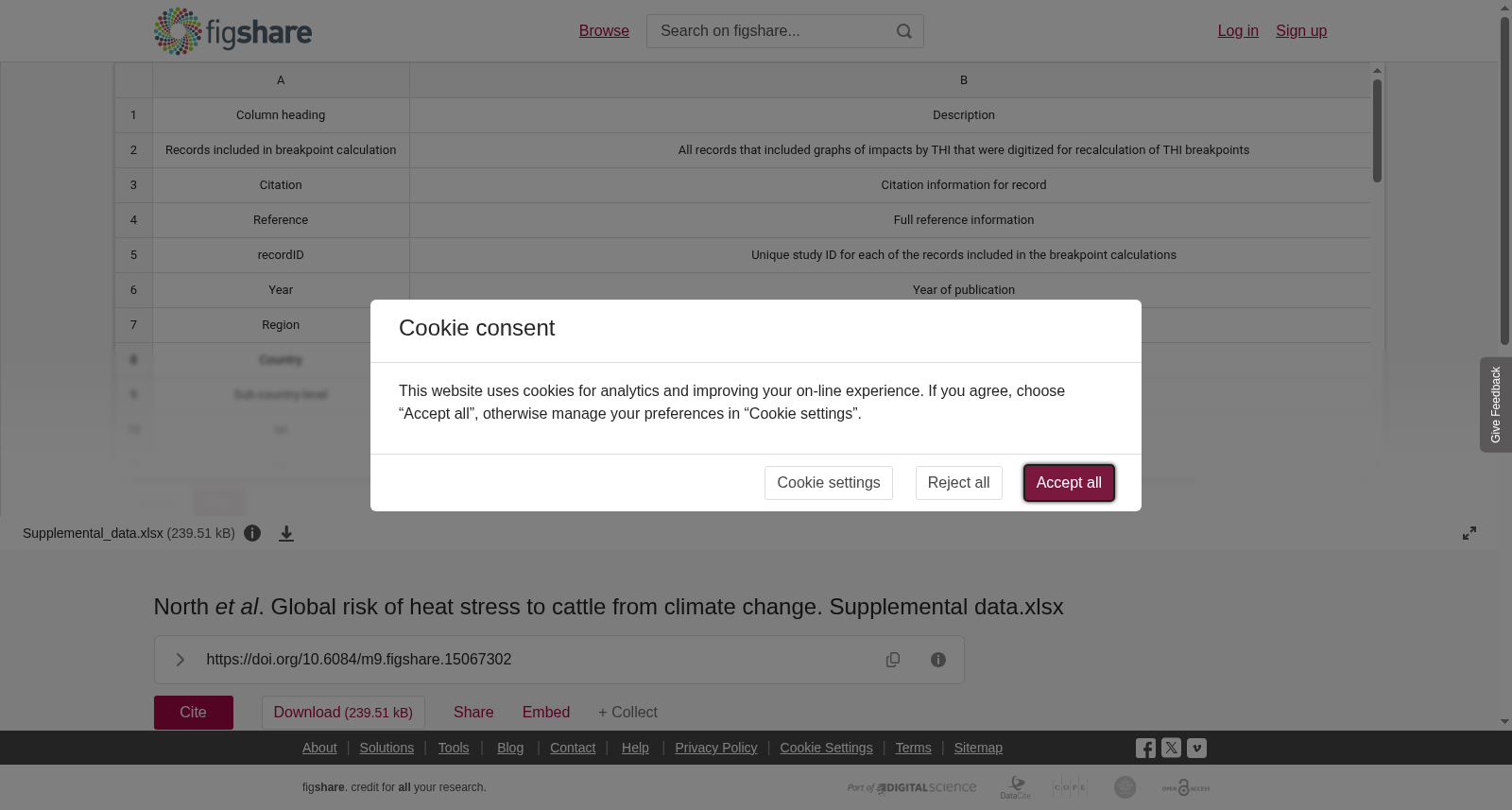
North <em>et al</em>. Global risk of heat stress to cattle from climate change. Supplemental data.xlsx
收藏资源简介:
<strong>Abstract</strong> Cattle farming is a major source of global food production and livelihoods that is being impacted by climate change. However, despite numerous studies reporting local-scale heat impacts, quantifying the global risk of heat stress to cattle from climate change remains challenging, owing to a lack of comparable data across studies and regions. We conducted a global synthesis of documented heat stress for cattle to identify temperature-humidity conditions associated with decreased production and increased mortality. We then projected how alternative future socio-economic pathways and associated land-use decisions will mitigate or exacerbate heat stress, and mapped this globally. Forty research articles containing 105 records were used to calculate heat stress thresholds for production, fertility and mortality, and 59 records reported the impact of heat stress on milk yield. The median threshold for the onset of negative impacts on cattle was a temperature-humidity index of 68.8 (95% CI: 67.3-70.7). Around 80% of cattle globally are currently exposed to conditions exceeding this threshold for >30 days a year. Under a high greenhouse gas emissions scenario, year-round heat stress for cattle is projected to expand across all tropical regions by 2100, with heat stress of >180 days emerging in temperate regions. Under a low emissions scenario, the expansion of 180 days of heat stress is limited to sub-tropical regions. In all scenarios, heat stress severity will increase most in tropical regions, reducing global milk yields. Future land-use decisions are an important driver of risk. Under a low environmental protection scenario, the greatest expansion of cattle farming is projected for tropical regions (e.g., Amazon and Congo rainforests), where heat stress is also projected to increase the most. This would expose over 500 million more cattle to severe heat risk by 2100. These results highlight the contradiction of pursuing land-use practices that are themselves at high risk from the resulting increase in climate hazards. <strong>This dataset includes the results of the literature review, the included articles and underlying records, and the extracted data (THI thresholds, THI equations, source of equation, impact slopes, species, and more).</strong>
**摘要** 牛养殖业是全球粮食生产与民生生计的重要支柱,当前正受气候变化的显著影响。尽管已有诸多研究报道了局地尺度的热应激影响,但由于不同研究与区域间缺乏可比对的数据集,量化气候变化对牛群的全球热应激风险仍颇具挑战。本研究针对已公开报道的牛群热应激情况开展全球综合分析,以识别与生产性能下降、死亡率上升相关的温湿度条件。随后我们预测了不同未来社会经济路径及配套土地利用决策将如何缓解或加剧热应激,并完成了全球尺度的热应激分布制图。本研究纳入40篇学术论文、共计105条记录,用于计算生产、繁殖与死亡率相关的热应激阈值;另有59条记录报道了热应激对乳产量的影响。牛群出现负面影响的临界阈值为温湿度指数(Temperature-Humidity Index, THI)68.8(95%置信区间:67.3~70.7)。当前全球约80%的牛群每年暴露于超过该阈值的环境中时长超过30天。在高温室气体排放情景下,预计至2100年,牛群全年热应激将覆盖所有热带地区,温带地区也将出现每年超过180天的热应激情况。在低排放情景下,每年180天以上热应激的范围仅局限于亚热带地区。在所有情景中,热带地区的热应激严重程度增幅最大,将导致全球乳产量下降。未来的土地利用决策是热应激风险的重要驱动因素。在低环境保护情景下,牛养殖业扩张幅度最大的区域预计为热带地区(如亚马逊与刚果热带雨林),该区域的热应激增幅也最为显著;至2100年,这将使超过5亿头额外的牛群面临严重热应激风险。上述结果凸显了推行此类土地利用模式的矛盾性:这类模式本身也会因气候灾害加剧而面临极高风险。本数据集涵盖本次文献综述的研究结果、纳入的学术论文及原始记录,以及提取得到的各类数据(温湿度指数阈值、温湿度指数计算公式、公式来源、影响斜率、物种类型等)。