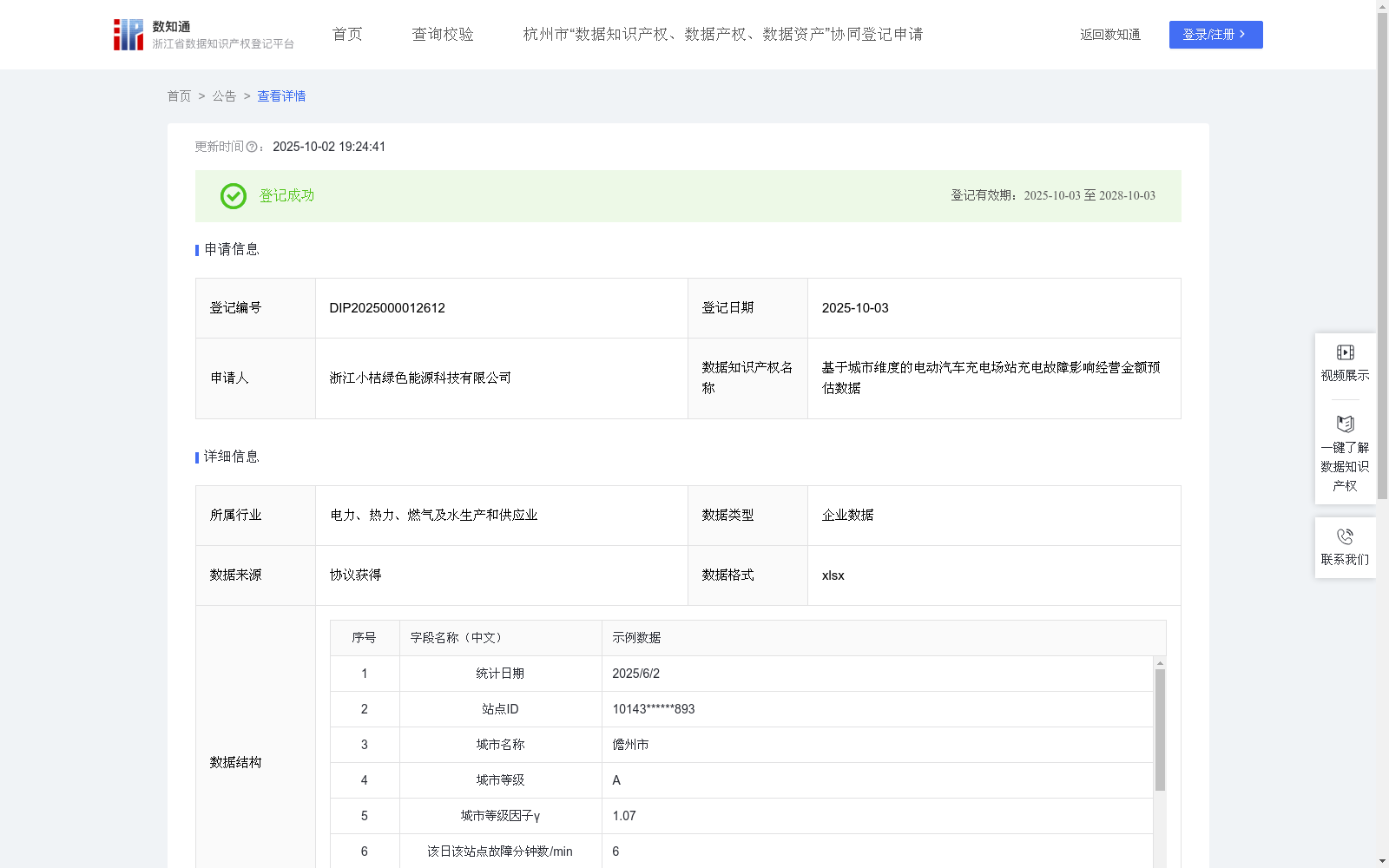
基于城市维度的电动汽车充电场站充电故障影响经营金额预估数据
收藏资源简介:
本数据集以城市为基本分析单元,聚焦因充电枪故障而造成的潜在营收损失,结合城市等级因子,构建“故障行为-金额损失”核算模型。具体应用场景如下: 1.对平台(即申请人)而言:可量化各城市因设备故障导致的经营金额损失量,作为区域营收稳定性的重要指标,辅助制定城市拓展节奏与运维投入优先级; 2.对场站商家而言:可用于判断特定城市中设备故障对收入造成的影响程度,支持设施投资回收期评估与预算安排优化; 3.对政府而言:可作为城市级基础设施经营效益缺口监测的输入,支撑差异化补贴政策与公共设施运行绩效考核。1.数据采集:原始数据经授权合法获取,采集统计日期、站点ID、城市名称、城市等级(根据城市充电场站经营规模排序进行赋级)、该日该站点故障分钟数、该日该站点故障分钟占比、该日该站点无故障时段经营金额等字段。 2.设置影响因子-城市等级因子γ:若城市等级为S级,则γ赋值1.21,A级则γ赋值1.07,B级则γ赋值0.95。 3.建立充电故障影响经营金额的预估模型:(1)计算该日该站点无故障分钟占比:该日该站点无故障分钟占比=1-该日该站点故障分钟占比;(2)计算该日该站点基准故障经营金额预估值:该日该站点基准故障经营金额预估值=该日该站点无故障时段经营金额/该日该站点无故障分钟占比-该日该站点无故障时段经营金额;(3)修正计算:修正后的该日该站点故障经营金额预估值=该日该站点故障时段的基准经营金额预估值*城市等级因子γ。
This dataset takes cities as the basic analytical unit, focuses on potential revenue losses caused by charging gun malfunctions, and incorporates the city tier factor to build an "Malfunction Behavior - Monetary Loss" accounting model. The specific application scenarios are as follows: 1. For the platform (i.e., applicant): It can quantify the amount of operational revenue loss caused by equipment malfunctions in each city, serve as a key indicator of regional revenue stability, and assist in formulating the city expansion pace and priority of operation and maintenance investment; 2. For station operators: It can be used to assess the degree of revenue impact of equipment malfunctions in specific cities, and support facility payback period assessment and budget arrangement optimization; 3. For the government: It can be used as an input for monitoring the operational benefit gap of urban-level infrastructure, and support differentiated subsidy policies and public facility operation performance appraisal. 1. Data Collection: Original data is legally obtained with authorization. Collected fields include statistical date, station ID, city name, city tier (graded based on the ranking of the operational scale of local charging stations), daily faulty minutes of the station, daily proportion of faulty minutes of the station, daily operational revenue during fault-free periods of the station, and other related fields. 2. Setting of the Impact Factor: City Tier Factor γ: If the city tier is S-level, γ is assigned a value of 1.21; for A-level, γ is 1.07; and for B-level, γ is 0.95. 3. Establishment of the Prediction Model for the Impact of Charging Malfunctions on Operational Revenue: (1) Calculate the daily proportion of fault-free minutes for the station: Daily proportion of fault-free minutes = 1 - Daily proportion of faulty minutes for the station; (2) Calculate the daily estimated baseline operational revenue loss due to malfunctions for the station: Daily estimated baseline operational revenue loss due to malfunctions = (Daily operational revenue during fault-free periods / Daily proportion of fault-free minutes) - Daily operational revenue during fault-free periods; (3) Corrected Calculation: Corrected daily estimated operational revenue loss due to malfunctions for the station = Daily estimated baseline operational revenue loss due to malfunctions * City Tier Factor γ.