
Cortical Contributions to Local and Global Biological Motion Perception: Insights from Transcranial Magnetic Stimulation
收藏DataCite Commons2025-04-27 更新2025-04-16 收录
下载链接:
https://www.scidb.cn/detail?dataSetId=a205dc3630b54ce1ac97eaf1999212dd
下载链接
链接失效反馈官方服务:
资源简介:
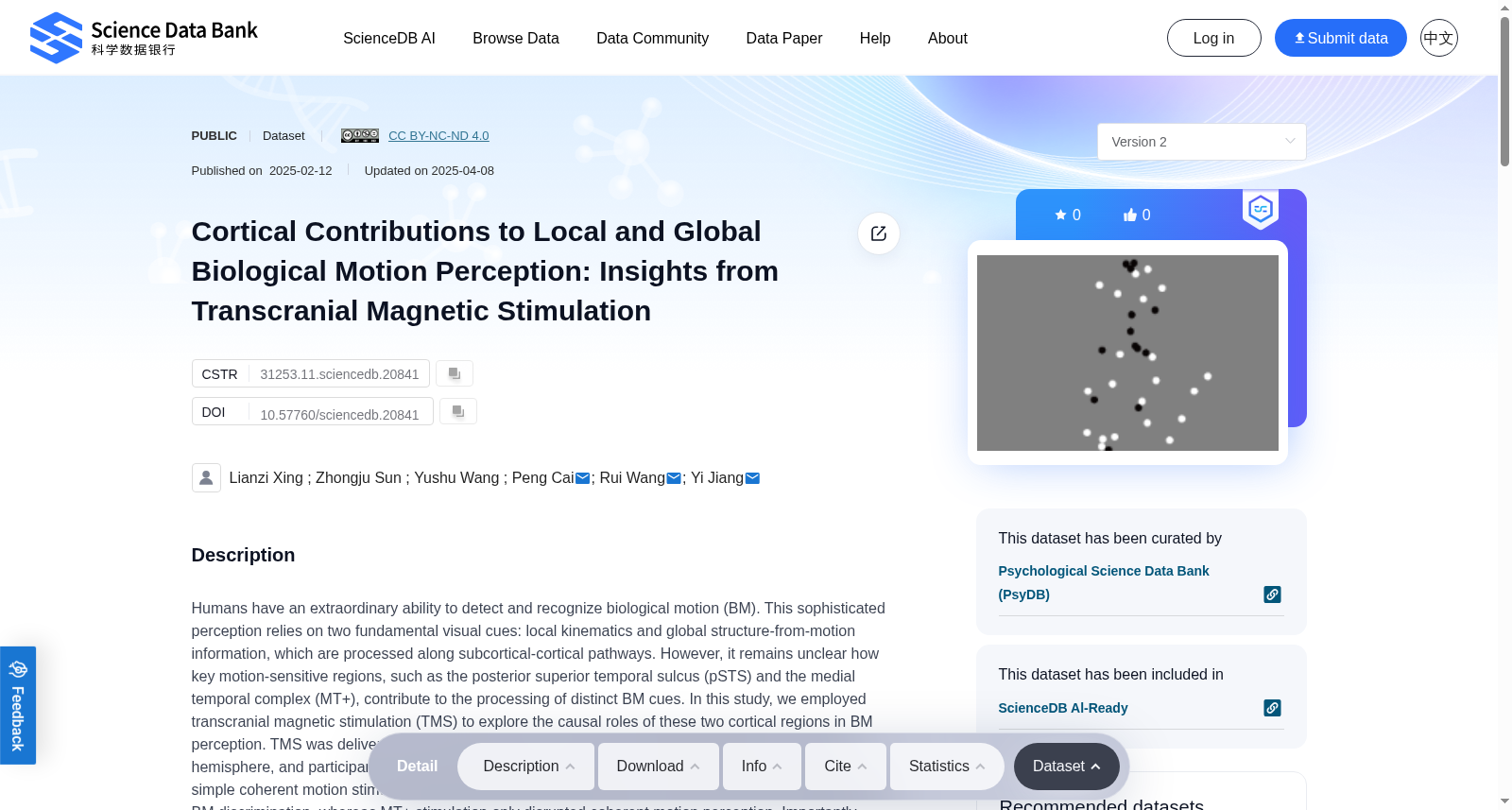
Humans have an extraordinary ability to detect and recognize biological motion (BM). This sophisticated perception relies on two fundamental visual cues: local kinematics and global structure-from-motion information, which are processed along subcortical-cortical pathways. However, it remains unclear how key motion-sensitive regions, such as the posterior superior temporal sulcus (pSTS) and the medial temporal complex (MT+), contribute to the processing of distinct BM cues. In this study, we employed transcranial magnetic stimulation (TMS) to explore the causal roles of these two cortical regions in BM perception. TMS was delivered to the pSTS and MT+, which were individually localized in the right hemisphere, and participants performed direction discrimination tasks with intact BM, scrambled BM, and simple coherent motion stimuli. Results demonstrated that TMS over the pSTS selectively impaired intact BM discrimination, whereas MT+ stimulation only disrupted coherent motion perception. Importantly, neither site showed significant impairment in scrambled BM direction discrimination. These findings suggest that while pSTS and MT+ are critical for global BM and coherent motion perception, respectively, they are not obligatory for local BM processing. The detection of local BM signals may rely on a specialized mechanism operating at an early stage of visual processing.
提供机构:
Science Data Bank
创建时间:
2025-02-12
搜集汇总
数据集介绍
背景与挑战
背景概述
该数据集通过经颅磁刺激(TMS)研究大脑皮层区域对生物运动感知的贡献,重点关注后颞上沟(pSTS)和内侧颞复合体(MT+)。实验结果表明,pSTS对全局生物运动感知起关键作用,而MT+主要影响连贯运动感知,两者均不直接参与局部生物运动处理。这揭示了皮层区域在生物运动感知中的特异性功能分工,局部信号可能依赖早期视觉机制。
以上内容由遇见数据集搜集并总结生成



