
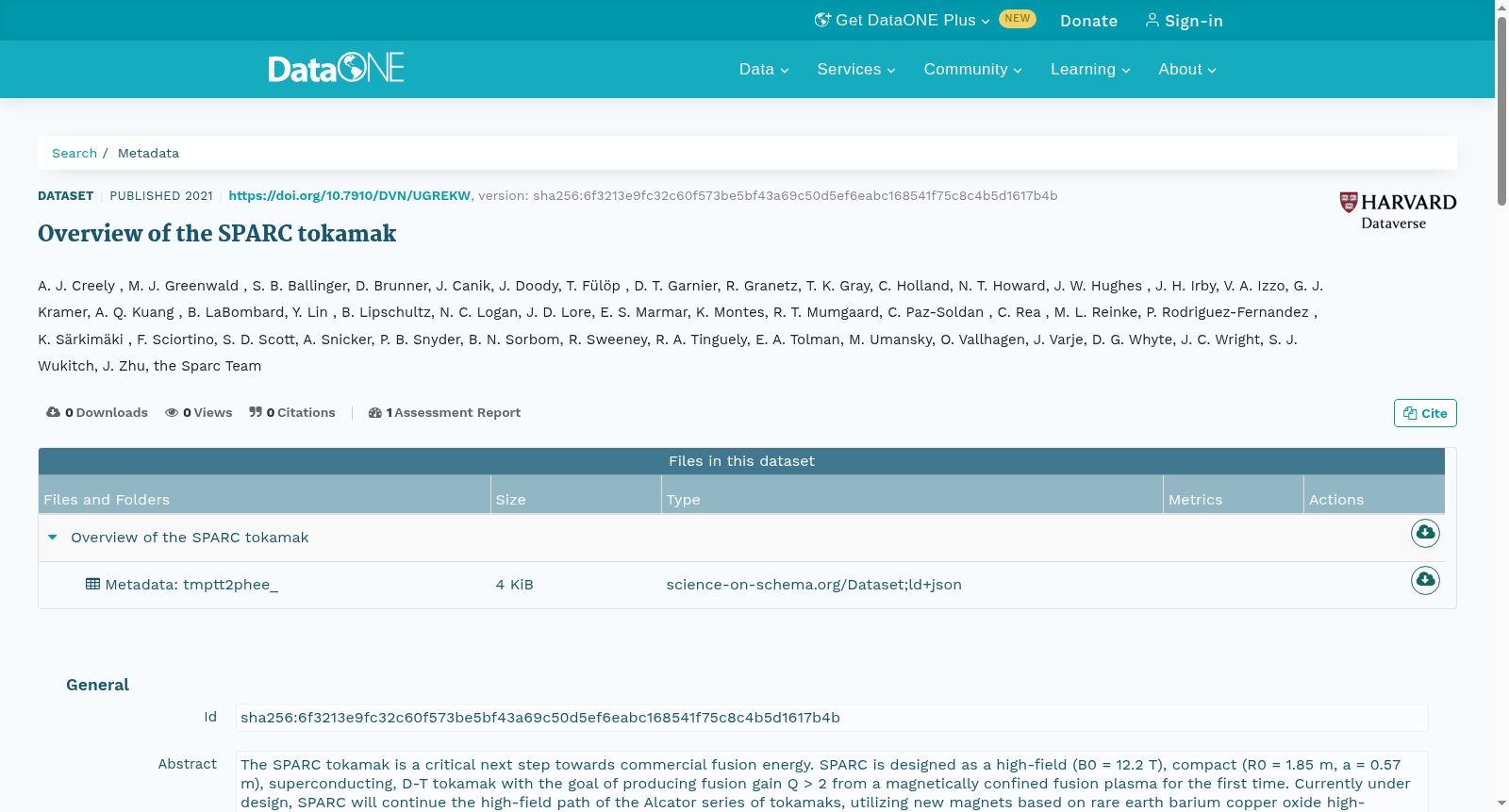
Overview of the SPARC tokamak
收藏DataONE2021-02-18 更新2024-06-08 收录
下载链接:
https://search.dataone.org/view/sha256:6f3213e9fc32c60f573be5bf43a69c50d5ef6eabc168541f75c8c4b5d1617b4b
下载链接
链接失效反馈官方服务:
资源简介:
The SPARC tokamak is a critical next step towards commercial fusion energy. SPARC is designed as a high-field (B0 = 12.2 T), compact (R0 = 1.85 m, a = 0.57 m), superconducting, D-T tokamak with the goal of producing fusion gain Q > 2 from a magnetically confined fusion plasma for the first time. Currently under design, SPARC will continue the high-field path of the Alcator series of tokamaks, utilizing new magnets based on rare earth barium copper oxide high-temperature superconductors to achieve high performance in a compact device. The goal of Q > 2 is achievable with conservative physics assumptions (H98,y2 = 0.7) and, with the nominal assumption of H98,y2 = 1, SPARC is projected to attain Q ≈ 11 and Pfusion ≈ 140 MW. SPARC will therefore constitute a unique platform for burning plasma physics research with high density (⟨ne⟩ ≈ 3 × 10²⁰ m−3), high temperature (⟨Te⟩ ≈ 7 keV) and high power density (Pfusion/Vplasma ≈ 7 MW m−3) relevant to fusion power plants. SPARC’s place in the path to commercial fusion energy, its parameters and the current status of SPARC design work are presented. This work also describes the basis for global performance projections and summarizes some of the physics analysis that is presented in greater detail in the companion articles of this collection.
SPARC托卡马克(tokamak)是迈向商用聚变能源的关键一步。SPARC被设计为一款高场(B0=12.2 T)、紧凑型(R0=1.85 m,a=0.57 m)超导氘氚(D-T)托卡马克,其目标是首次实现磁约束聚变等离子体的聚变增益Q>2。目前SPARC仍处于设计阶段,它将延续阿尔卡特(Alcator)系列托卡马克的高场研发路线,采用基于稀土钡铜氧化物高温超导体(rare earth barium copper oxide high-temperature superconductors)的新型磁体,以在紧凑型装置中实现高性能。在保守物理假设(H98,y2=0.7)下,达成Q>2的目标具备可行性;若采用H98,y2=1的标称假设,SPARC预计可实现Q≈11,聚变功率(Pfusion)≈140 MW。因此,SPARC将成为针对商用聚变堆相关的高电子数密度平均值(⟨ne⟩≈3×10²⁰ m⁻³)、高电子温度平均值(⟨Te⟩≈7 keV)以及高功率密度(Pfusion/Vplasma≈7 MW m⁻³)的燃烧等离子体物理研究的独特平台。本文介绍了SPARC在商用聚变能源发展路径中的定位、各项参数以及当前的设计工作进展;同时阐述了全局性能投影的依据,并总结了部分物理分析内容,相关细节已在本合集的配套论文中展开详述。
创建时间:
2023-11-19
搜集汇总
数据集介绍
以上内容由遇见数据集搜集并总结生成



