
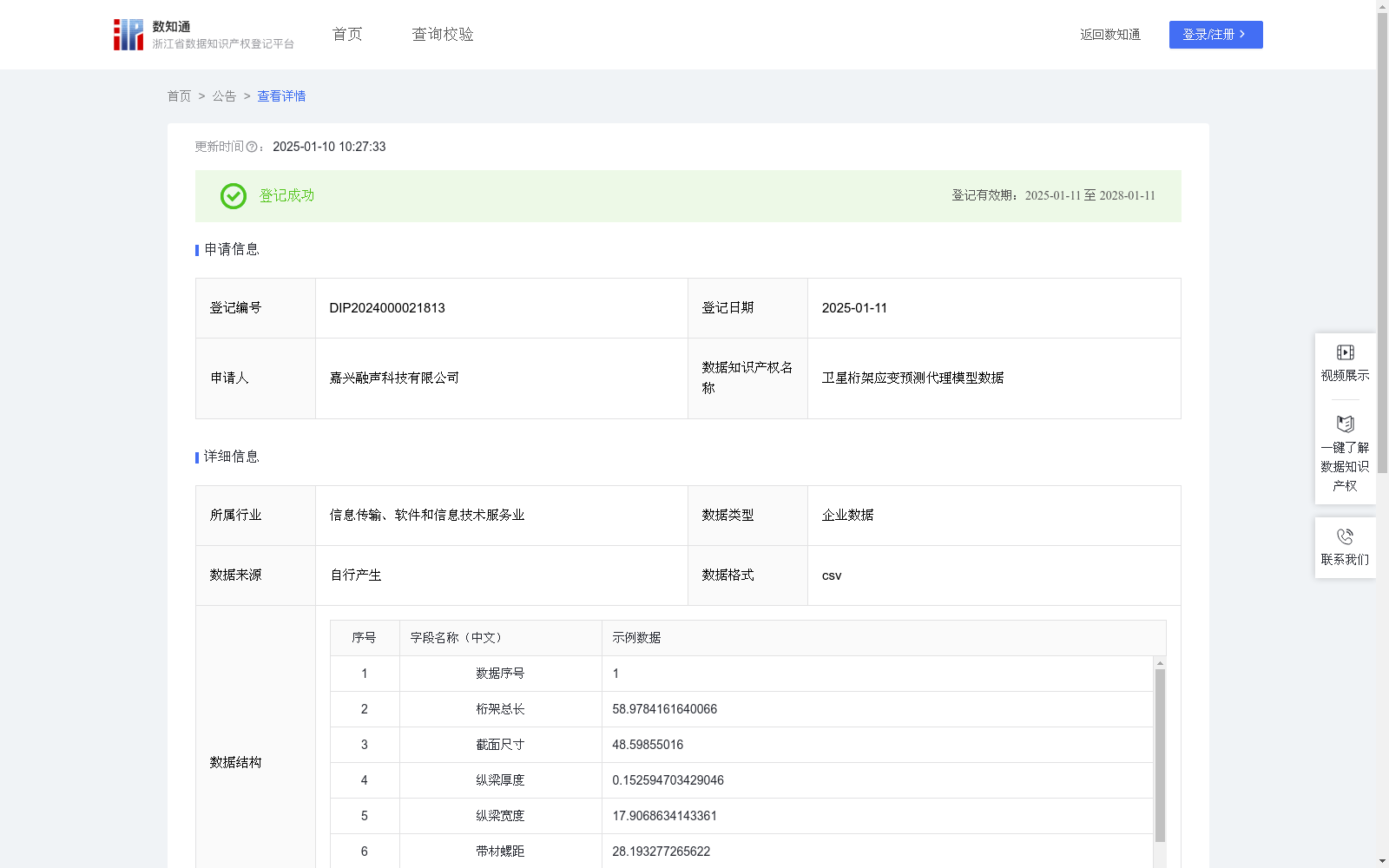
卫星桁架应变预测代理模型数据
收藏浙江省数据知识产权登记平台2025-01-10 更新2025-01-11 收录
下载链接:
https://www.zjip.org.cn/home/announce/trends/110861
下载链接
链接失效反馈官方服务:
资源简介:
该数据将广泛运用于卫星桁架制造的应用场景,为保障卫星在复杂工况下的稳定运行,卫星桁架在设计过程中需要进行大量的仿真分析。而代理模型(Surrogate Model)是一种通过基于已知数据的统计分析方法,构建一个能够近似原始模型行为的模型,从而在计算资源受限或原始模型无法进行实际测试的情况下,快速地分析和优化设计。因此本数据用于对卫星桁架的应变预测模型进行训练,从而得到一个用于应变水平快速预测的模型结构。这样可以对于输入的结构值进行快速分析,得到应变水平,从而方便后续的优化和迭代。1.数据收集:根据仿真模拟系统的捕捉功能,我们获得了仿真卫星的结构变量;紧接着我们通过仿真测试得到了桁架应变的值2.构建高斯过程:构建代理模型对结构性能评估本质是一个回归问题的模型。将卫星结构方案的设计参数作为高斯过程的输入参数,结构性能指标作为高斯过程的输出参数。通过仿真数据的训练,可得到仿真卫星的代理模型3.模型预测:通过代理模型数据的估计,我们可以得到预测模型,多项式核函数是高斯过程中常用的核函数之一,可以用来建模输入变量与输出变量之间的非线性关系,当输入新型卫星的结构变量时,我们就可以快速得到他的应变的数量预测值。其形式为:K(x,y)=(σ^2*<x,y>+c)^d,其中x和y是输入向量,<x,y>表示它们的内积,d是多项式的次数,σ是一个比例因子,c是一个常数项。模型训练前首先准备数据集,共有100个样本,输入变量为二维,输出变量为一维,使用随机划分的方法将数据集划分为训练集和测试集,其中,80%用于训练,剩余20%数据用于测试。经过模型训练,将测试集应用于高斯过程模型进行测试,使用MAE、MAPE、MSE、RMSE四个参考值对模型的准确性进行评估。
This dataset is widely applicable to satellite truss manufacturing scenarios. To ensure the stable operation of satellites under complex working conditions, extensive simulation analyses are required during the design phase of satellite trusses. A surrogate model is a statistical analysis method based on known data that constructs a model capable of approximating the behavior of the original model, enabling rapid analysis and design optimization when computational resources are limited or the original model cannot be physically tested. Therefore, this dataset is used to train a strain prediction model for satellite trusses, yielding a model architecture that enables rapid strain level prediction. It allows fast analysis of input structural values to obtain strain levels, facilitating subsequent design optimization and iteration.
1. Data Collection: We collected the structural variables of the simulated satellite via the capture function of the simulation system, and subsequently obtained the truss strain values through simulation tests.
2. Gaussian Process Construction: Building a surrogate model for structural performance evaluation is essentially a regression model. We take the design parameters of the satellite structural scheme as the input parameters of the Gaussian process, and the structural performance indicators as the output parameters. Training with the simulation data yields a surrogate model for the simulated satellite.
3. Model Prediction: Through estimation using the surrogate model data, we obtain the prediction model. The polynomial kernel is one of the commonly used kernel functions in Gaussian processes, which can model the nonlinear relationship between input and output variables. When inputting the structural variables of a new satellite, we can quickly obtain the predicted strain value. Its form is: $K(x,y)=(sigma^2 cdot langle x,y
angle + c)^d$, where $x$ and $y$ are input vectors, $langle x,y
angle$ denotes their inner product, $d$ is the polynomial degree, $sigma$ is a scaling factor, and $c$ is a constant term.
Prior to model training, the dataset is first prepared: it contains 100 samples, with two-dimensional input variables and one-dimensional output variables. The dataset is randomly split into training and test sets, where 80% is used for training and the remaining 20% for testing. After model training, the test set is applied to the Gaussian process model for evaluation, and the model's accuracy is assessed using four reference metrics: Mean Absolute Error (MAE), Mean Absolute Percentage Error (MAPE), Mean Squared Error (MSE), and Root Mean Squared Error (RMSE).
提供机构:
嘉兴融声科技有限公司
创建时间:
2024-12-06
搜集汇总
数据集介绍
以上内容由遇见数据集搜集并总结生成



