electricsheepafrica/africa-ilo-how-xees-sex-geo-nb-mean-weekly-hours-actually-worked-per-employee-by
收藏资源简介:
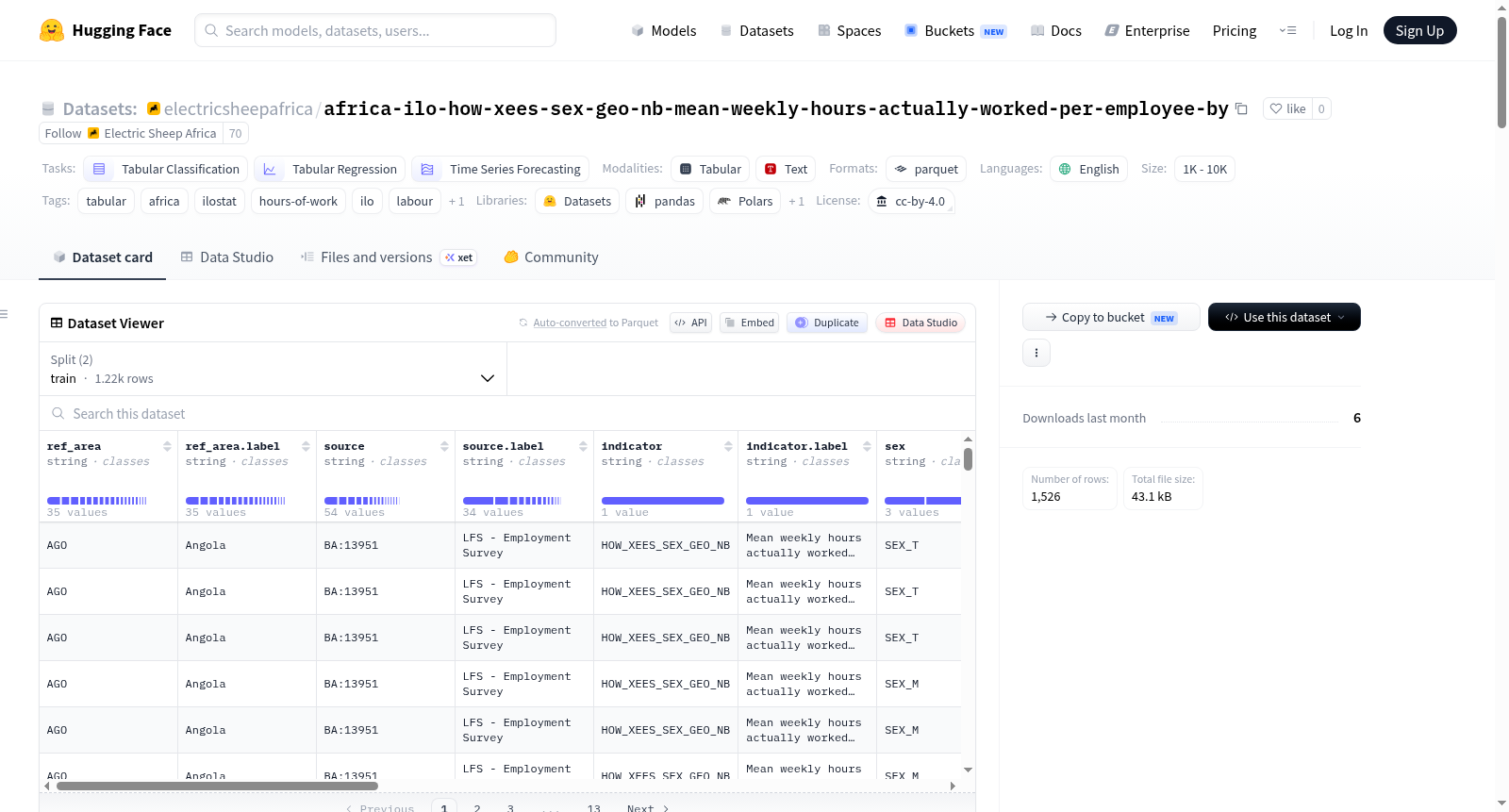
该数据集名为按性别和城乡地区划分的非洲员工每周实际平均工作时间(ILOSTAT),由Electric Sheep Africa重新打包,基于国际劳工组织(ILO)的ILOSTAT数据库。它包含1,526个观测值,覆盖38个非洲国家,时间跨度为1996年至2025年。数据集专注于一个核心指标:按性别和城乡地区划分的员工每周实际平均工作时间(指标代码:HOW_XEES_SEX_GEO_NB)。数据通过ILOSTAT REST API获取,并经过过滤以仅包括非洲国家。数据集采用表格格式,包含多列,如国家代码(ref_area)、国家名称(ref_area.label)、数据来源(source和source.label)、指标代码和标签(indicator和indicator.label)、性别分类(sex和sex.label,包括总计、男性和女性)、分类变量(classif1和classif1.label,如地区类型:全国)、观察年份(time)、观测值(obs_value,单位为小时)、观测状态(obs_status和obs_status.label,例如不可靠)以及备注(note_indicator和note_source等)。数据质量方面,数据为年度频率,ILO选择最佳来源处理多来源情况,且分类列仅在指标发布细分数据时非空。数据集适用于表格分类、回归和时间序列预测等任务,旨在为非洲提供机器学习就绪的数据层,便于研究人员和开发者快速加载和分析。
The dataset is named Mean weekly hours actually worked per employee by sex and rural / urban areas | Africa (ILOSTAT), repackaged by Electric Sheep Africa and based on the International Labour Organization (ILO)s ILOSTAT database. It contains 1,526 observations covering 38 African countries from 1996 to 2025. The dataset focuses on a single core indicator: Mean weekly hours actually worked per employee by sex and rural / urban areas (indicator code: HOW_XEES_SEX_GEO_NB). Data is pulled directly from the ILOSTAT REST API and filtered to Africa ISO3 country codes. It is presented in a tabular format with columns including country code (ref_area), country name (ref_area.label), data source (source and source.label), indicator code and label (indicator and indicator.label), sex disaggregation (sex and sex.label, covering total, male, and female), classification variables (classif1 and classif1.label, such as area type: national), observation year (time), observed value (obs_value, in hours), observation status (obs_status and obs_status.label, e.g., unreliable), and notes (note_indicator and note_source, among others). Data quality notes include annual frequency, use of ILO-selected best source for multiple sources per country-year, and non-null disaggregation columns only when breakdowns are published. The dataset is suitable for tasks like tabular classification, regression, and time-series forecasting, aiming to provide a machine learning-ready data layer for Africa to enable quick loading and analysis by researchers and developers.