
juliensimon/iers-earth-orientation
收藏Hugging Face2026-03-28 更新2026-03-29 收录
下载链接:
https://hf-mirror.com/datasets/juliensimon/iers-earth-orientation
下载链接
链接失效反馈官方服务:
资源简介:
---
license: cc-by-4.0
pretty_name: "IERS Earth Orientation Parameters"
language:
- en
description: >-
Earth Orientation Parameters (EOP) from the IERS finals2000A series.
Includes polar motion, UT1-UTC, and nutation offsets. Updated daily.
size_categories:
- 10K<n<100K
task_categories:
- tabular-regression
tags:
- space
- earth-orientation
- iers
- geodesy
- ut1
- polar-motion
- open-data
- tabular-data
- parquet
configs:
- config_name: default
data_files:
- split: train
path: data/iers_earth_orientation.parquet
---
# IERS Earth Orientation Parameters
*Part of the [Space Weather Datasets](https://huggingface.co/collections/juliensimon/space-weather-datasets-69c24cae98f1666f2101ca70) collection on Hugging Face.*


Earth Orientation Parameters from the IERS finals2000A series, spanning **1992-01-01** to
**2027-05-23**. Currently **12,927** daily records.
## Dataset description
Earth Orientation Parameters (EOP) describe the irregularities in Earth's rotation and
the motion of its poles. These parameters are essential for transforming between
celestial and terrestrial reference frames, which is critical for:
- **Satellite operations**: precise orbit determination and manoeuvre planning
- **GPS/GNSS**: sub-centimetre positioning requires accurate UT1-UTC and polar motion
- **Precise pointing**: telescope and antenna tracking, deep-space navigation
- **Geodesy**: monitoring Earth's rotation rate, polar wander, and length of day
The IERS finals2000A series combines observed values (from VLBI, SLR, GPS) with
predictions extending ~1 year into the future.
## Schema
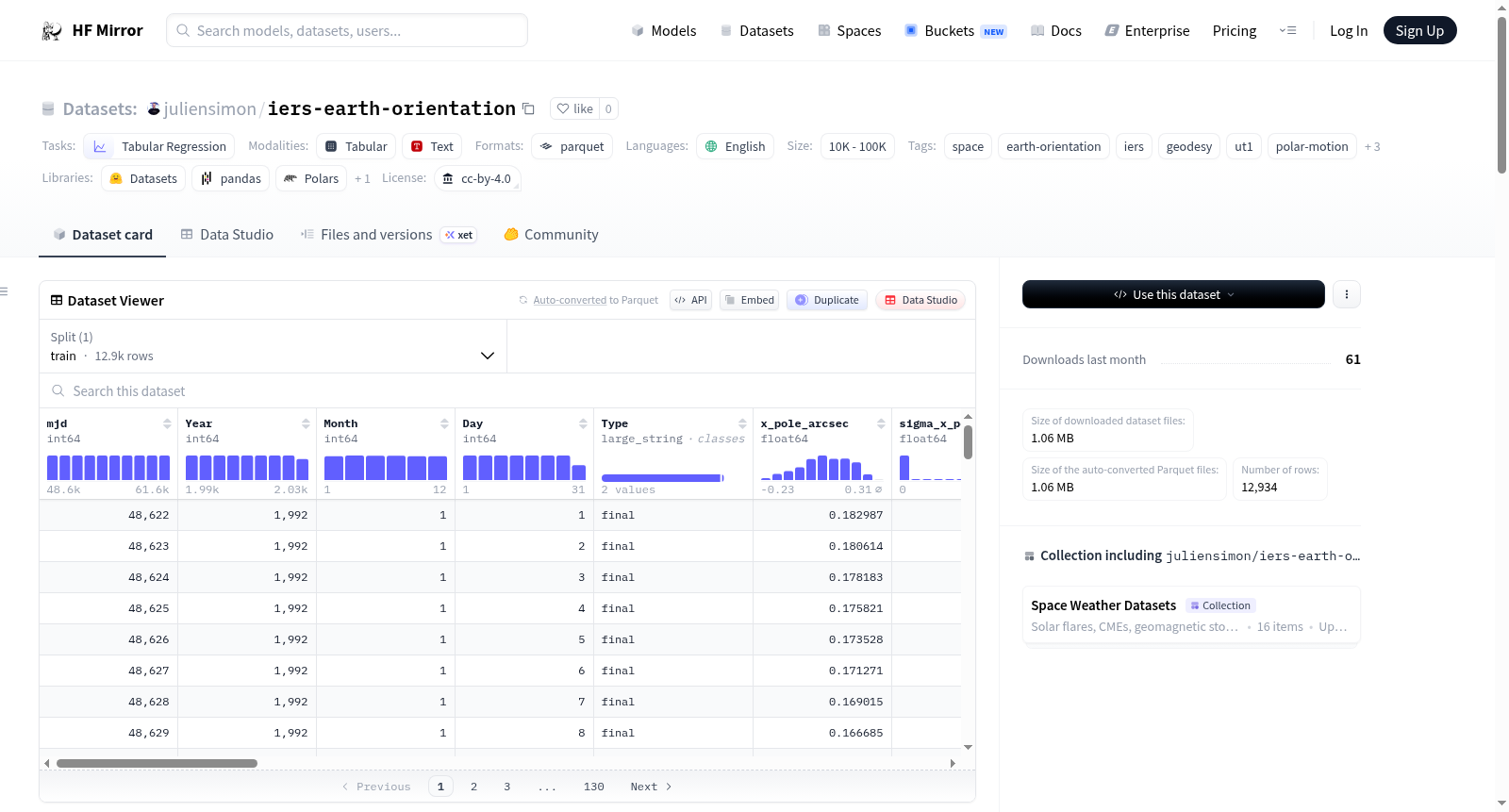
| Column | Type | Description |
|--------|------|-------------|
| `date` | datetime | Calendar date (UTC) |
| `mjd` | float64 | Modified Julian Date |
| `x_pole_arcsec` | float64 | Pole coordinate x (arcseconds) |
| `y_pole_arcsec` | float64 | Pole coordinate y (arcseconds) |
| `ut1_utc_sec` | float64 | UT1-UTC difference (seconds) |
| `lod_ms` | float64 | Length of Day excess (milliseconds) |
| `dx_mas` | float64 | Celestial pole offset dX (milliarcseconds) |
| `dy_mas` | float64 | Celestial pole offset dY (milliarcseconds) |
## Quick stats
- **12,927** daily records (1992-01-01 to 2027-05-23)
## Usage
```python
from datasets import load_dataset
ds = load_dataset("juliensimon/iers-earth-orientation", split="train")
df = ds.to_pandas()
# Recent UT1-UTC values
recent = df[df["date"] > "2025-01-01"].sort_values("date")
print(recent[["date", "ut1_utc_sec", "x_pole_arcsec", "y_pole_arcsec"]])
# Polar motion scatter plot
import matplotlib.pyplot as plt
fig, ax = plt.subplots(figsize=(8, 8))
ax.scatter(df["x_pole_arcsec"], df["y_pole_arcsec"], s=0.5, alpha=0.3)
ax.set_xlabel("x pole (arcsec)")
ax.set_ylabel("y pole (arcsec)")
ax.set_title("Polar Motion")
plt.show()
```
## Data source
[International Earth Rotation and Reference Systems Service (IERS)](https://www.iers.org/)
finals2000A data series from the IERS Earth Orientation Centre.
## Update schedule
Daily at 13:00 UTC via [GitHub Actions](https://github.com/juliensimon/space-datasets).
## Pipeline
Source code: [juliensimon/space-datasets](https://github.com/juliensimon/space-datasets)
## Support
If you find this dataset useful, please give it a ❤️ on the [dataset page](https://huggingface.co/datasets/juliensimon/iers-earth-orientation) and share feedback in the Community tab! Also consider giving a ⭐️ to the [space-datasets](https://github.com/juliensimon/space-datasets) repo.
## Citation
```bibtex
@dataset{iers_earth_orientation,
author = {Simon, Julien},
title = {IERS Earth Orientation Parameters},
year = {2026},
publisher = {Hugging Face},
url = {https://huggingface.co/datasets/juliensimon/iers-earth-orientation},
note = {Based on IERS finals2000A Earth Orientation Parameters}
}
```
## License
[CC-BY-4.0](https://creativecommons.org/licenses/by/4.0/)
提供机构:
juliensimon
搜集汇总
数据集介绍
构建方式
在地球定向参数研究领域,数据集的构建依赖于国际地球自转与参考系服务提供的权威观测序列。该数据集整合了IERS finals2000A系列数据,涵盖自1992年1月1日至2027年5月30日的每日记录,通过甚长基线干涉测量、卫星激光测距和全球定位系统等多种大地测量技术采集原始观测值,并结合未来约一年的预测数据形成连续时间序列。数据以Parquet格式存储,通过自动化工作流每日更新,确保了数据的时效性与完整性,为地球自转动力学研究提供了可靠的基础资料。
特点
本数据集的核心特征在于其高精度与多维参数覆盖,完整收录了极移坐标、世界时与协调时差值、日长变化以及章动偏移等关键地球定向参数。数据时间跨度长达三十余年,不仅包含历史观测记录,还融入了基于模型的预测值,能够支持从短周期波动到长期趋势的全面分析。参数以角秒、毫秒等标准单位呈现,物理意义明确,便于直接应用于卫星定轨、深空导航和大地测量等专业场景,体现了地球自转监测数据的科学价值与应用潜力。
使用方法
使用该数据集时,可通过Hugging Face的datasets库直接加载,并利用Pandas进行灵活的数据处理与分析。研究人员可以提取特定时间段的参数序列,例如筛选近年来的UT1-UTC数据以研究地球自转速率变化,或绘制极移坐标的散点图可视化地极运动轨迹。数据集的结构化设计支持回归建模、时间序列预测等机器学习任务,同时其每日更新机制确保了模型能够基于最新观测值进行训练与验证,为空间天气与地球物理研究提供了动态数据支撑。
背景与挑战
背景概述
地球定向参数作为大地测量学与空间科学的核心观测要素,其精确测定对于构建天球与地球参考架之间的转换至关重要。国际地球自转与参考系统服务自上世纪九十年代起,通过整合甚长基线干涉测量、卫星激光测距及全球定位系统等多源观测数据,发布了finals2000A系列产品,系统记录了自1992年以来的极移、UT1-UTC时差及章动偏移等参数。该数据集由Julien Simon等人于2026年整理并发布于Hugging Face平台,旨在为卫星轨道确定、全球导航卫星系统精密定位、深空探测天线指向等应用提供标准化、持续更新的基础数据,显著推动了高精度时空参考框架在航天工程与地球科学领域的实际应用。
当前挑战
在地球定向参数所针对的领域问题中,主要挑战在于地球自转的不规则性受多尺度物理过程驱动,包括地幔后冰期回弹引起的极移长期漂移、大气与海洋角动量交换导致的短周期波动,以及地核-地幔耦合引发的十年尺度起伏,这些复杂动力学机制使得高精度预测与建模极为困难。在数据集构建过程中,挑战则体现在多源异构观测数据的融合与质量控制上,需协调不同技术(如VLBI、SLR、GPS)在精度、采样率与系统偏差方面的差异,并确保数据序列在长期跨度内的一致性;同时,每日更新的运维机制要求自动化流程能可靠处理IERS数据源的格式变化与潜在异常,以维持数据集的时效性与完整性。
常用场景
经典使用场景
在地球科学和空间技术领域,地球定向参数是连接天球与地面参考系的关键桥梁。该数据集最经典的使用场景在于为卫星轨道确定、全球导航卫星系统(GNSS)高精度定位以及深空探测器的天线指向校准提供基础数据。研究人员利用这些时序参数,能够精确建模地球自转轴在空间中的复杂运动,包括极移、UT1-UTC差异以及章动偏移,从而确保从近地轨道到星际空间的各种观测与操作在统一的时空框架下进行。
解决学术问题
该数据集系统地解决了地球自转动力学研究中的若干核心问题。它使得学者能够定量分析地球自转速率的不规则变化、极移的周期性波动(如钱德勒摆动和周年摆动)及其驱动机制,包括大气、海洋角动量交换以及地核-地幔耦合效应。通过提供高精度的观测与预测数据,它支撑了对地球系统质量重新分布、固体地球与流体圈层相互作用等前沿科学问题的探索,将地球自转变化从现象描述提升至物理机制理解的层面。
衍生相关工作
围绕该数据集,学术界和工程界衍生了一系列经典研究工作。在科学层面,它催生了改进的地球自转预测模型、更精细的地球物理激发源研究以及对国际天球参考框架(ICRF)的持续精化。在技术应用领域,基于此数据开发了实时数据同化系统,用于增强GNSS和卫星激光测距(SLR)的数据处理流程。同时,它也作为基准数据,支撑了国际地球自转服务(IERS)发布的多项标准产品和预警服务,形成了从基础研究到业务化应用的完整链条。
以上内容由遇见数据集搜集并总结生成



