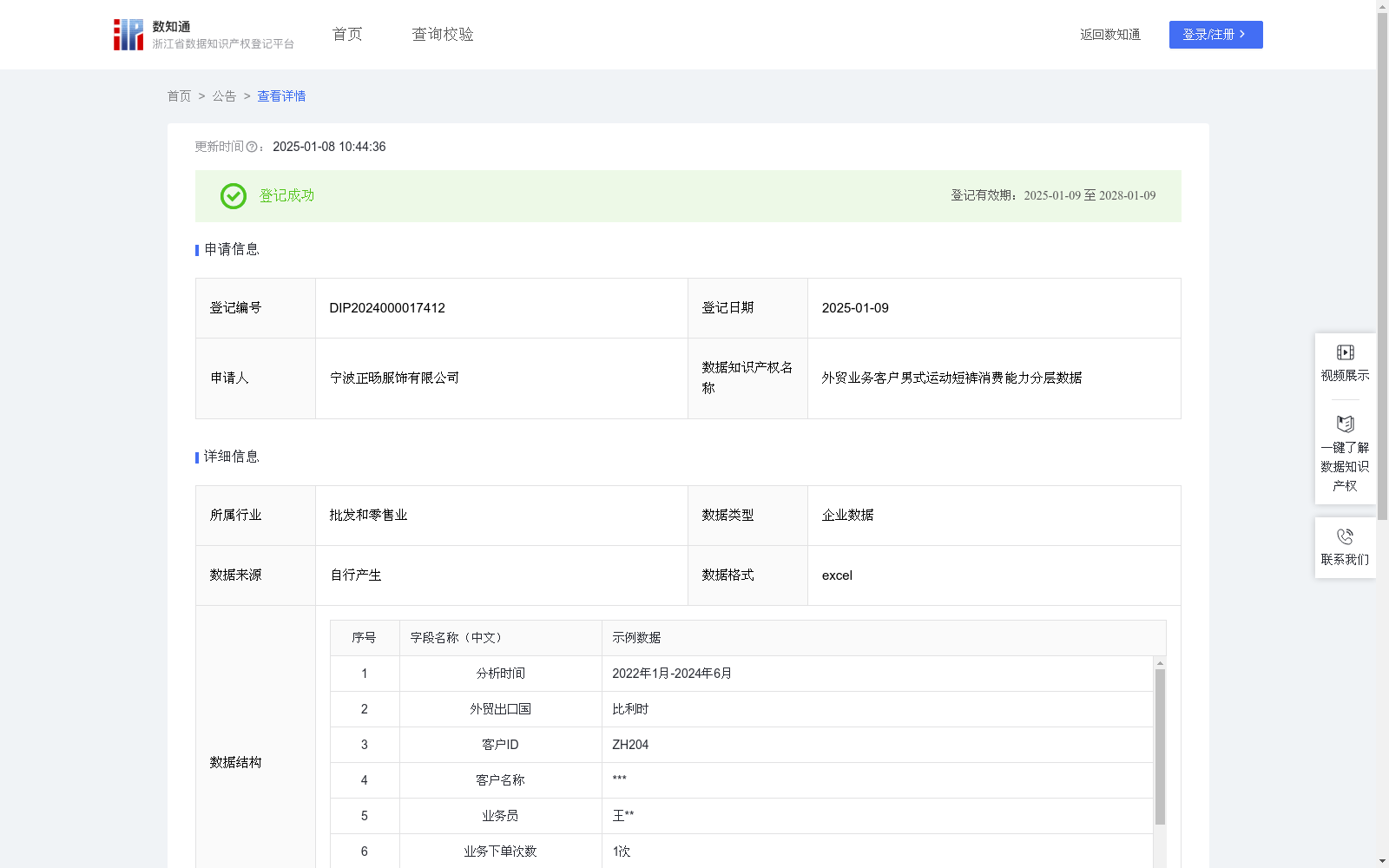
外贸业务客户男式运动短裤消费能力分层数据
收藏资源简介:
服装外贸出口规模在全球市场中占据重要地位,本数据基于公司外贸业务经营中客户消费能力统计分层数据,通过分析公司外贸业务记录中客户,出口地、下订单次数、下订单数量等数据,了解各出口地的客户对服装外贸产品的需求状况,映射出各种外贸产品的受欢迎程度和市场认知度,为供货商、品牌方以及外贸从业者提供了有力的数据支撑,指导其精准定位营销方向,优化内容策略,定制高效推广计划,进一步增强市场竞争力和品牌影响力。应用场景广泛,通过充分利用这些数据资源,可以更好地理解服装领域范围用户外贸业务需求,优化产品和服务,提升市场竞争力。1、数据采集:采集了公司业务管理系统CRM中男式运动短裤外贸业务销售数据,通过对历史外贸客户用户画像建立,对区域用户进行标签制定,定位区域外贸业务销售情况。2、数据计算:首先对敏感信息进行加密处理,对数据进行加工、脱敏、筛选、统计、分析。订单量占比(%)=男式运动短裤(件)/总订单数量(件)*100%。3、用户消费能力运用ABCD分类法,对订单量占比>15.00%的,给予“A类”用户分级;订单量占比>5.00%且≤15.00%区间的,给予“B类”用户分级;订单量占比>0.00%且≤5.00%区间的,给予“C类”用户分级;订单量占比≤0.00%的,给予“D类”用户分级,消费能力从A-D依次降低,A级为最高客户分级。
The scale of global clothing foreign trade exports occupies a pivotal position in the international market. This dataset is built upon stratified statistical data of customer consumption capacity derived from the company's foreign trade business operations. By analyzing data points including customer information, export destinations, order frequencies, and order volumes recorded in the company's foreign trade business records, this work aims to investigate the demand of customers in different export destinations for foreign trade clothing products, and reflect the popularity and market awareness of various foreign trade apparel products. It provides robust data support for suppliers, brand owners, and foreign trade practitioners, enabling them to accurately position marketing directions, optimize content strategies, formulate efficient promotion plans, and further enhance their market competitiveness and brand influence. This dataset has broad application scenarios. By fully leveraging these data resources, relevant stakeholders can gain a deeper understanding of the foreign trade business demands of users in the clothing sector, optimize products and services, and improve overall market competitiveness. 1. Data Collection: Sales data of men's sports shorts foreign trade business is extracted from the company's CRM (Customer Relationship Management) system. User personas for historical foreign trade customers are established, and tags are formulated for regional users to identify the regional foreign trade sales performance. 2. Data Processing and Calculation: Sensitive information is first encrypted, followed by data processing, desensitization, filtering, statistical analysis and evaluation. The order quantity proportion (%) is calculated as: (Number of men's sports shorts orders / Total number of orders) * 100%. 3. User Consumption Capacity Grading: The ABCD classification method is applied to grade users. Users with an order quantity proportion greater than 15.00% are classified as "Class A"; those with an order quantity proportion in the range of >5.00% and ≤15.00% are classified as "Class B"; those with an order quantity proportion in the range of >0.00% and ≤5.00% are classified as "Class C"; and those with an order quantity proportion ≤0.00% are classified as "Class D". The consumption capacity decreases sequentially from Class A to Class D, with Class A representing the highest-tier customers.