PITg-Curated
收藏资源简介:
PITg-Curated是一个专为聚酰亚胺玻璃化转变温度预测及结构设计而构建的精选数据集,由大连理工大学研究团队创建。该数据集包含10066条去重后的聚酰亚胺重复单元结构,并标注了对应的玻璃化转变温度(Tg)标签。数据集的构建过程包括从现有数据资源收集聚酰亚胺结构,经过严格的去重和清洗,确保每个重复单元唯一且具有可靠的Tg信息。该数据集主要用于聚酰亚胺结构-性质关系建模,支持目标条件下的结构生成、性能预测及候选结构推荐,旨在解决传统聚酰亚胺设计中候选结构性质偏差大、实验验证成本高的问题。
PITg-Curated is a curated dataset specifically developed for polyimide glass transition temperature (Tg) prediction and structural design, created by the research team from Dalian University of Technology. This dataset contains 10,066 deduplicated repeating unit structures of polyimides, with corresponding glass transition temperature (Tg) labels annotated. The dataset construction workflow includes collecting polyimide structures from existing data resources, followed by strict deduplication and cleaning steps to ensure each repeating unit is unique and accompanied by reliable Tg information. This dataset is primarily used for polyimide structure-property relationship modeling, supporting structure generation under target conditions, performance prediction, and candidate structure recommendation, aiming to address the issues of large property deviation of candidate structures and high experimental verification costs in traditional polyimide design.
UniPolymer 数据集概述
项目简介
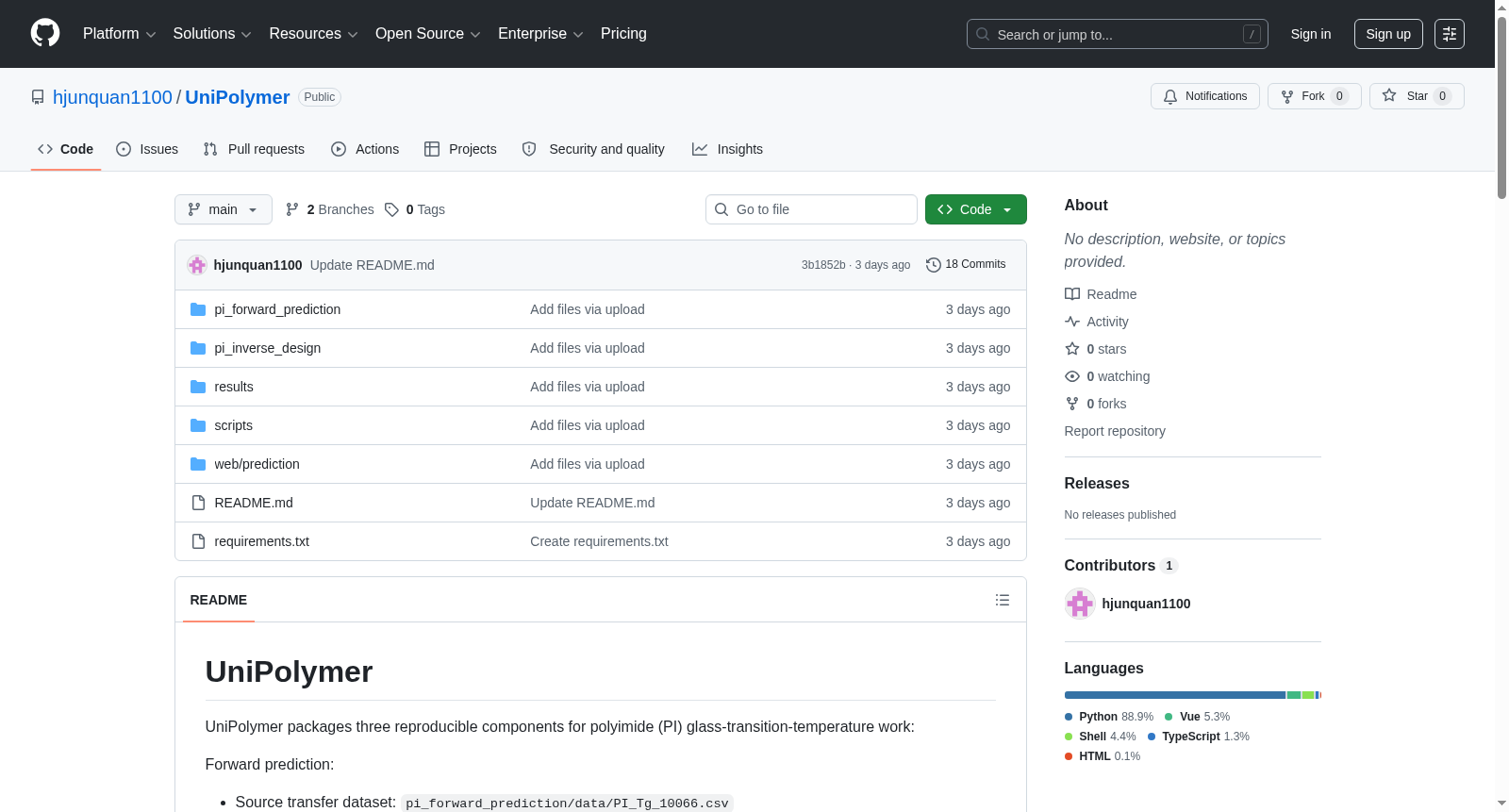
UniPolymer 是一个面向聚酰亚胺(PI)玻璃化转变温度(Tg)研究的数据集与工具包,提供正向预测和逆向设计两条完整流程。
数据集构成
基础数据集
- PI_Tg_10066.csv:统一项目数据集,包含 10,066 条数据,包含
smiles(化学结构)和tg(玻璃化转变温度)两个核心列。
正向预测数据
- PI_Tg_10066_with_desc_p1_m128.csv:完整 10,066 行的迁移训练表格,扩展至 145 列,包括
smiles、value、15 个标量描述符以及mfp_0至mfp_127共 128 个分子指纹特征。 - PI_Tg_10066_holdout80_p1_m128.csv:确定性的 80 行留出验证集,使用相同特征模式。
逆向设计数据
- data.xlsx:原始数据集转换格式,用于逆向设计脚本。
- processed/:处理后的 SELFIES 数据集,包含 2,290 个唯一的 RDKit 验证结构,可由当前 SELFIES 编码器表示。
模型检查点
正向预测模型
- 对比学习骨干网络:
contrastive_roberta/目录下 - 最佳 Tg 预测模型:
PI_Tg_best_model.pt
逆向设计模型
- 生成器检查点:
best_model_valloss_0.9011.pt,训练统计中tg_min=19.0,tg_max=460.0 - GBR 正向评估器:
forward_model_best_r2_0.8535.pkl
功能模块
- 正向预测:支持 SMILES 或图像输入,预测 Tg 值,Web 后端使用打包的检查点进行单 SMILES 预测。
- 逆向设计:给定目标 Tg,生成候选 PI 结构,可通过命令行或 Web 界面操作。
- Web 应用:提供
/(SMILES/图像到 Tg 预测)和/inverse(目标 Tg 到候选结构)两个界面。 - 终端演示:一键脚本生成演示结果。
使用说明
- 模型文件较大,需使用 Git LFS 管理。
- 推荐 Python 3.10 环境,通过 Conda 创建
unipolymer环境并安装依赖。 - 图像识别功能需要 DECIMER 及其模型文件;SMILES 预测和逆向生成无需 DECIMER。