
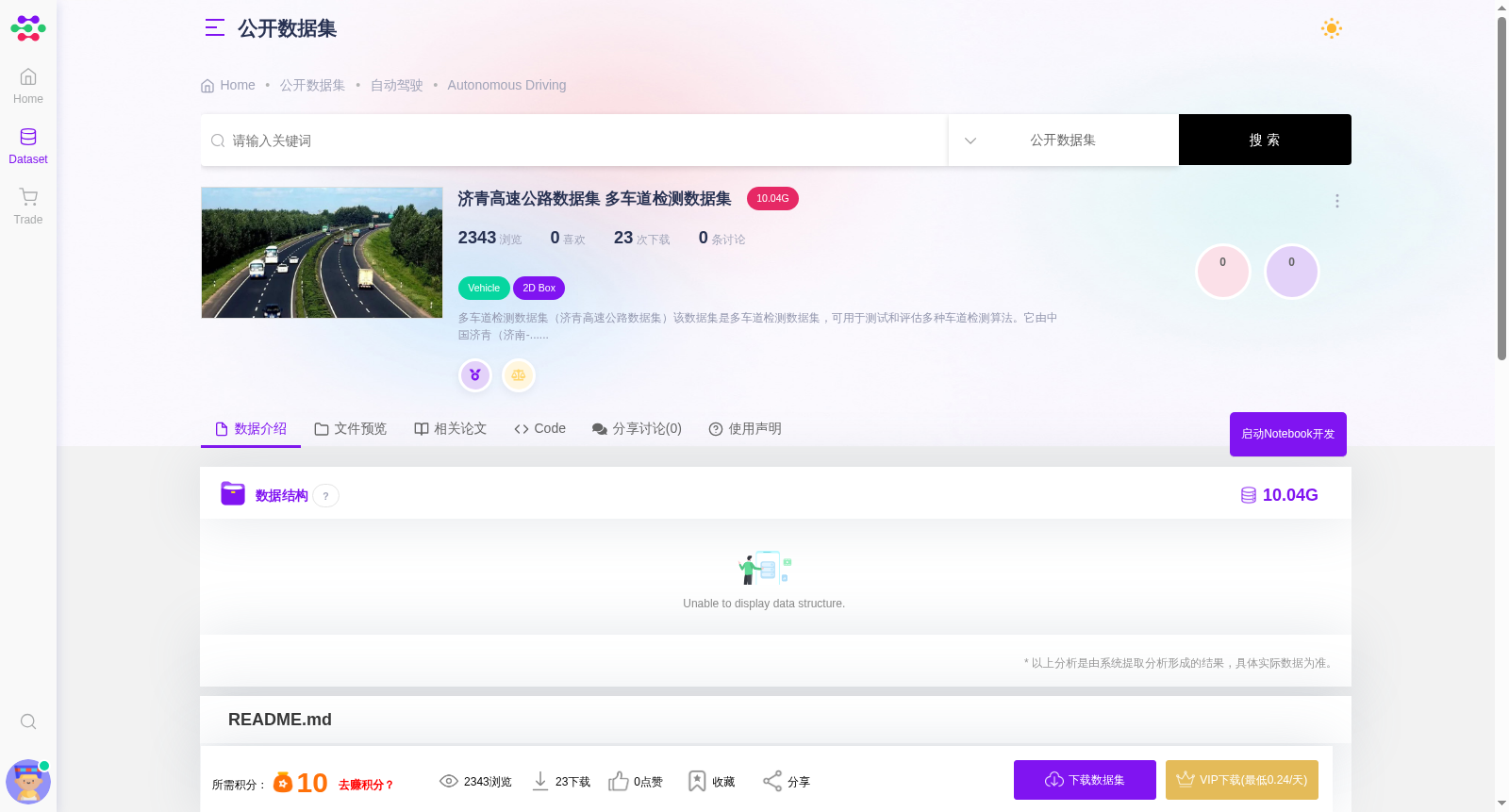
济青高速公路数据集 多车道检测数据集
收藏帕依提提2024-03-04 收录
下载链接:
https://www.payititi.com/opendatasets/show-26399.html
下载链接
链接失效反馈官方服务:
资源简介:
多车道检测数据集(济青高速公路数据集)该数据集是多车道检测数据集,可用于测试和评估多种车道检测算法。它由中国济青(济南-青岛)高速公路某些路段的路面行车记录仪收集,车道采用半手动方法标注(如下所述)。数据集中有40个视频剪辑,每个视频剪辑持续3分钟,帧速率为30 fps,视频分辨率为1920×1080。总共包含210610个具有不同照明强度和不同道路状况(上游,下坡,隧道,涵洞,坡道等)的道路图像。 此外,我们在每个帧中标记泳道,并将标记结果保存为txt文件。不同车道的关键特征点坐标(x,y)存储在不同的行中,车道“ x”(x = 0、1、2、3,...)用于表示车道序列号 车道注释的结果显示在下面的图2中。 通过集成自动识别和手动注释来构造数据集。自动识别模块由C ++和opencv库实现。车道提取流程图如图3所示。具体步骤如下: 1。加载视频或图像,并为初始帧手动标记ROI的初始位置。 2。将高斯平滑应用于ROI中的图像。根据透视关系,高斯核从近到远逐渐减小。因此,平滑图像中的车道线的边缘的灰度值较低,而中央骨架的灰度值较高。 3。对平滑图像执行非最大抑制,以提取车道骨架。 4。对车道骨架的像素点使用分段最小二乘法拟合。三次或二次拟合用于曲线车道,而线性拟合用于直线。 5。如果拟合结果与测试结果一致,则通过分段采样存储拟合结果,并作为确定下一帧ROI的基础。否则,将手动重新标记框架。
Multi-lane Detection Dataset (Ji-Qing Expressway Dataset)
This dataset is a multi-lane detection dataset that can be used to test and evaluate various lane detection algorithms. It was collected using on-board dashboard cameras from certain sections of the Ji-Qing (Jinan-Qingdao) Expressway in China, with lanes annotated via a semi-manual method (as detailed below).
The dataset consists of 40 video clips, each with a duration of 3 minutes, a frame rate of 30 fps, and a resolution of 1920×1080. In total, it contains 210,610 road images captured under varying illumination conditions and diverse road scenarios, including uphill sections, downhill sections, tunnels, culverts, ramps, and others.
Furthermore, we annotated the lanes in every frame and saved the annotation results as txt files. The coordinates (x, y) of key feature points for different lanes are stored in separate lines, where lane "x" (x = 0, 1, 2, 3, ...) denotes the lane serial number. The lane annotation results are illustrated in Figure 2 below.
This dataset was constructed by integrating automatic recognition and manual annotation. The automatic recognition module was implemented using C++ and the OpenCV library. The flowchart for lane extraction is presented in Figure 3. The specific steps are as follows:
1. Load the video or image, and manually mark the initial position of the ROI (Region of Interest) for the initial frame.
2. Apply Gaussian smoothing to the image within the ROI. Based on the perspective projection relationship, the Gaussian kernel gradually decreases in size from near to far. Consequently, the gray values of the edges of lane lines in the smoothed image are relatively low, while those of the central skeleton are relatively high.
3. Perform Non-Maximum Suppression (NMS) on the smoothed image to extract the lane skeleton.
4. Fit the pixel points of the lane skeleton using piecewise least squares fitting. Cubic or quadratic fitting is employed for curved lanes, whereas linear fitting is used for straight lanes.
5. If the fitting result aligns with the test result, store the fitting result via segmented sampling and use it as the basis for determining the ROI of the next frame. Otherwise, manually re-annotate the frame.
提供机构:
帕依提提
搜集汇总
数据集介绍
背景与挑战
背景概述
该数据集是一个专注于多车道检测的自动驾驶领域数据集,基于中国济青高速公路的行车记录仪视频构建,包含210,610张高分辨率道路图像,覆盖多种照明和道路场景。数据集提供半手动标注的车道线坐标,适用于测试和评估车道检测算法,并采用自动识别与手动校正的方法确保标注准确性。
以上内容由遇见数据集搜集并总结生成


