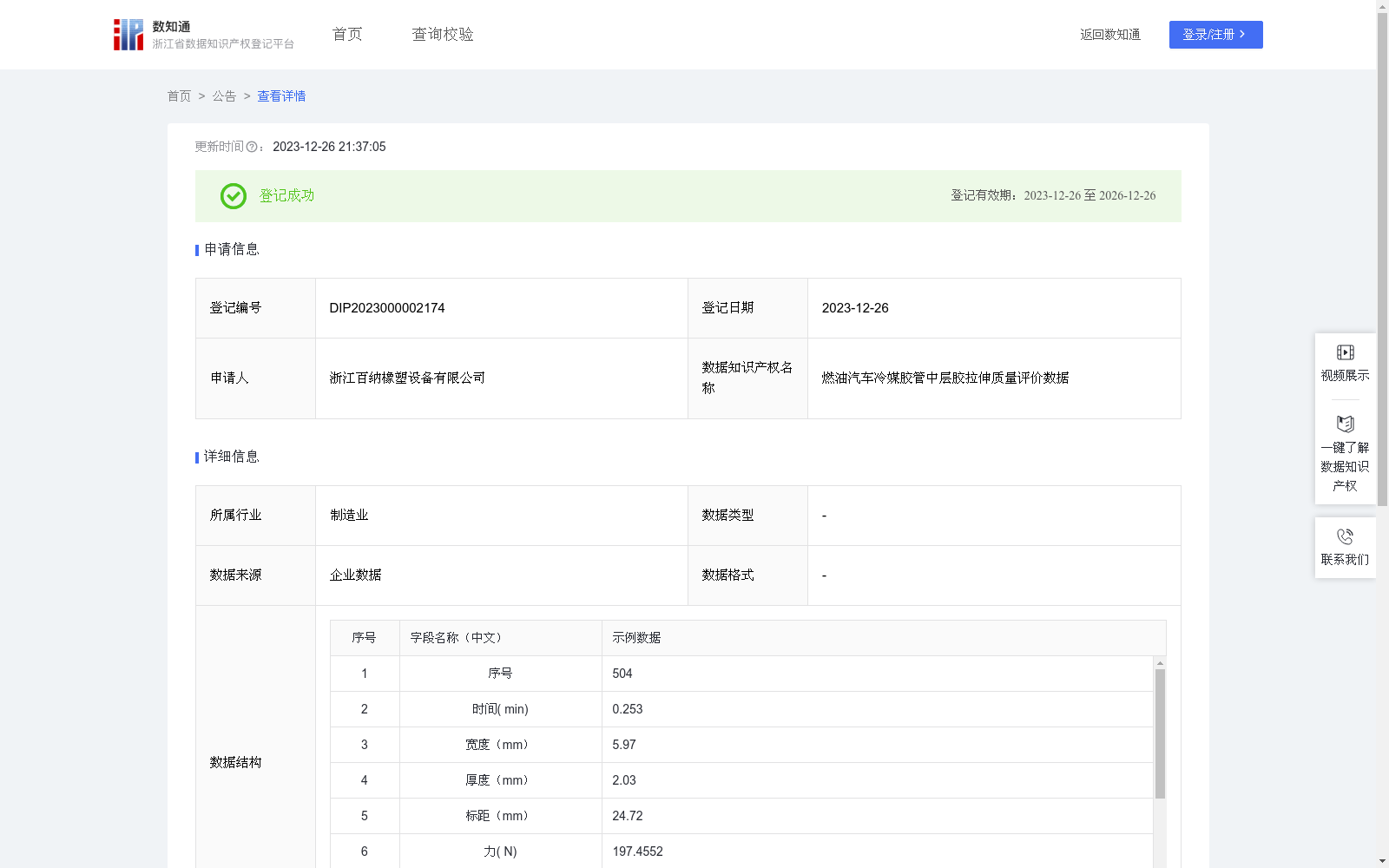
燃油汽车冷媒胶管中层胶拉伸质量评价数据
收藏资源简介:
现阶段燃油汽车空调系统为了适应环保的要求,普遍选用二氧化碳作为冷媒,对传统的氟氮碳化物作为冷媒的胶管提出了新的技术要求,且中层胶作为连接内外层胶层的夹层,拉伸性能对胶管的力学性能影响十分明显。在动夹持器或滑轮恒速移动的拉力试验机上,将哑铃状标准试样进行拉伸,按要求记录试样在不断拉伸过程中和当其断裂时所需的力和伸长率的值,根据公式变形量÷标准基线的宽度×100%=应变(%)、力值÷(厚度×宽度)=应力(MPa)进行计算得出断裂伸长率、拉伸强度等拉伸性能结果,并将算出的性能结果与国家标准或客户技术要求进行对比判断,用于评价该产品拉伸质量是否合格,用于作出是否需要改进生产工艺、生产配方和该产品是否符合客户要求的判定依据。算法规则简要说明:1、样品采集:用专用裁刀取胶管内层胶制成标准I型哑铃状试样,用测厚仪和游标卡尺分别测出待测样条的厚度和宽度,并画出两条间隔25mm±0.5mm的标准基线,并测量实际基线宽度; 2、样品测试:将试样对称地夹在拉力试验机的上、下夹持器上,使拉力均匀地分布在待测样条的横截面上,拉伸速度设置为500±50mm/min,点击触控面板上的"开始"按钮进行测试 ; 3.数据采集:每组样品测试完成之后导出变形量(mm)和力值(N);4、数据计算:变形量÷标准基线的宽度×100%=应变(%);力值÷(厚度×宽度)=应力(MPa);5、根据该样品的技术要求,应力最大值≥15MPa,且应变最大值≥250%即判定为合格,任一参数不满足技术要求即记为不合格品,用于作出是否需要改进生产工艺或生产配方的判定依据。
Currently, carbon dioxide is widely used as the refrigerant in fuel vehicle air conditioning systems to meet environmental protection requirements, which puts forward new technical requirements for hoses that traditionally use fluorine-nitrogen-carbon compounds as refrigerants. As the interlayer connecting the inner and outer rubber layers, the tensile properties of the middle rubber layer have a significant impact on the mechanical properties of the hose. Standard dumbbell-shaped specimens are stretched on a tensile testing machine with constant-speed moving movable grips or pulleys. The force and elongation values required during continuous stretching and at the moment of specimen fracture are recorded as required. Tensile performance results such as elongation at break and tensile strength are calculated using the formulas: Strain (%) = (Displacement / Standard Gauge Line Width) × 100%, Stress (MPa) = Force / (Thickness × Width). The calculated performance results are compared with national standards or customer technical requirements to evaluate whether the tensile quality of the product is qualified, and serve as the judgment basis for determining whether production processes and formulas need to be improved and whether the product meets customer requirements. Brief description of the algorithm rules: 1. Sample collection: Use a specialized cutting die to cut the inner rubber of the hose into standard Type I dumbbell-shaped specimens. Measure the thickness and width of the test strip using a thickness gauge and vernier caliper respectively, draw two standard gauge lines spaced 25mm ±0.5mm apart, and measure the actual gauge line width. 2. Sample testing: Symmetrically clamp the specimen on the upper and lower grips of the tensile testing machine to ensure uniform force distribution across the cross-section of the test strip. Set the tensile speed to 500±50 mm/min, and click the "Start" button on the touch panel to conduct the test. 3. Data collection: Export the displacement (mm) and force (N) after each group of samples is tested. 4. Data calculation: Strain (%) = (Displacement / Standard Gauge Line Width) × 100%; Stress (MPa) = Force / (Thickness × Width). 5. Judgment criteria: According to the technical requirements of the sample, the product is judged as qualified only if the maximum stress ≥15 MPa and the maximum strain ≥250%. If either parameter fails to meet the technical requirements, it is recorded as a non-conforming product. This serves as the judgment basis for determining whether production processes or formulas need to be improved.