NOAA Antarctic UV Monitoring Network
收藏资源简介:
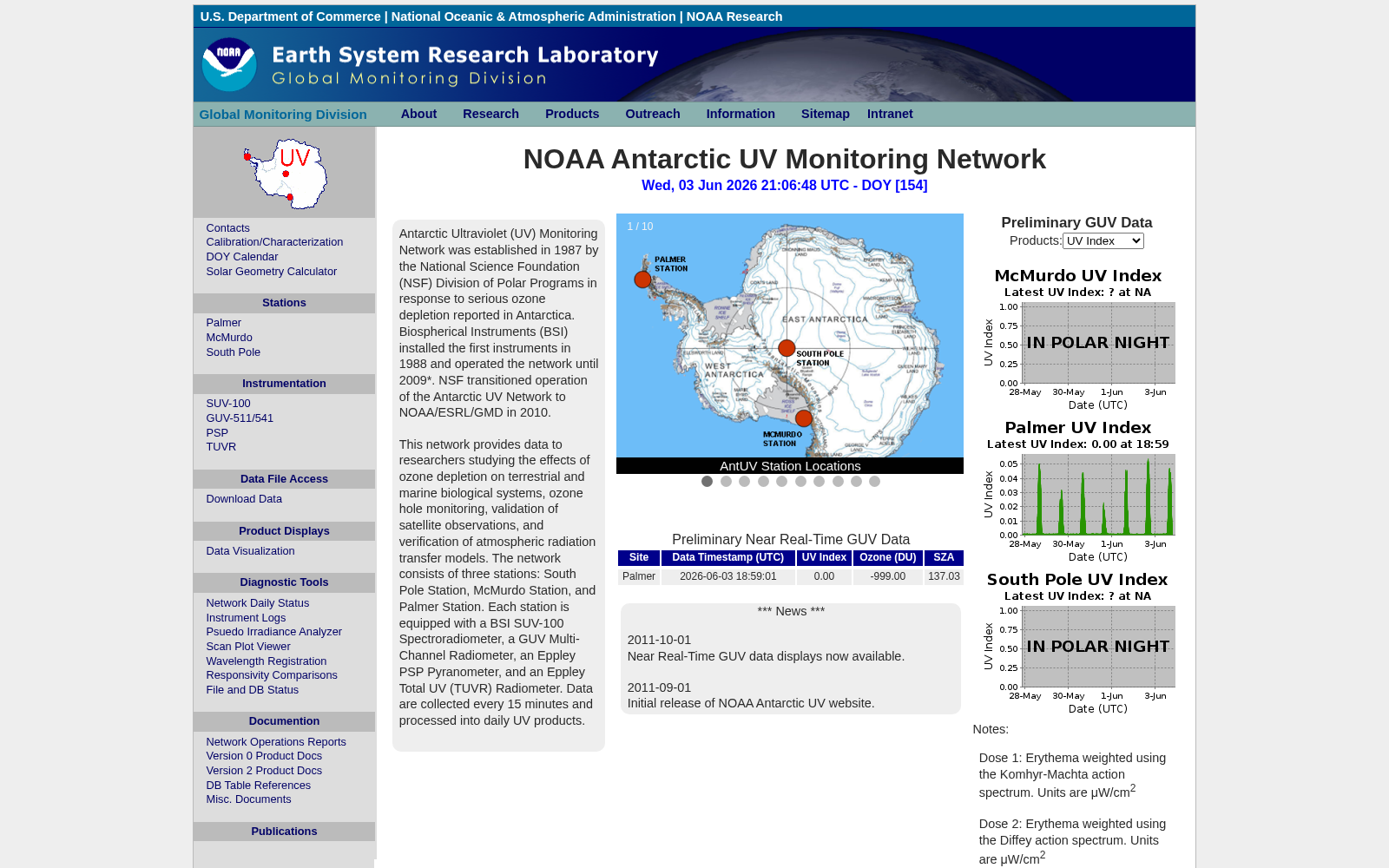
The Antarctic Ultraviolet (UV) Monitoring Network was established in 1987 by the National Science Foundation (NSF) Division of Polar Programs in response to serious ozone depletion reported in Antarctica. Biospherical Instruments (BSI) installed the first instruments in 1988 and operated the network until 2009*. NSF transitioned operation of the Antarctic UV Network to NOAA/ESRL/GMD in 2010. This network provides data to researchers studying the effects of ozone depletion on terrestrial and marine biological systems, ozone hole monitoring, validation of satellite observations, and verification of atmospheric radiation transfer models. *Data of the former NSF UV Monitoring Network and the current NOAA networks are now distributed via the website, which also provides extensive information on the network's instrumentation, data processing, quality control, and data format.
南极紫外(UV)监测网络由美国国家科学基金会(National Science Foundation, NSF)极地项目部门于1987年设立,旨在应对当时南极洲报告的严重臭氧损耗问题。1988年,生物球面仪器公司(Biospherical Instruments, BSI)布设了首批监测仪器,并负责运营该网络直至2009年*。2010年,美国国家科学基金会将南极紫外监测网络的运营管理权移交至美国国家海洋和大气管理局/地球系统研究实验室/全球监测分部(NOAA/ESRL/GMD)。该网络可为开展臭氧损耗对陆地与海洋生物系统影响、臭氧空洞监测、卫星观测数据验证以及大气辐射传输模型校验等研究的科研人员提供数据支撑。* 原隶属于美国国家科学基金会的紫外监测网络,以及当前由NOAA运维的该网络相关数据,现已通过该官方网站对外分发;网站同时提供了关于该网络的仪器配置、数据处理流程、质量控制规范以及数据格式的详尽说明。