MP-fragment-ESWA-dataset
收藏资源简介:
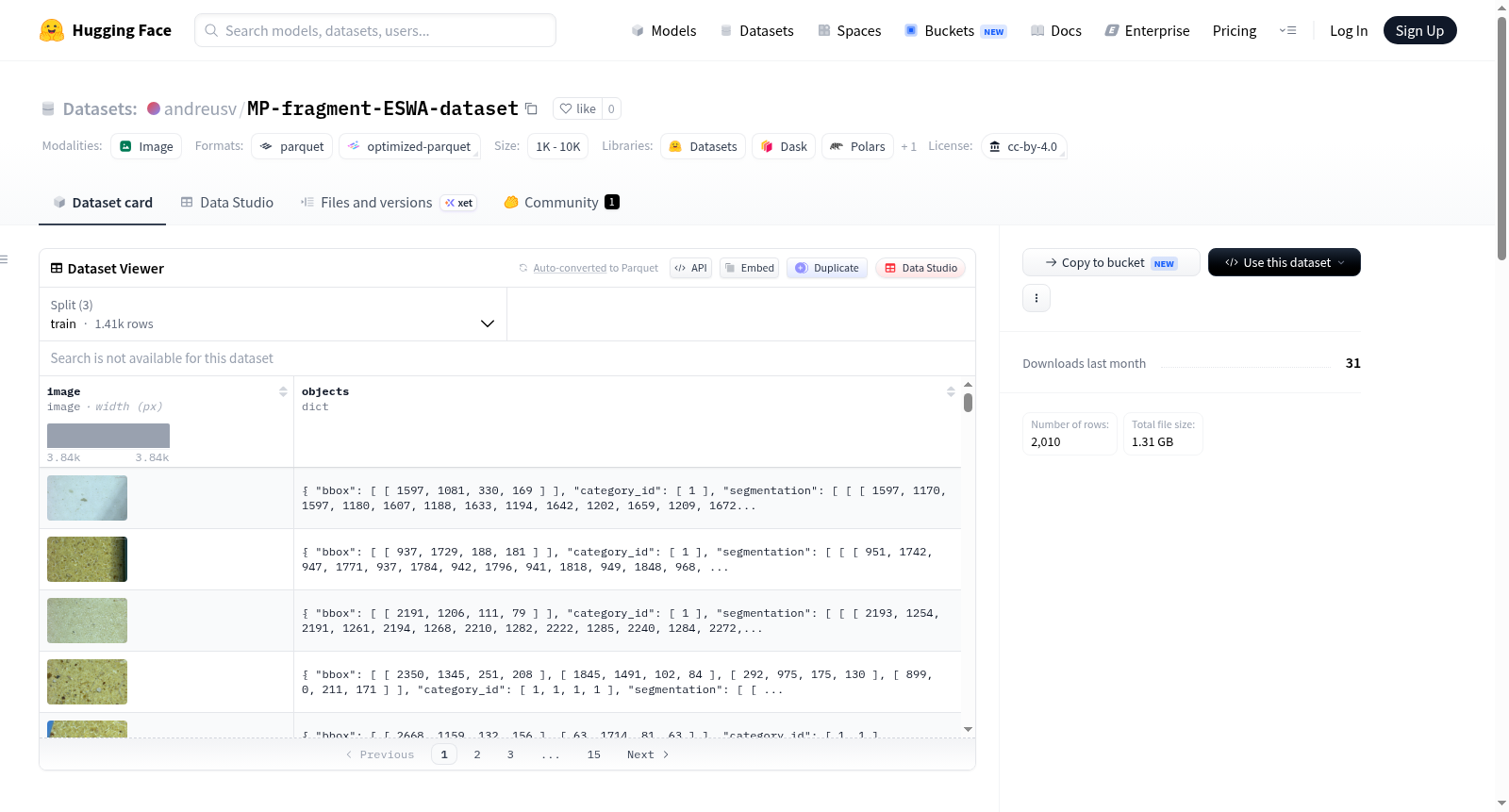
MP-fragment-ESWA-dataset 是一个专门用于计算机视觉的数据集,旨在训练和评估深度学习模型,以在高度复杂的真实世界环境中检测和分割微塑料(MP)碎片。该数据集包含2010张经过标注的高分辨率图像,捕捉了污泥处理的不同阶段,图像采集自西班牙瓦伦西亚一个运营中的污水处理厂(WWTP)的污泥线。标注包括边界框和多边形分割掩码,支持单阶段检测器、两阶段框架和基础模型。数据集通过提供在复杂有机背景下的碎片图像(而非理想实验室条件),解决了环境监测中的一个关键空白。数据收集涉及严格的化学处理流程:样品经过氧化(使用H2O2)、过滤(使用5µm孔径的醋酸纤维素滤膜)和干燥(60°C)处理。图像使用连接LAS X1软件的Leica S APO Zoom 80:10x立体显微镜采集,放大倍率为42x、32x、20x和16x,每张图像的右上角都嵌入了比例尺。数据集以Hugging Face DatasetDict形式提供,包含预定义的训练集(1406个样本)、验证集(302个样本)和测试集(302个样本)划分。每个样本包含两个主要特征:image(解码后的视觉表示,原始为3840x2160像素的JPG图像)和objects(一个包含地面实况标注的序列,结构化为字典,包含COCO标准格式的边界框[xmin, ymin, width, height]、多边形分割掩码点[x0, y0, ..., xn, yn]、类别标签和面积计算)。探索性数据分析显示,50%的图像恰好包含一个碎片,90%的图像包含四个或更少的碎片;数据集捕捉了广泛的碎片尺度,大多数实例的边界框相对面积占图像总面积的30%。使用注意事项包括:标注由专业人员手动完成,区分高度降解的塑料与周围碎片涉及主观判断;数据集专门针对微塑料碎片,其他形态(如合成纤维)代表性不足或完全排除;仅基于此数据集训练的模型在部署到不同地理来源(如海洋环境)或不同化学处理流程的样本时需要谨慎评估。
MP-fragment-ESWA-dataset is a computer vision dataset specifically designed for training and evaluating deep learning models to detect and segment microplastic (MP) fragments in highly complex real-world environments. It contains 2010 annotated high-resolution images capturing different stages of sludge treatment, collected from the sludge line of an operational wastewater treatment plant (WWTP) in Valencia, Spain. Annotations include bounding boxes and polygon segmentation masks, supporting one-stage detectors, two-stage frameworks, and foundational models. The dataset addresses a critical gap in environmental monitoring by providing images of fragments in complex organic backgrounds rather than ideal laboratory conditions. Data collection involves rigorous chemical processing: samples undergo oxidation (using H2O2), filtration (using cellulose acetate filters with 5µm pore size), and drying (at 60°C). Images are acquired using a Leica S APO Zoom 80:10x stereomicroscope connected to LAS X1 software, at magnifications of 42x, 32x, 20x, and 16x, with a scale bar embedded in the upper right corner of each image. The dataset is provided in Hugging Face DatasetDict format with predefined splits: training set (1,406 samples), validation set (302 samples), and test set (302 samples). Each sample includes two main features: image (a decoded visual representation, originally JPG images of 3840x2160 pixels) and objects (a sequence of ground truth annotations structured as dictionaries, containing bounding boxes [xmin, ymin, width, height] in COCO standard format, polygon segmentation mask points [x0, y0, ..., xn, yn], category labels, and area calculations). Exploratory data analysis shows that 50% of images contain exactly one fragment, and 90% contain four or fewer fragments; the dataset captures a wide range of fragment scales, with most instances having bounding boxes covering about 30% of the total image area. Usage notes include: annotations are manually done by professionals with subjective judgment in distinguishing highly degraded plastics from surrounding debris; the dataset is specific to microplastic fragments, with other forms (e.g., synthetic fibers) underrepresented or excluded; models trained solely on this dataset should be carefully evaluated when deployed to samples from different geographic sources (e.g., marine environments) or with different chemical processing protocols.