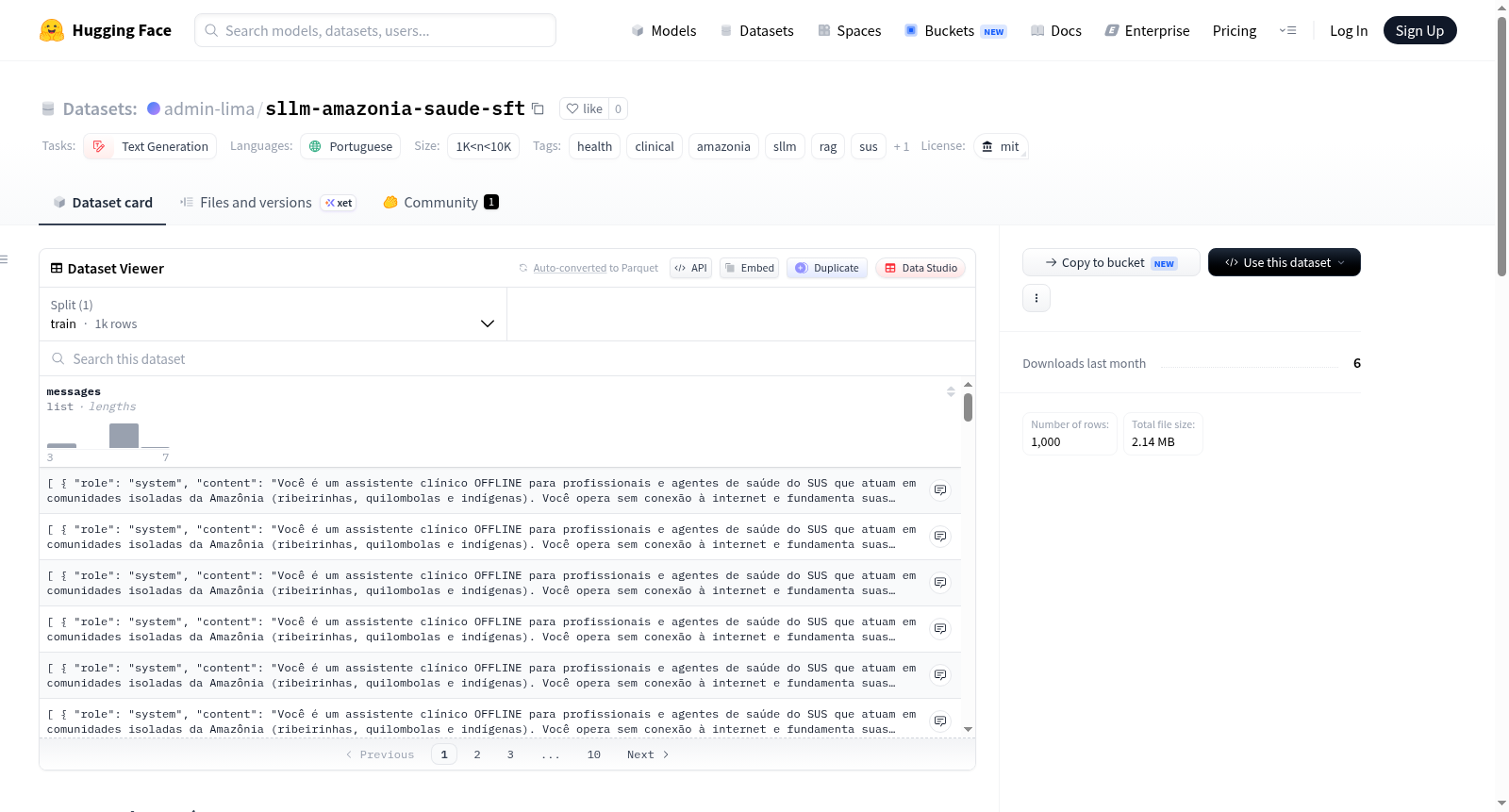
sllm-amazonia-saude-sft
收藏资源简介:
sLLM Amazônia Saúde SFT 是一个专为微调小语言模型(sLLMs)而设计的合成数据集,旨在为巴西亚马逊地区偏远、孤立社区(如河岸社区、逃亡黑奴社区和原住民社区)提供离线临床助手支持。该数据集包含1000个巴西葡萄牙语临床对话,其核心目标是使语言模型适应亚马逊地区的特定语言风格、临床领域和文化背景,并融入区域术语(如rabeta, bubuia, baque, pajé, igarapé)。数据集特别强调安全行为建模,其中18.5%的对话场景专门设计了“拒绝回答”的范例,即当临床专业人员询问的用药剂量信息在提供的上下文中缺失时,助手会基于安全原则明确拒绝并提供指导(如建议查阅官方协议),而非猜测或生成不准确信息。数据构成方面,1000个样本均衡分布在两个支柱领域:P3(土著健康,490个样本)和P5(初级卫生保健,510个样本),共覆盖16个不同的临床场景(每个场景包含56至67个样本)。数据格式采用多轮对话的`messages`结构,包含system、user和assistant角色。总计约405,000个token,平均每个样本包含405个token,助手平均回复轮次为1.8轮。数据集主要用于文本生成任务,特别是面向健康、临床、亚马逊地区语境的小型语言模型的监督微调(SFT)或QLoRA微调,以支持检索增强生成(RAG)等应用场景。需要注意的是,数据集中的临床上下文为合成生成并用于说明目的,在实际生产部署中,建议通过RAG管道替换为巴西统一卫生系统(SUS)的官方协议文本。
sLLM Amazônia Saúde SFT is a synthetic dataset designed for fine-tuning small language models (sLLMs), aimed at providing offline clinical assistant support for remote and isolated communities in the Brazilian Amazon region (such as riverine communities, quilombola communities, and indigenous communities). The dataset contains 1,000 clinical dialogues in Brazilian Portuguese, with the core goal of adapting language models to the specific linguistic style, clinical domain, and cultural context of the Amazon region, incorporating regional terms (e.g., rabeta, bubuia, baque, pajé, igarapé). The dataset emphasizes safety behavior modeling, with 18.5% of dialogue scenarios specifically designed as refusal to answer examples, where the assistant explicitly refuses and provides guidance (such as recommending consulting official protocols) based on safety principles when medication dosage information is missing in the provided context, rather than guessing or generating inaccurate information. In terms of data composition, the 1,000 samples are evenly distributed across two pillar domains: P3 (Indigenous Health, 490 samples) and P5 (Primary Health Care, 510 samples), covering 16 different clinical scenarios (each with 56 to 67 samples). The data format uses a multi-turn dialogue `messages` structure, including system, user, and assistant roles. The total is approximately 405,000 tokens, with an average of 405 tokens per sample and an average of 1.8 assistant response turns per dialogue. The dataset is primarily used for text generation tasks, especially for supervised fine-tuning (SFT) or QLoRA fine-tuning of small language models in health, clinical, and Amazonian contexts, to support applications like retrieval-augmented generation (RAG). It is important to note that the clinical contexts in the dataset are synthetically generated for illustrative purposes; in actual production deployment, it is recommended to replace them with official protocol texts from the Brazilian Unified Health System (SUS) via RAG pipelines.
数据集概述:sLLM Amazônia Saúde SFT
该数据集是一个合成的巴西葡萄牙语临床对话数据集,用于对小型语言模型(sLLMs)进行微调(SFT/QLoRA),使其能够作为离线临床助手服务于亚马逊地区偏远社区。
基本信息
- 语言: 葡萄牙语 (pt)
- 许可证: MIT
- 任务类别: 文本生成
- 大小: 1,000 个样本 (1K < n < 10K)
- 标签: 健康、临床、亚马逊、sLLM、RAG、SUS、葡萄牙语
背景与目标
亚马逊地区的沿河、 quilombola 和原住民社区的卫生专业人员和社区工作者经常在没有网络连接的情况下工作。该数据集旨在使语言模型适应亚马逊地区的风格、语言领域和文化背景,包含区域术语(如 rabeta、bubuia、baque、pajé、igarapé),并具有安全行为(拒绝回答上下文中未提供的剂量信息)。
数据集构成
| 属性 | 值 |
|---|---|
| 样本总数 | 1,000 |
| 支柱划分 | P3(原住民健康)= 490;P5(初级保健)= 510 |
| 临床场景 | 16 个(每个场景 56-67 个样本) |
| 拒绝示例数量 | 185 (18.5%) |
| 令牌总数 / 平均 | ~405,000 / ~405 每样本 |
| 助理平均轮次 | 1.8(多轮对话) |
| 格式 | messages (system/user/assistant) |
数据结构
每条数据以 messages 格式存储,包含 system、user 和 assistant 三个角色。示例结构如下:
json {"messages": [ {"role": "system", "content": "Você é um assistente clínico OFFLINE..."}, {"role": "user", "content": "..."}, {"role": "assistant", "content": "..."} ]}
安全属性
18.5% 的样本属于拒绝场景:当专业人士请求的剂量信息不在已检索到的上下文中时,目标回答会基于理由拒绝请求,并建议查阅官方协议。
使用方式
python from datasets import load_dataset ds = load_dataset("admin-lima/sllm-amazonia-saude-sft", split="train")
注意事项
数据集中的上下文是合成且仅为说明性的。在生产环境中,应通过 RAG 方式替换为 SUS 的官方文本。