
Data and metadata supporting the article: PD-L1 immunohistochemistry for canine cancers and clinical benefit of anti-PD-L1 antibody in dogs with pulmonary metastatic oral malignant melanoma
收藏Mendeley Data2024-06-25 更新2024-06-27 收录
下载链接:
https://springernature.figshare.com/articles/dataset/Data_and_metadata_supporting_the_article_PD-L1_immunohistochemistry_for_canine_cancers_and_clinical_benefit_of_anti-PD-L1_antibody_in_dogs_with_pulmonary_metastatic_oral_malignant_melanoma/13385441
下载链接
链接失效反馈官方服务:
资源简介:
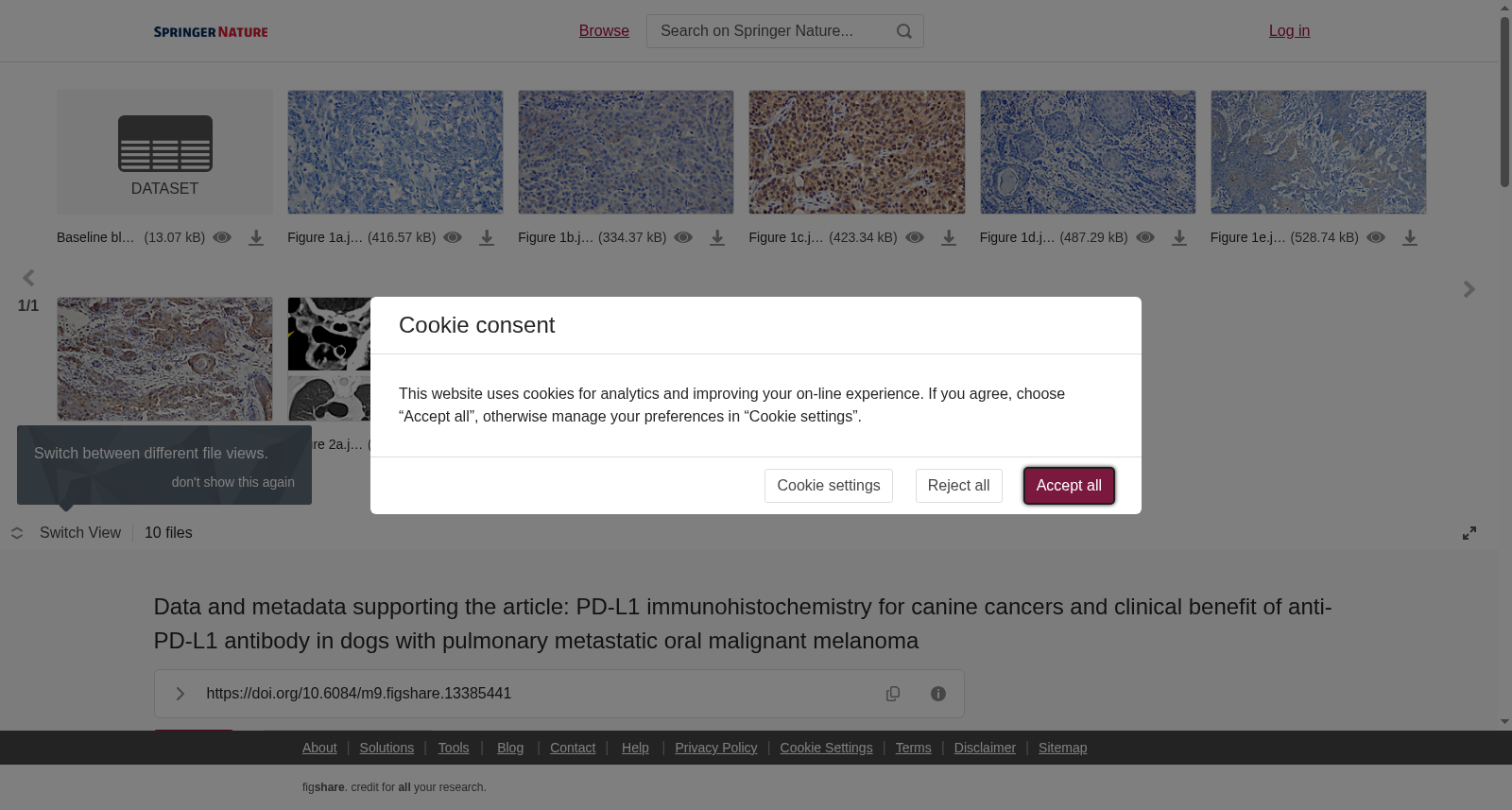
In the present study, canine Programmed death-ligand 1 (PD-L1) expression was assessed in various cancer types, using a new anti-PD-L1 mAb, 6C11-3A11, and the safety and efficacy of c4G12 were explored in 29 dogs with pulmonary metastatic oral malignant melanoma (OMM). Data access: High resolution immunohistochemistry (IHC) and computerized tomography (CT) images supporting figures 1 and 2 of the article, are available in the figshare repository, as part of this data record. Baseline blood test analysis data supporting figure 3, are also part of this figshare data record. The datasets supporting the survival analysis plots in figure 3, and all other data supporting the findings of the current study, are included in the supplementary files that accompany the article. Study approval and ethical compliance: The study was approved by the Institutional Animal Care Committee, Hokkaido University (Approval number: 15-0149) and the Faculty of Veterinary Medicine, Hokkaido University (Approval number: 15028). The use of animals throughout the clinical study was approved by the ethics committee, Faculty of Veterinary Medicine, Hokkaido University. Prior to study enrollment, written informed consent was obtained from both the dogs’ owner and veterinarian. Study aims and methodology: Immunotherapy targeting programmed cell death 1 (PD-1) and PD-ligand 1 (PD-L1) represents promising treatments for human cancers.Recent studies have demonstrated that the PD-1/PD-L1 pathway is also involved in immune evasion of canine cancers. Some canine cancers, including OMM, were reported to express PD-L1, and specific anti-PD-1/PD-L1 mAbs induced immune-cell activation in vitro. However, few studies have attempted to assess PD-L1 expression in various canine cancers, and there is currently no consensus on PD-L1 expression status in each cancer type. The authors of this study aimed to assess PD-L1 expression in various cancer types, including OMM, using a novel anti-PD-L1 mAb (6C11-3A11) and compared its sensitivity to 6G7-E1, a previously reported mAb for canine IHC.In addition, a recent pilot study demonstrated antitumor efficacy of a canine chimeric anti-PD-L1 mAb (c4G12) against canine OMM and undifferentiated sarcoma (n = 2), among a sample of 9 dogs. The authors further aimed to assess the efficacy and safety of c4G12, in dogs with pulmonary metastatic OMM, using a predetermined dosage regimen. A secondary objective included the exploration of factors predictive of survival, including known correlates of improved survival in anti-PD-1/PD-L1 therapy-treated patients; use of radiation therapy, C reactive protein (CRP) level and lymphocyte-to-monocyte ratio (LMR).Formalin-fixed and paraffin-embedded (FFPE) tissue samples were used for PD-L1 IHC. A new anti-PD-L1 mAb, 6C11-3A11, was used for ICH.In total, 29 dogs were enrolled in the study. PD-L1 expression in the primary tumors, obtained by surgical excision at prior surgeries or biopsies, was assessed by 6C11-3A11 IHC. Dogs were treated with c4G12 every 2 weeks at 2 mg or 5 mg/kg by intravenous administration using a syringe pump over 1 hour. For more details on the methodology, including evaluation of adverse events, evaluation of tumour response and evaluation of survival, please refer to the related article. Data supporting the findings of the study: The following image files are in .jpg file format and show PD-L1 immunohistochemistry data with 6C11-3A11: Figure 1a.jpg, Figure 1b.jpg, Figure 1c.jpg, Figure 1d.jpg, Figure 1e.jpg and Figure 1f.jpg. These are the high-resolution images included in figure 1 of the article. The following files are in .jpg file format and show computed tomography (CT) scans of dogs with oral malignant melanoma, that were receiving treatment with c4G12: Figure 2a.jpg, Figure 2b.jpg and Figure 2c.jpg. The dataset Baseline blood test.xlsx, is in .xlsx file format, and includes the blood test analysis data of 29 dogs at baseline. The file includes data on the baseline levels of C-Reactive Protein, lymphocyte-to-monocyte ratio, absolute lymphocyte count, and absolute monocyte count. Additional data supporting the findings of the current study, are included in the supplementary files that accompany the article.
本研究采用新型抗程序性死亡配体1(Programmed death-ligand 1, PD-L1)单克隆抗体(monoclonal antibody, mAb)6C11-3A11,对多种犬类癌症类型的PD-L1表达水平进行了检测,并针对29例伴肺转移的口腔恶性黑色素瘤(oral malignant melanoma, OMM)患犬,探究了c4G12的安全性与有效性。数据获取:支撑本文图1与图2的高分辨率免疫组织化学(immunohistochemistry, IHC)图像及计算机断层扫描(computed tomography, CT)图像,已作为本数据集的一部分上传至figshare知识库。支撑图3的基线血液检测分析数据,同样收录于该figshare数据集。支撑图3中生存分析图表的数据集,以及支撑本研究所有其他研究结果的数据集,均包含于本文附带的补充材料中。研究审批与伦理合规:本研究经北海道大学实验动物管理委员会(批准编号:15-0149)及北海道大学兽医学院(批准编号:15028)批准。本临床研究中动物的使用,亦获北海道大学兽医学院伦理委员会批准。在研究入组前,已获得所有患犬主人及执业兽医的书面知情同意。研究目的与方法:靶向程序性死亡蛋白1(programmed cell death 1, PD-1)与PD-L1的免疫治疗,是人类癌症极具前景的治疗手段。近期研究表明,PD-1/PD-L1通路同样参与犬类癌症的免疫逃逸过程。已有研究显示,包括OMM在内的部分犬类癌症可表达PD-L1,且特异性抗PD-1/PD-L1单克隆抗体可在体外诱导免疫细胞活化。然而,目前针对多种犬类癌症的PD-L1表达水平检测研究较少,且各犬类癌症类型的PD-L1表达状态尚无统一共识。本研究的首要目的为:采用新型抗PD-L1单克隆抗体6C11-3A11,对包括OMM在内的多种犬类癌症的PD-L1表达水平进行检测,并将其检测灵敏度与既往报道的犬类IHC用单克隆抗体6G7-E1进行对比。此外,前期一项先导研究显示,犬源嵌合抗PD-L1单克隆抗体c4G12在9只患犬的受试样本中,对OMM及未分化肉瘤展现出抗肿瘤活性。本研究进一步旨在通过预设给药方案,评估c4G12在伴肺转移OMM患犬中的有效性与安全性。次要研究目标包括探索生存预后预测因素,如抗PD-1/PD-L1治疗患者中已证实的生存改善相关因素:放射治疗使用情况、C反应蛋白(C reactive protein, CRP)水平及淋巴细胞-单核细胞比值(lymphocyte-to-monocyte ratio, LMR)。本研究采用福尔马林固定石蜡包埋(Formalin-fixed and paraffin-embedded, FFPE)组织样本进行PD-L1免疫组化检测,所用抗体为新型抗PD-L1单克隆抗体6C11-3A11。本研究共纳入29只患犬。通过既往手术切除或活检获取的原发肿瘤组织,采用6C11-3A11免疫组化法检测其PD-L1表达水平。患犬接受c4G12静脉给药治疗,给药方案为每2周1次,剂量为2 mg/kg或5 mg/kg,采用注射泵持续输注1小时。关于不良反应评估、肿瘤应答评估及生存评估等实验方法的更多细节,请参阅相关研究论文。研究结果支撑数据:以下为采用6C11-3A11进行PD-L1免疫组化检测的高分辨率图像文件(格式为.jpg):Figure 1a.jpg、Figure 1b.jpg、Figure 1c.jpg、Figure 1d.jpg、Figure 1e.jpg及Figure 1f.jpg,对应本文图1的高分辨率图像。以下为接受c4G12治疗的OMM患犬的CT扫描图像文件(格式为.jpg):Figure 2a.jpg、Figure 2b.jpg及Figure 2c.jpg。数据集《Baseline blood test.xlsx》格式为.xlsx,包含29只患犬的基线血液检测分析数据,涵盖C反应蛋白、淋巴细胞-单核细胞比值、绝对淋巴细胞计数及绝对单核细胞计数的基线水平。支撑本研究结果的其他额外数据,均包含于本文附带的补充材料中。
创建时间:
2023-06-28
搜集汇总
数据集介绍
以上内容由遇见数据集搜集并总结生成


