
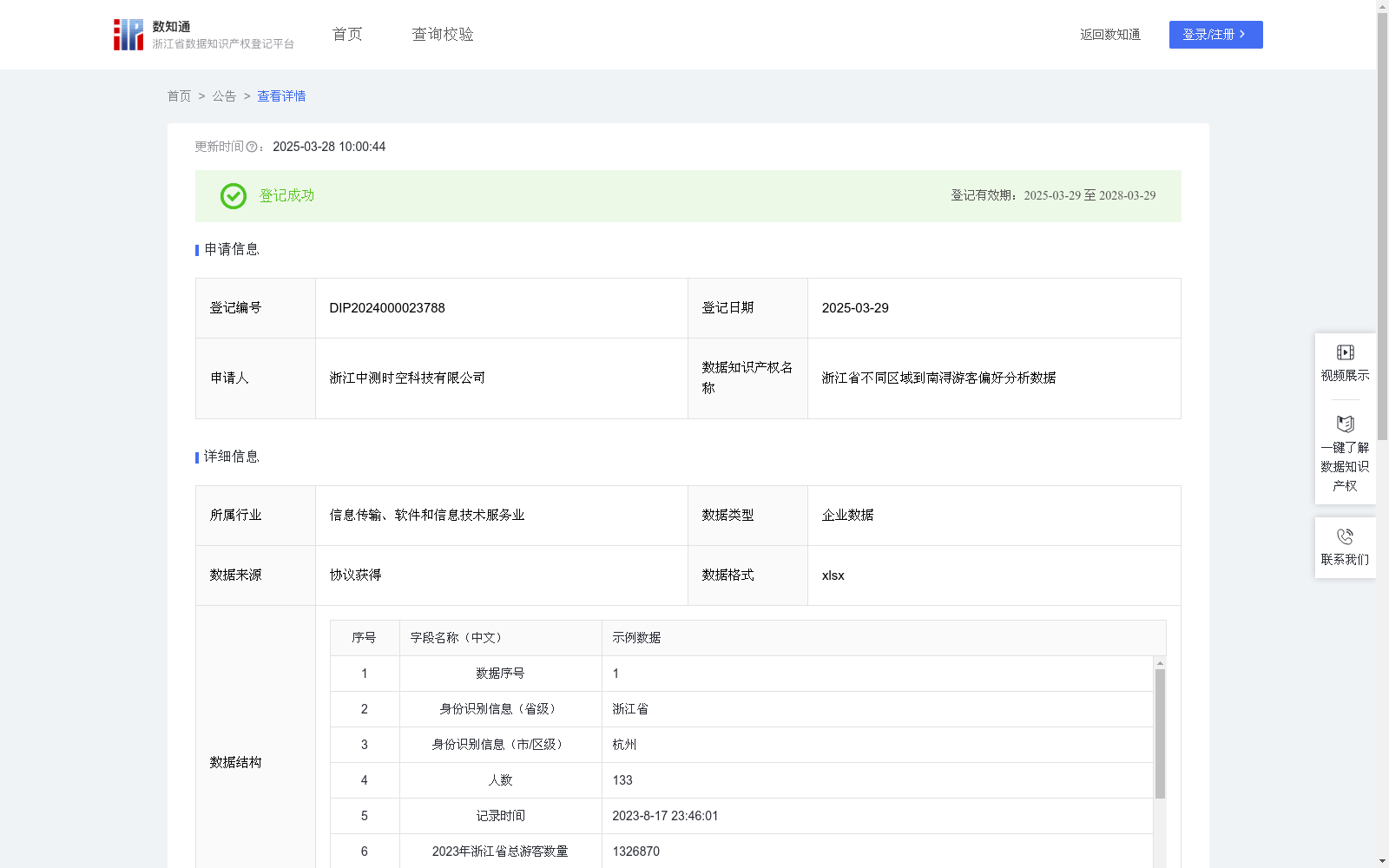
浙江省不同区域到南浔游客偏好分析数据
收藏浙江省数据知识产权登记平台2025-03-28 更新2025-03-29 收录
下载链接:
https://www.zjip.org.cn/home/announce/trends/120231
下载链接
链接失效反馈官方服务:
资源简介:
根据浙江省不同区域到南浔游客量,可以反映旅游趋势和各地区对南浔区旅游的兴趣程度,反映出旅游的主要人群,帮助各大景区更加精准地细分市场,针对不同地区的游客偏好开发或优化旅游产品,各大景区制定更加有效的营销策略提供数据支持,文旅部门依据客源数据,制定更加符合市场偏好的旅游政策和发展规划,调整宣传方向。根据客源地的地方特点,引进对应的饮食、文化等相关商业,为有意向在此地投资的企业提供经营方向,满足多数地区游客的喜好。一.数据来源:数据来源于南浔古镇实景三维-一网统管平台,根据浙江省不同区域到南浔游客偏好分析数据实际情况实时记录,我公司已获得统管平台所有权人“浙江南浔古镇旅游发展有限公司”数据使用授权许可。二.算法:1、数据采集:采集身份识别信息为浙江省的游客信息(包含省内多个市),识别方式包括人工核验,机器采集,全年龄段记录,一个人记“1”,当日内无相关游客则不进行数据记录,;2、数据处理,对采集到的数据进行分类、梳理,清洗便于分析使用。3、算法加工:对数据包内容进行计算(本数据包内为2023年数据)。浙江省平均游客数量=浙江省总游客数量/浙江省记录数据总条数,某区域偏好指数P=(某区域总游客数量/浙江省平均游客数量)*(浙江省记录数据总条数/浙江省总游客数量),例如,示例数据中“杭州市”对应公式中“某区域”。其中“浙江省记录数据总条数/浙江省总游客数量”作为一个常数,用于将算法基于全浙江省平均游客数量的偏好估算(保留整数)。数据为整理后状态,依地区汇集,记录不完全按照时间先后顺序,依据行业经验采用浙江省平均游客数量进行标准化算法处理。4、数据分类分级复用:根据计算出的偏好水平,p>1.0记为高偏好地区,0.5<P≤1.0记为中偏好地区,0.5≥P记为低偏好地区,根据地区等级安排更精准的景区经营策略,例如:加大高偏好地区相关配套美食产品的招商引资等。注意:数据包内省、市、区等为区域划分,若一级名称为省,则二级划分到市,若一级划分区域为直辖市,则二级划分会出现xx区。
Tourist volume from different regions of Zhejiang Province to Nanxun can reflect tourism trends, the interest levels of various regions in tourism of Nanxun District, and the main demographic groups of tourists. This dataset provides data support for major scenic spots to accurately segment the market, develop or optimize tourism products tailored to tourist preferences of different regions, and formulate more effective marketing strategies. Additionally, cultural and tourism authorities can use the source tourist data to develop tourism policies and development plans that better align with market preferences, and adjust their publicity directions.
1. Data Source: The data is sourced from the Real-scene 3D Unified Management Platform of Nanxun Ancient Town, which records in real time based on the actual situation of tourist preference analysis data from different regions of Zhejiang Province to Nanxun. Our company has obtained the data usage authorization license from "Zhejiang Nanxun Ancient Town Tourism Development Co., Ltd.", the owner of the Unified Management Platform.
2. Algorithm:
1) Data Collection: Collect tourist information whose identity is identified as from Zhejiang Province (including multiple cities within the province). The identification methods include manual verification and machine collection. All age groups are recorded, with each individual counted as "1". No data will be recorded if there are no relevant tourists on that day.
2) Data Processing: Classify, sort and clean the collected data to facilitate analysis and usage.
3) Algorithm Processing: Calculate the content of the data package (the data in this package is from 2023). The formula is as follows:
Average tourist volume of Zhejiang Province = Total tourist volume of Zhejiang Province / Total number of recorded data entries in Zhejiang Province
Preference Index P of a certain region = (Total tourist volume of the region / Average tourist volume of Zhejiang Province) * (Total number of recorded data entries in Zhejiang Province / Total tourist volume of Zhejiang Province)
For example, "Hangzhou City" in the sample data corresponds to "a certain region" in the formula. Here, "Total number of recorded data entries in Zhejiang Province / Total tourist volume of Zhejiang Province" is used as a constant to standardize the algorithm's preference estimation based on the average tourist volume of the entire Zhejiang Province (results are rounded to integers). The data is in a processed and aggregated state, grouped by region, and the records are not arranged in chronological order. Industry experience is applied to conduct standardized algorithm processing using the average tourist volume of Zhejiang Province.
4) Data Classification, Grading and Reuse: According to the calculated preference level, regions are categorized as high-preference areas when P>1.0, medium-preference areas when 0.5<P≤1.0, and low-preference areas when P≤0.5. More precise scenic spot management strategies can be formulated based on the regional level, such as increasing investment attraction for supporting food products in high-preference regions.
Note: Provinces, cities, districts and other divisions in the dataset are regional classifications. If the first-level division is a province, the second-level division will be cities; if the first-level division is a municipality directly under the Central Government, the second-level division will include districts (e.g., XX District).
提供机构:
浙江中测时空科技有限公司
创建时间:
2024-12-24
搜集汇总
数据集介绍
背景与挑战
背景概述
该数据集包含2023年浙江省不同区域到南浔游客的偏好分析数据,共4720条记录,每年更新一次。数据通过算法计算各区域的偏好指数,用于帮助景区细分市场、优化旅游产品和制定营销策略。
以上内容由遇见数据集搜集并总结生成


