
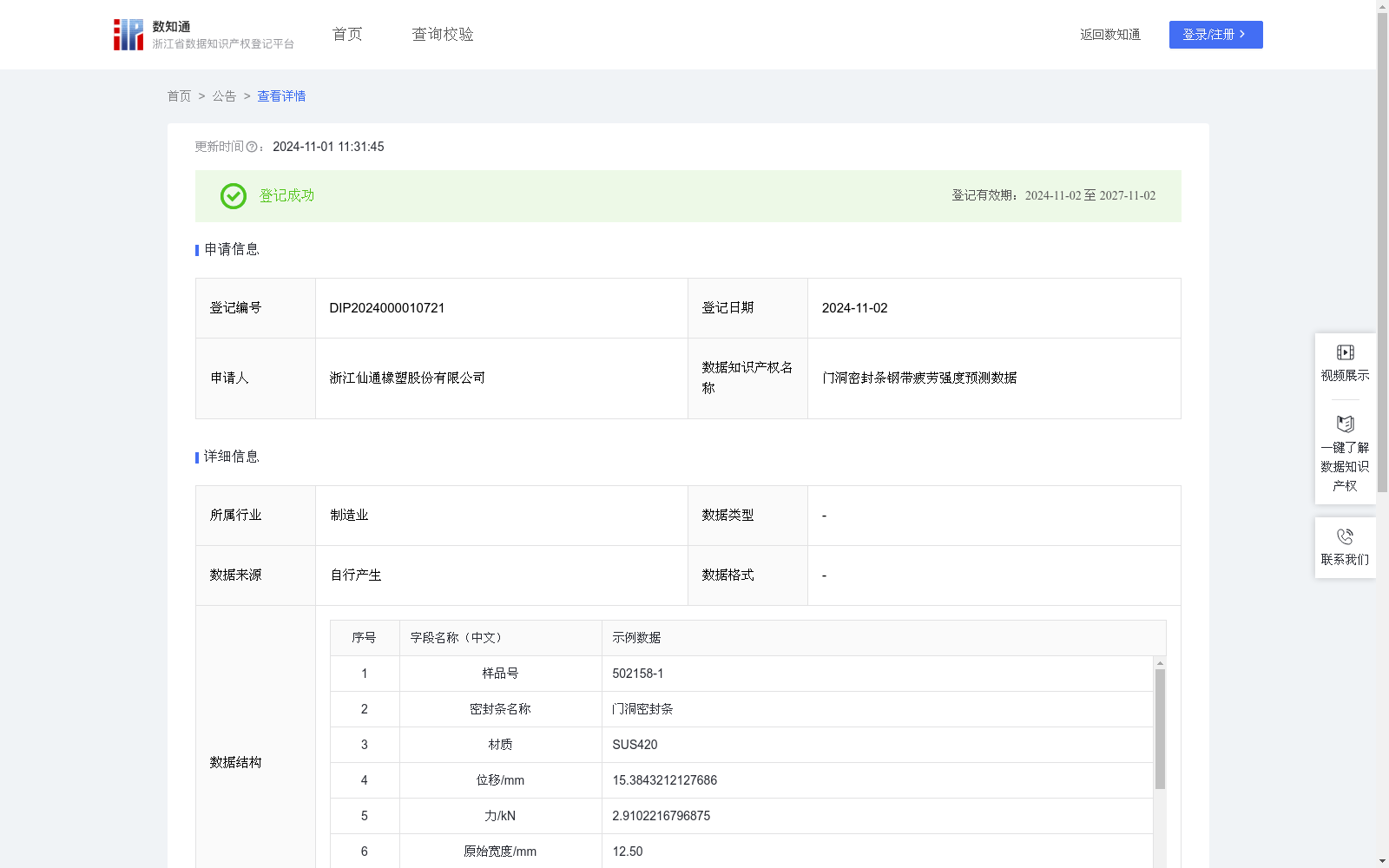
门洞密封条钢带疲劳强度预测数据
收藏浙江省数据知识产权登记平台2024-11-01 更新2024-11-02 收录
下载链接:
https://www.zjip.org.cn/home/announce/trends/79480
下载链接
链接失效反馈官方服务:
资源简介:
作为工程材料在循环交变载荷作用下长期服役安全可靠性的关键指标,疲劳强度(一般指材料在经受10^7次交变载荷作用后不发生疲劳断裂时的最大应力)得到了抗疲劳设计开发者们的持续关注。目前疲劳强度的获得主要依靠疲劳测试,经济成本与时间成本因此而居高不下。申请人在Wohler公式等理论的基础上,以σw=σy*[C-(σy/σb)]/ω为基本函数形式,以静态拉伸性能预测动态疲劳性能为基本指导思想,通过对材料弹性、塑性、硬化能力、组织缺陷等疲劳强度几大影响因素的整合集中反映了疲劳损伤的基本原理,并以简洁的形式建立起疲劳强度σw与屈服强度σy、拉伸强度σb的本征关系,同时兼顾了普适性与实用性,有效减少了工程材料开发与选择过程中的大量疲劳实验测试,实现了材料疲劳强度高效预测。(1)力学性能测试:选择若干同系列金属材料进行拉伸性能测试,获得若干组材料屈服强度σy与抗拉强度σb值;
(2)疲劳性能测试:在同系列金属材料中选择2-4种材料制备疲劳测试样品,对其进行疲劳强度测试,获得材料的疲劳强度σw实测值。
(3)参数拟合:利用测得的拉伸性能数据与疲劳强度数据,求得材料的σy/σb与σw/σy值,然后以σy/σb值为横坐标、以σw/σy值为纵坐标绘制σw/σy--σy/σb关系图,并通过线性拟合求得参数ω与C,其中ω为拟合直线斜率的负倒数,C为拟合直线与σy/σb轴的截距。
(4)疲劳强度预测:通过待预测材料的拉伸性能确定材料的σy/σb值,即σw/σy--σy/σb关系图中横坐标位置,通过拟合直线可进一步确定材料的σw/σy值,即纵坐标位置,从而求得相应材料的疲劳强度σw预测值;或者,将待预测材料的拉伸性能σy、σb与参数值ω、C直接代入公式σw=σy*[C-(σy/σb)]/ω,经计算求得相应材料的疲劳强度σw预测值。
As a key indicator of the long-term service safety and reliability of engineering materials under cyclic alternating loads, fatigue strength (generally referring to the maximum stress at which a material does not undergo fatigue fracture after undergoing 10^7 cycles of alternating loads) has received continuous attention from developers of anti-fatigue design. Currently, fatigue strength is mainly obtained through fatigue testing, resulting in high economic and time costs. Based on theories such as Wöhler's formula, the applicant takes σw=σy*[C-(σy/σb)]/ω as the basic functional form, and takes predicting dynamic fatigue performance via static tensile properties as the core guiding ideology. By integrating several major influencing factors of fatigue strength including material elasticity, plasticity, hardening ability, and microstructural defects, the basic principles of fatigue damage are centrally reflected. An intrinsic relationship between fatigue strength σw, yield strength σy and tensile strength σb is established in a concise form, which balances both universality and practicality. This effectively reduces a large number of fatigue experimental tests during the development and selection of engineering materials, enabling efficient prediction of material fatigue strength.
(1) Mechanical property testing: Select several metal materials of the same series to conduct tensile property tests, and obtain multiple sets of yield strength σy and tensile strength σb values of the materials;
(2) Fatigue property testing: Select 2 to 4 materials from the same series of metal materials to prepare fatigue test specimens, perform fatigue strength tests on them, and obtain the measured fatigue strength σw values of the materials.
(3) Parameter fitting: Use the measured tensile property data and fatigue strength data to calculate the σy/σb and σw/σy values of the materials. Then plot the σw/σy -- σy/σb relationship graph with σy/σb values as the abscissa and σw/σy values as the ordinate. Obtain the parameters ω and C through linear fitting, where ω is the negative reciprocal of the slope of the fitted straight line, and C is the intercept of the fitted straight line with the σy/σb axis.
(4) Fatigue strength prediction: Determine the σy/σb value of the material to be predicted based on its tensile properties, which corresponds to the abscissa position in the σw/σy -- σy/σb relationship graph. The σw/σy value of the material, i.e., the ordinate position, can be further determined via the fitted straight line, thereby obtaining the predicted fatigue strength σw value of the corresponding material. Alternatively, directly substitute the tensile properties σy, σb of the material to be predicted and the parameter values ω and C into the formula σw=σy*[C-(σy/σb)]/ω, and calculate the predicted fatigue strength σw value of the corresponding material.
提供机构:
浙江仙通橡塑股份有限公司
创建时间:
2024-10-08
搜集汇总
数据集介绍
特点
该数据集专注于门洞密封条钢带的疲劳强度预测,包含1164条详细记录,每季度更新。数据来源于自行产生,详细记录了样品的物理和力学性能参数,应用场景为工程材料的长期服役安全可靠性评估。通过理论公式预测疲劳强度,减少了实验测试的需求。
以上内容由遇见数据集搜集并总结生成



