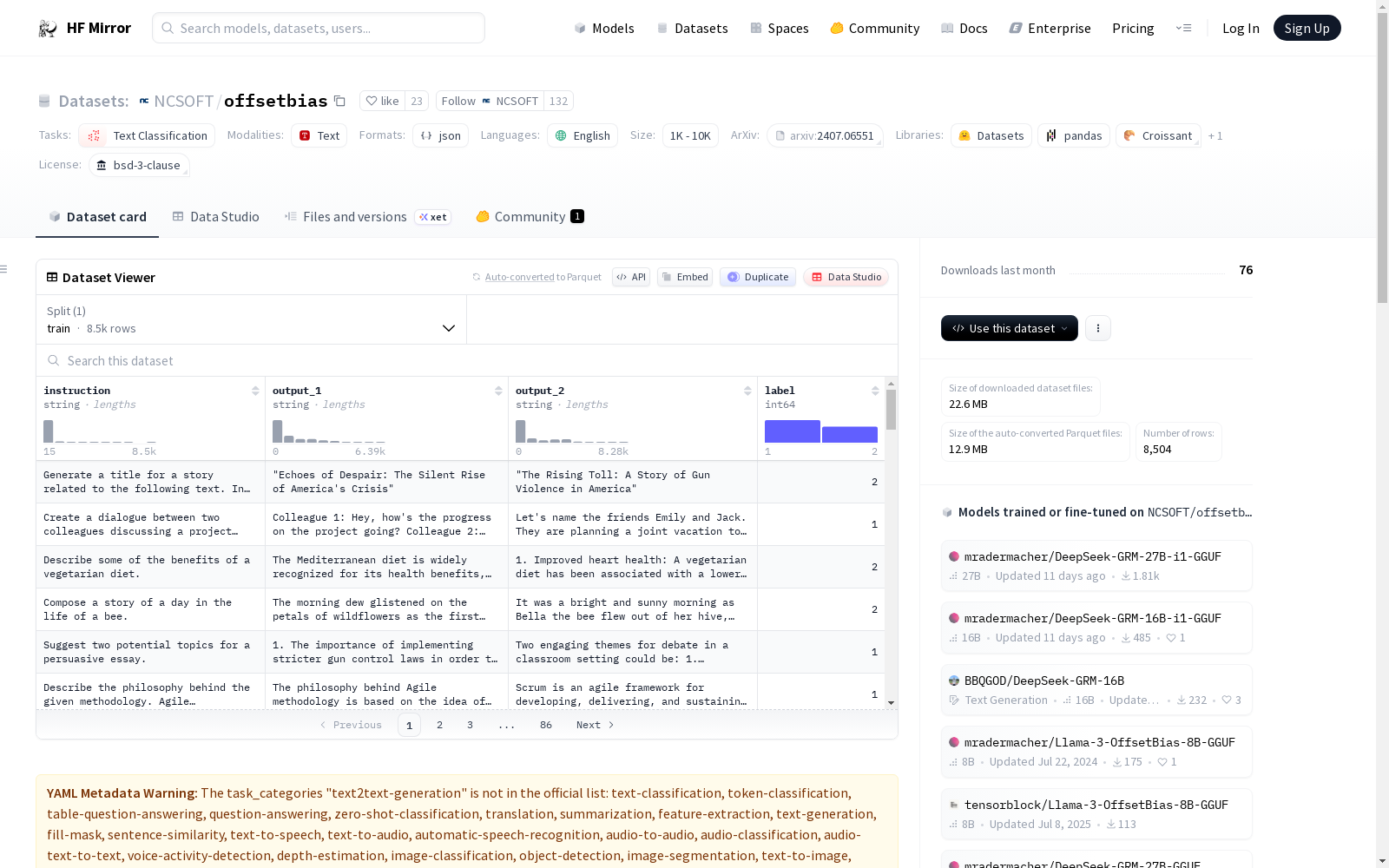
NCSOFT/offsetbias
收藏资源简介:
OffsetBias是一个用于减少评估模型中常见偏差的成对偏好数据集,包含8,504个训练样本。每个样本包括一个指令、两个候选输出和一个标签,标签指示哪个输出更好。数据集的指令来源于多个源数据集,输出由GPT-3.5、GPT-4和Claude-3-Opus模型生成。该数据集不适合单独用于训练评估模型,而应作为补充数据集使用。
OffsetBias is a pairwise preference dataset intended to reduce common biases inherent in judge models (language models specialized in evaluation). The dataset contains 8,504 samples for training judge (or reward) models. The dataset structure includes instructions, two candidate responses, and a label indicating the better response number. The dataset is constructed using instructions from multiple source datasets and outputs generated by GPT-3.5, GPT-4, and Claude-3-Opus models. This dataset is intended to be a collection of counter-examples to existing common biases in evaluation models, thus it is not suitable for training an evaluation model alone, but rather as a complementary dataset that can complement other general-purpose evaluation datasets.
数据集卡片:OffsetBias
数据集描述
数据集概述
OffsetBias 是一个成对偏好数据集,旨在减少评估模型(专门用于评估的语言模型)中固有的常见偏差。该数据集包含8,504个样本,用于训练评估(或奖励)模型。
数据集结构
数据实例
json { "instruction": "Rewrite the following sentence, paying attention to spelling and grammar. Distance learning is harder then in-person classes", "output_1": "Distance learning is harder than in-person classes.", "output_2": "The original sentence is grammatically correct and the punctuation is also appropriate. However, if you wish to slightly rephrase it for clarity or emphasis, one possibility is:
"Studying online can be more challenging than in traditional classroom settings."
This slight tweak emphasizes the comparison between "studying online" and "studying... in traditional classroom settings."", "label": 1 }
数据字段
instruction: 字符串,响应需要回答的指令output_1: 字符串,第一个候选响应output_2: 字符串,第二个候选响应label: 整数,1或2,表示更好的响应编号
数据集构建
指令来自包括Alpaca、Ultrachat、Evol-Instruct和Flan在内的源数据集。输出使用GPT-3.5、GPT-4和Claude-3-Opus模型生成。
数据使用注意事项
该数据集旨在作为现有评估模型中常见偏差的反例集合。因此,单独使用此数据集进行训练不适合训练评估模型,因为它会引入另一种偏差。最好将其用作可以补充其他通用评估数据集的附加数据集。
引用
bibtex @misc{park2024offsetbias, title={OffsetBias: Leveraging Debiased Data for Tuning Evaluators}, author={Junsoo Park and Seungyeon Jwa and Meiying Ren and Daeyoung Kim and Sanghyuk Choi}, year={2024}, eprint={2407.06551}, archivePrefix={arXiv}, primaryClass={cs.CL} }