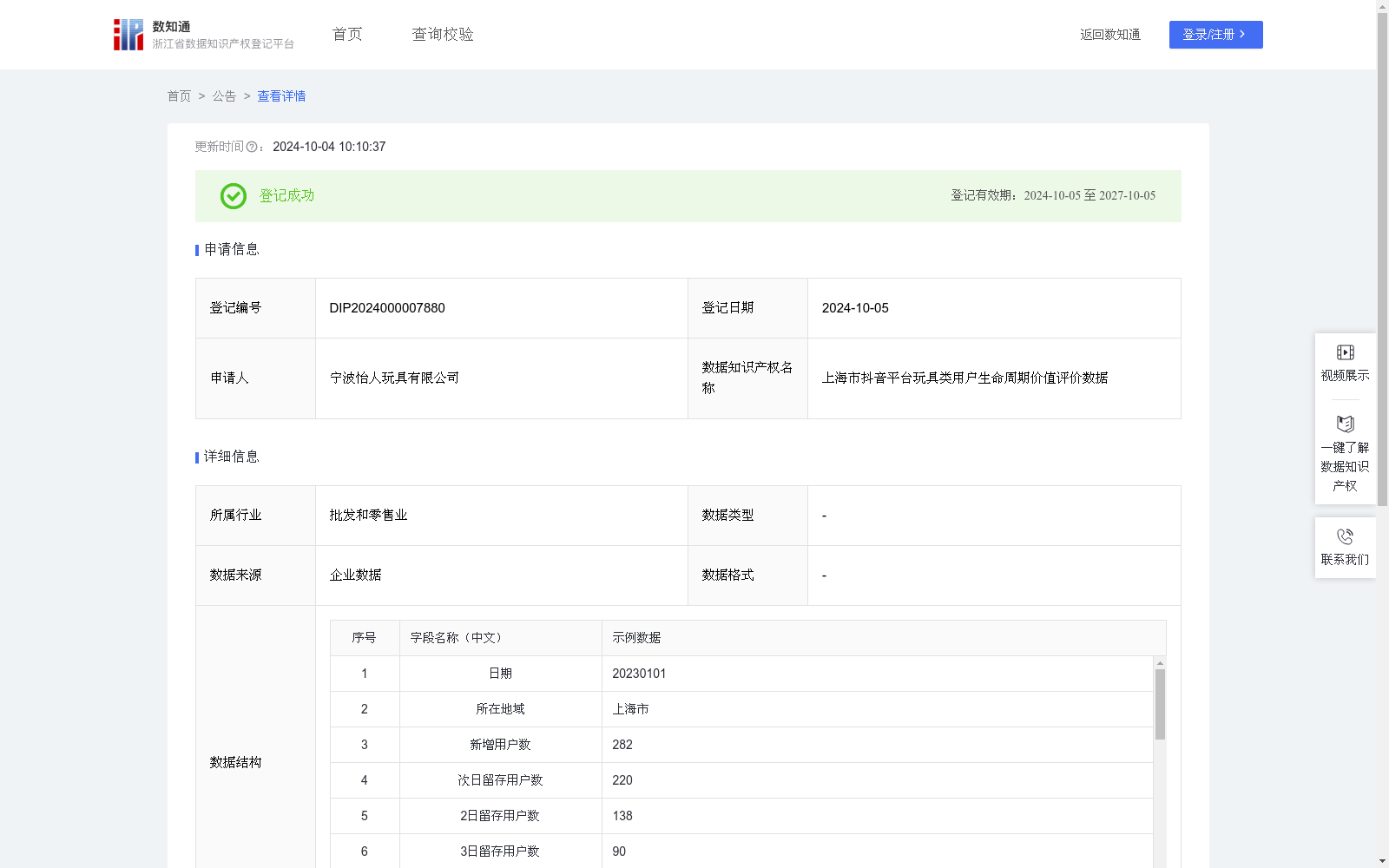
上海市抖音平台玩具类用户生命周期价值评价数据
收藏资源简介:
通过上海市抖音平台玩具类新增活跃用户的用户价值,评估上海市抖音平台采用生命周期价值模型来评价企业(CAC)获客成本的合理性。简单来说,在新用户的获取上,要保证一个用户在整个生命周期中给产品带来的价值(LTV)大于获取这个新用户所耗费的成本(CAC),否则获取的用户越多,回本周期越长,平均收益越低。此评价数据适用于所有消费品行业企业,为消费品行业企业在制定营销政策,管理促销费用等提供数据支持。采用生命周期价值模型来评价企业CAC获客成本的合理性。LT=(新增用户数+次日留存用户数+2日留存用户数+3日留存用户数+4日留存用户数+…+14日留存用户数)/新增用户数;LTV=LT*ARPU;平均收益=LTV/CAC;LT:用户的平均生命周期;LTV:用户生命周期价值;ARPU:用户的平均收入;CAC:获客成本。① 当LTV/CAC<1时,说明用户获取越多,亏损越严重,商业变现失败,缺乏明确的变现方式。② 当1 ≤LTV/CAC < 3时,说明产品是有明确的变现方式的,获客可以获得正向收益,存在一定的发展空间,但收益与成本的转化率较低。③ 当3≤LTV/CAC < 5时,可以判断该产品的发展潜力较大,模式更容易被认可。④ 当LTV/CAC≥5时,说明市场拓展太保守,为了保持该转化率,过于严控获客成本,不利于开拓市场,应该加大投入。
This dataset is intended to evaluate the rationality of enterprises' customer acquisition cost (CAC) assessed via the user lifetime value (LTV) model, based on the user value of newly activated toy-category users on the Douyin platform in Shanghai. Briefly, for new user acquisition, the total value a single user brings to the product over their entire lifecycle (LTV) must exceed the cost incurred to acquire this new user (CAC). Otherwise, the more users are acquired, the longer the payback period and the lower the average revenue. This evaluation data is applicable to all enterprises in the consumer goods industry, providing data support for them to formulate marketing policies and manage promotional expenses. The LTV model is adopted to evaluate the rationality of enterprises' CAC. The relevant formulas are defined as follows: 1. Average User Lifespan (LT) = (Number of New Users + Number of 1-day Retained Users + Number of 2-day Retained Users + Number of 3-day Retained Users + Number of 4-day Retained Users + … + Number of 14-day Retained Users) / Number of New Users; 2. User Lifetime Value (LTV) = LT × ARPU; 3. Average Revenue = LTV / CAC; Where LT represents the average user lifespan, LTV represents user lifetime value, ARPU represents average revenue per user, and CAC represents customer acquisition cost. The following are the interpretations of different LTV/CAC ratio scenarios: ① When LTV/CAC < 1: It indicates that the more users are acquired, the more severe the losses, with failed commercial monetization and no clear monetization approach. ② When 1 ≤ LTV/CAC < 3: It indicates that the product has a clear monetization approach, and customer acquisition yields positive returns with certain development space, but the conversion rate between returns and costs is low. ③ When 3 ≤ LTV/CAC < 5: It can be judged that the product has great development potential and its business model is more easily recognized by the market. ④ When LTV/CAC ≥ 5: It indicates that market expansion is too conservative; to maintain this conversion rate, the enterprise overly strictly controls customer acquisition costs, which is not conducive to market expansion, and more investment should be made.