
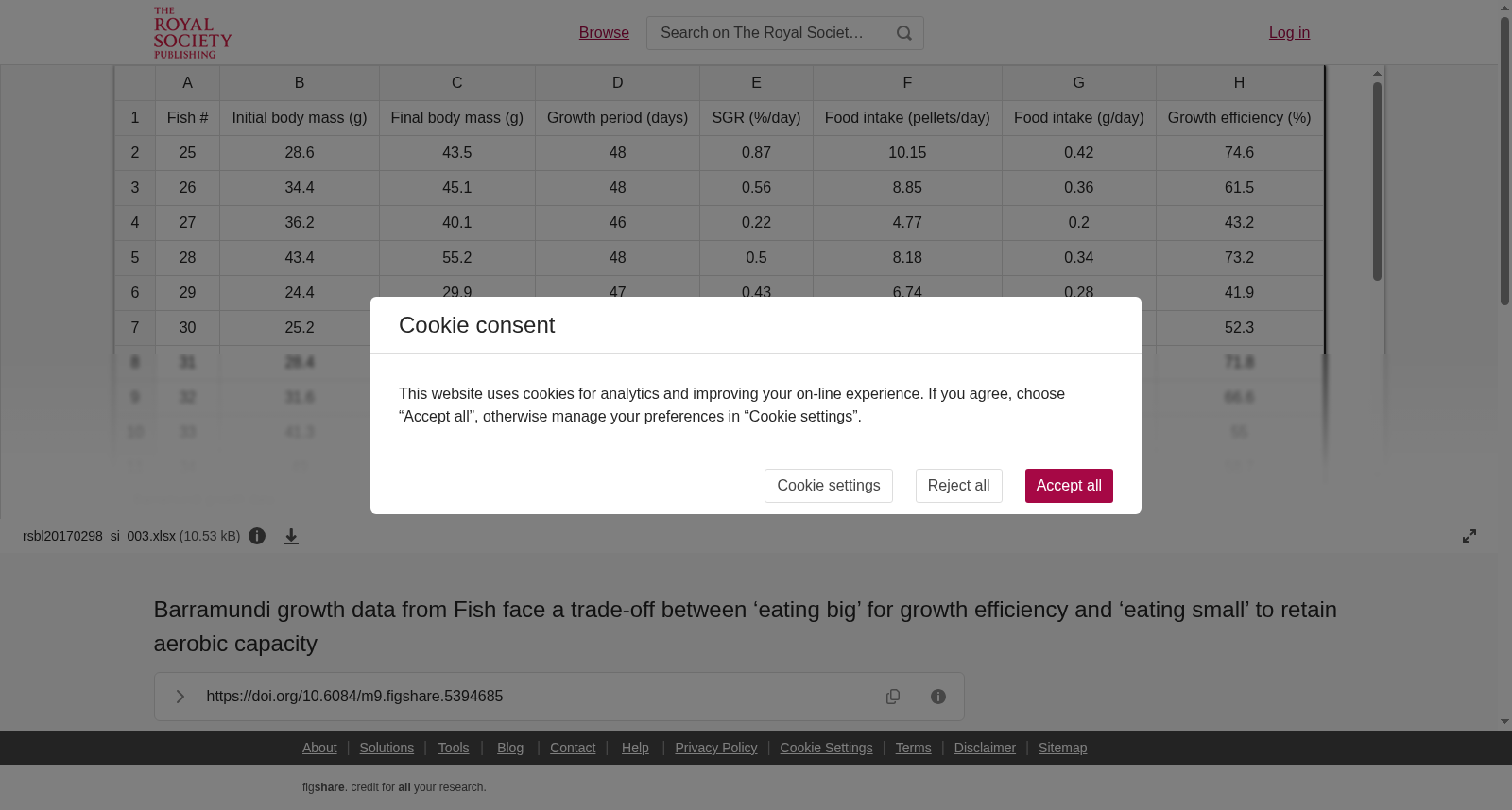
Barramundi growth data from Fish face a trade-off between ‘eating big’ for growth efficiency and ‘eating small’ to retain aerobic capacity
收藏DataCite Commons2020-09-01 更新2024-07-25 收录
下载链接:
https://rs.figshare.com/articles/dataset/Barramundi_growth_data_from_Fish_face_a_trade-off_between_eating_big_for_growth_efficiency_and_eating_small_to_retain_aerobic_capacity/5394685/1
下载链接
链接失效反馈官方服务:
资源简介:
Feeding provides the necessary energy to fuel all fitness-related processes including activity, growth and reproduction. Nevertheless, prey consumption and digestive processes can have physical and physiological trade-offs with other critical functions, many of which are not clearly understood. Using an ambush predator, barramundi (<i>Lates calcarifer</i>), fed meals ranging 0.6–3.4% of body mass, we examined interrelations between meal size, growth efficiency and surplus aerobic metabolic capacity (aerobic scope, AS). Large meals required a greater absolute investment of energy to process (a larger so-called specific dynamic action, SDA), but the percentage of digestible meal energy required in the SDA response (SDA coefficient) decreased with increasing meal size. Combined with the findings that growth rate and growth efficiency also increased with food intake, our results demonstrate that it is energetically advantageous for fish to select large prey. However, following a large meal, SDA processes occupied up to 77% of the available AS, indicating that other oxygen-demanding activities like swimming may be compromised while large meals are processed. This trade-off between meal size and AS suggests that fishes like barramundi would benefit from regulating prey size based on imminent requirements and threats.
摄食可为包括活动、生长与繁殖在内的所有适合度相关生理过程提供必需的能量供给。然而,猎物摄取与消化过程会与其他关键生理功能产生物理及生理层面的权衡效应,其中诸多调控机制目前尚未被完全阐明。本研究以伏击捕食性鱼类尖吻鲈(<i>Lates calcarifer</i>)为实验对象,投喂其体重0.6%至3.4%的饵料,探讨了摄食量、生长效率与剩余有氧代谢能力(aerobic scope,简称AS)之间的内在关联。较大的摄食量需要更高的绝对能量投入以完成消化过程(即所谓的特殊动力作用,specific dynamic action,简称SDA),但消化过程所需的可消化饵料能量占比(SDA系数)会随摄食量的增加而降低。结合生长速率与生长效率同样随摄食量提升而升高的实验结果,本研究证实鱼类选择大型猎物在能量代谢层面具备显著优势。然而,在进食大型饵料后,特殊动力作用过程最多可占据77%的可用有氧代谢范围,这表明在消化大型饵料的过程中,游泳等其他需氧生理活动可能会受到显著抑制。这种摄食量与有氧代谢范围之间的权衡效应表明,诸如尖吻鲈这类伏击捕食鱼类可根据即时生存需求与外界威胁调整猎物选择尺寸,从而获得最优的生存与繁殖收益。
提供机构:
The Royal Society
创建时间:
2017-09-11
搜集汇总
数据集介绍
以上内容由遇见数据集搜集并总结生成


