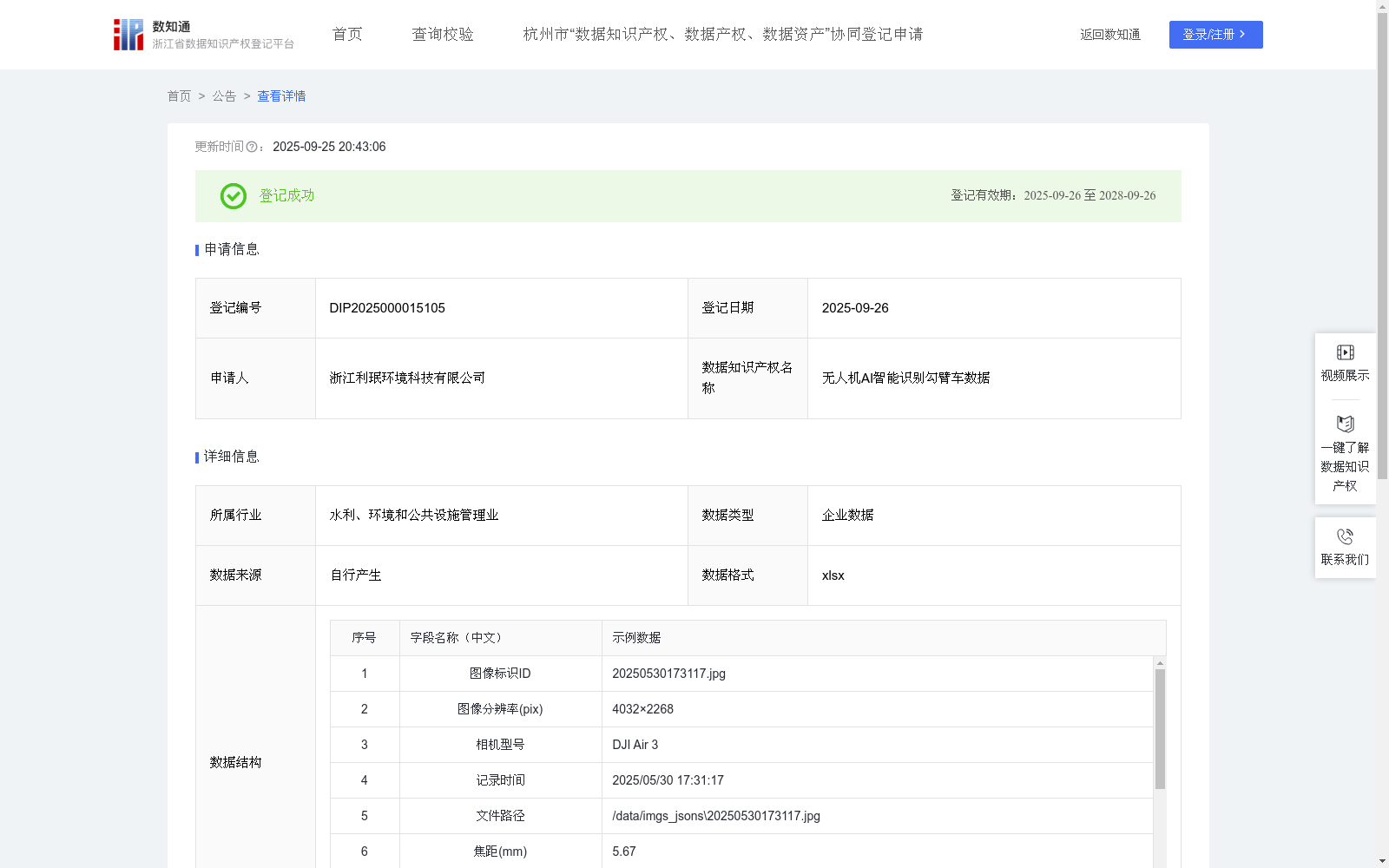
无人机AI智能识别勾臂车数据
收藏资源简介:
针对城市道路清洁作业,无人机凭借 70 至 100 米的中低空优势,结合高分辨率传感器与 AI 算法,能快速识别作业中的环卫车辆。给环卫企业智能化管理各种环卫车辆提供有力的数据支撑。可广泛应用于: 1、作业车辆轨迹监督 通过搭载的 AI 图像识别模块,无人机可快速区分洒水车、压缩车、高位自卸车、勾臂车等不同类型的环卫车辆,并实时比对其预设作业路线与实际轨迹,自动标记并推送至指挥中心,结合 GPS 位置数据生成辅助考核管理。 2、车辆故障状况判别 当环卫车辆发生故障,自动定位并向指挥中心发送精确坐标,联系维修人员赶赴现场尽快修理。 3、违规车辆监管 发现偏离路线、未按时段作业等违规行为时,无人机即时上传车辆编号与位置至指挥中心,自动生成整改工单。 4、作业时长统计 统计各种环卫车作业时长、覆盖面积,判定有效作业时段,排除空驶、停靠等非作业状态。生成量化考核报表,分析不同车型在各路段的作业效率。1、数据来源: 数据来源于本企业无人机智能巡查系统。2、高分辨率图像通过无人机采集,记录丰富元信息,包括图像标识ID、图像分辨率(pix)、相机型号、记录时间、文件路径、焦距(mm)、经纬度、海拔(m)、边界框组、置信度阈值、置信度、一级标签和二级标签,经人工清洗剔除噪声,确保数据可靠性。数据采用两级标签:初始细化目标类型标为二级标签(勾臂车),记录边界框及属性,后映射为一级标签(车辆)。3、算法基于YOLOv8m,集成P2层通过图像分片优化小目标检测,结合迁移学习加载预训练权重。预训练权重使用在COCO数据集上预训练的模型参数yolov8m.pt,适用于通用目标检测任务。微调时,保留骨干网络低层次特征提取层权重,冻结部分层以防过拟合,调整检测头参数,设置学习率0.01、批量大小8。4、在推理阶段,设定置信度阈值为0.45,目标置信度由模型输出,反映目标检测的可信水平。仅保留高于此阈值的检测结果作为目标,即置信度输出大于等于0.45的检测框视为正样本(勾臂车),小于0.45的检测框视为背景负样本。
For urban road cleaning operations, drones leveraging their 70–100 meter mid-low altitude advantage, combined with high-resolution sensors and AI algorithms, can rapidly identify sanitation vehicles in operation. This offers robust data support for sanitation enterprises to intelligently manage their fleets of sanitation vehicles. It can be widely applied in the following scenarios: 1. Operation Vehicle Trajectory Supervision: Equipped with an AI image recognition module, drones can quickly differentiate between different types of sanitation vehicles including water sprinkler trucks, compression garbage trucks, high-position dump trucks, hook-lift trucks, etc. It conducts real-time comparison between their preset operation routes and actual trajectories, automatically marks and pushes relevant information to the command center, and generates auxiliary assessment and management mechanisms by integrating GPS position data. 2. Vehicle Fault Diagnosis: When a sanitation vehicle malfunctions, drones can automatically locate it and transmit accurate coordinates to the command center, and notify maintenance personnel to rush to the scene for timely repairs. 3. Non-compliant Vehicle Supervision: Upon detecting violations such as deviating from the designated route or operating outside the scheduled time window, drones will immediately upload the vehicle ID and location to the command center and automatically generate rectification work orders. 4. Operation Duration Statistics: Calculate the operation duration and coverage area of various sanitation vehicles, identify valid operation periods, exclude non-operation states such as empty cruising and parking, generate quantitative assessment reports, and analyze the operation efficiency of different vehicle types across each road section. 1. Data Source: The dataset is sourced from the intelligent patrol system of our enterprise. 2. High-resolution images are collected by drones, with comprehensive metadata recorded, including image ID, image resolution (pix), camera model, recording timestamp, file path, focal length (mm), longitude and latitude, altitude (m), bounding box set, confidence threshold, confidence score, primary labels and secondary labels. Noise is removed via manual cleaning to ensure data reliability. The dataset adopts a two-level labeling scheme: the initially refined target type is labeled as the secondary label (hook-lift truck), with bounding boxes and corresponding attributes recorded, which are then mapped to the primary label (vehicle). 3. The algorithm is based on YOLOv8m, integrates the P2 layer to optimize small target detection through image tiling, and loads pre-trained weights via transfer learning. The pre-trained weights utilize the yolov8m.pt model parameters pre-trained on the COCO dataset, which is applicable to general object detection tasks. During fine-tuning, the weights of the low-level feature extraction layers of the backbone network are retained, some layers are frozen to prevent overfitting, the detection head parameters are adjusted, with the learning rate set to 0.01 and batch size set to 8. 4. During the inference stage, the confidence threshold is set to 0.45. The target confidence score is output by the model, reflecting the reliability level of object detection. Only detection results exceeding this threshold are retained as valid targets: detection boxes with a confidence score greater than or equal to 0.45 are considered positive samples (hook-lift trucks), while detection boxes with a confidence score less than 0.45 are regarded as background negative samples.