rocket-lab-launches
收藏资源简介:
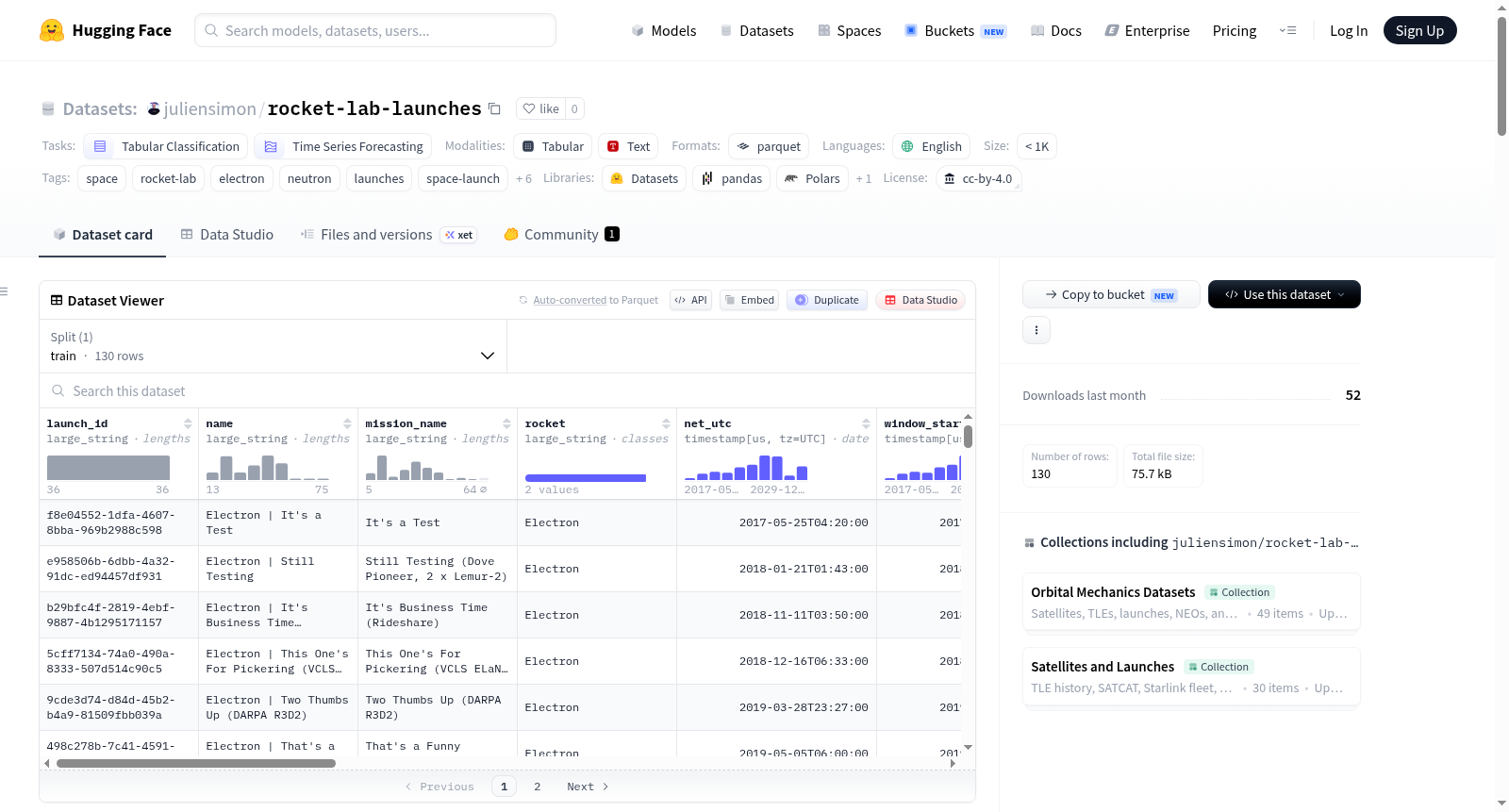
Rocket Lab Launch Log是一个完整的Rocket Lab公司发射清单数据集,涵盖了该公司自2017年起已执行和未来计划的所有任务。数据来源于The Space Devs Launch Library 2 API,详细记录了Electron小型运载火箭(自2017年从新西兰玛希亚半岛和美国弗吉尼亚州瓦勒普斯岛LC-2发射场运营)以及即将推出的Neutron中型部分可重复使用火箭的发射信息。每条记录包含任务标识符、运载火箭、发射时间、状态、发射场位置、目标轨道和任务描述等关键字段。数据集完整收录了从2017年5月首次试飞至今的Electron全部历史发射记录,以及已确认的未来Electron和Neutron客户任务。它包含130次发射(87次过去任务,43次未来计划),其中128次为Electron发射,2次为Neutron发射,已完成任务的成功率为95.4%,时间跨度从2017年至2029年。该数据集设计为与其他商业发射提供商数据集配套使用,便于比较发射节奏、成功率和运载工具使用情况,特别适用于跟踪小型发射市场细分、NASA和NRO合同扩张,以及Neutron进入中型发射市场的竞争。数据集适用于表格分类和时间序列预测任务。
Rocket Lab Launch Log is a comprehensive dataset of Rocket Labs launch manifest, covering all past executed and future planned missions by the small launch company founded by Peter Beck. The data is sourced from The Space Devs Launch Library 2 API. It details launch information for the Electron small-lift launch vehicle (operating since 2017 from Mahia Peninsula, New Zealand, and Wallops Island LC-2, Virginia, USA, using 3D-printed Rutherford engines) and the upcoming Neutron medium-lift partially reusable rocket. Each record includes key fields such as mission identifier, launch vehicle, launch time, status, launch site location, target orbit, and free-text mission description. The dataset fully encompasses all historical Electron launches from the May 2017 Its a Test inaugural test flight to the present, along with confirmed upcoming Electron and Neutron customer missions. It is designed to be used alongside datasets like juliensimon/spacex-launches, juliensimon/blue-origin-launches, and juliensimon/ula-launches for direct comparison of launch cadence, success rates, and vehicle usage among major commercial launch providers. It is particularly useful for tracking the small launch market niche pioneered by Electron, the rapid expansion of NASA Earth science and NRO small satellite constellation contracts, and Neutrons upcoming entry into the medium-lift market competing with SpaceX Falcon 9. The dataset includes 130 launches (87 past missions, 43 future plans), with 128 Electron launches and 2 Neutron launches, a success rate of 95.4% for completed missions, spanning from 2017 to 2029. It is suitable for tabular classification and time-series forecasting tasks.