
Commercial and Residential Hourly Load Profiles for all TMY3 Locations in the United States
收藏openenergyhub.ornl.gov2022-12-01 更新2025-01-15 收录
下载链接:
https://openenergyhub.ornl.gov/explore/dataset/commercial-and-residential-hourly-load-profiles-for-all-tmy3-locations-in-the-un/
下载链接
链接失效反馈官方服务:
资源简介:
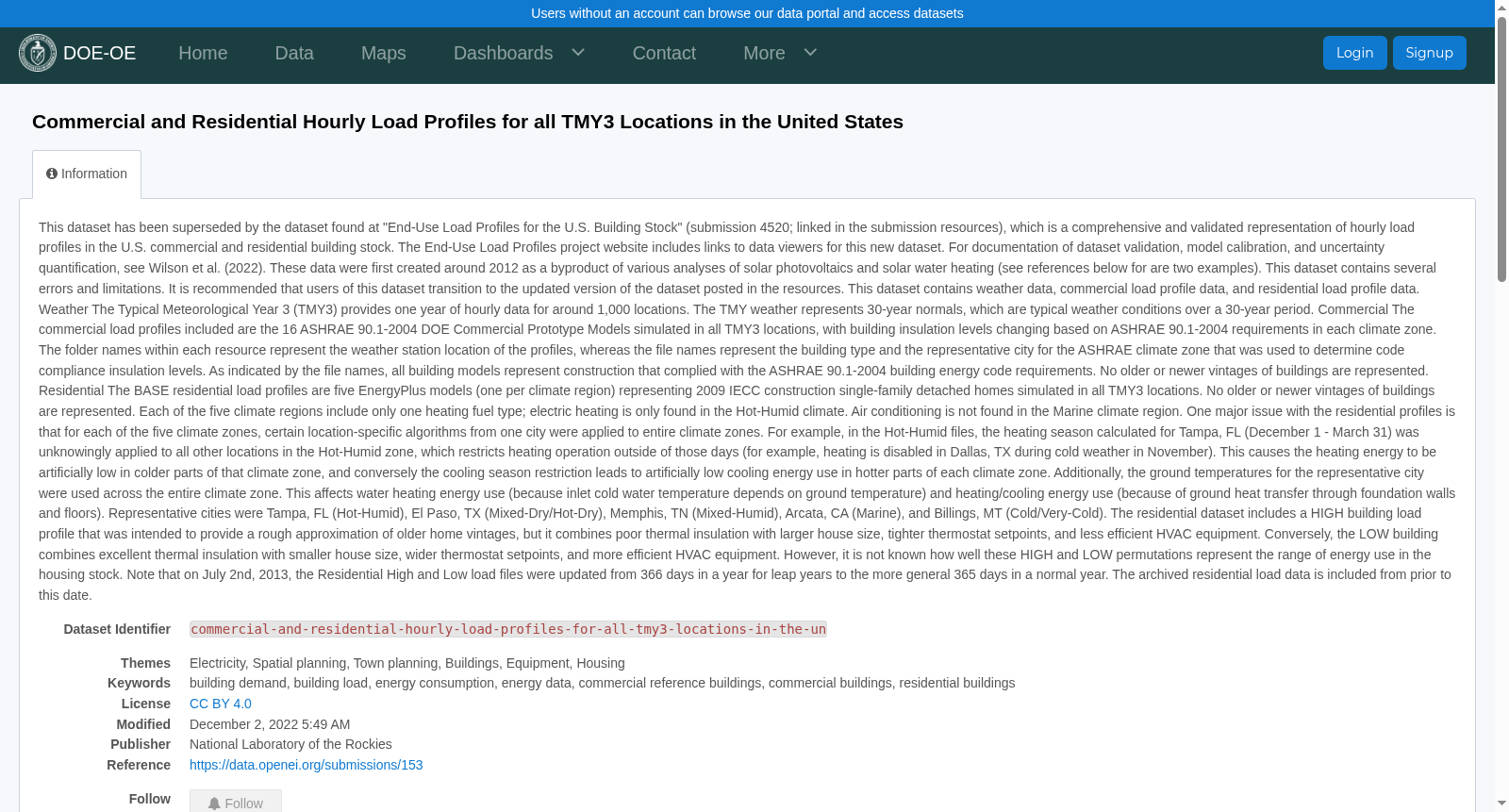
Note: This dataset has been superseded by the dataset found at "End-Use Load Profiles for the U.S. Building Stock" (submission 4520; linked in the submission resources), which is a comprehensive and validated representation of hourly load profiles in the U.S. commercial and residential building stock. The End-Use Load Profiles project website includes links to data viewers for this new dataset. For documentation of dataset validation, model calibration, and uncertainty quantification, see Wilson et al. (2022). These data were first created around 2012 as a byproduct of various analyses of solar photovoltaics and solar water heating (see references below for are two examples). This dataset contains several errors and limitations. It is recommended that users of this dataset transition to the updated version of the dataset posted in the resources. This dataset contains weather data, commercial load profile data, and residential load profile data.WeatherThe Typical Meteorological Year 3 (TMY3) provides one year of hourly data for around 1,000 locations. The TMY weather represents 30-year normals, which are typical weather conditions over a 30-year period.CommercialThe commercial load profiles included are the 16 ASHRAE 90.1-2004 DOE Commercial Prototype Models simulated in all TMY3 locations, with building insulation levels changing based on ASHRAE 90.1-2004 requirements in each climate zone. The folder names within each resource represent the weather station location of the profiles, whereas the file names represent the building type and the representative city for the ASHRAE climate zone that was used to determine code compliance insulation levels. As indicated by the file names, all building models represent construction that complied with the ASHRAE 90.1-2004 building energy code requirements. No older or newer vintages of buildings are represented.Residential The BASE residential load profiles are five EnergyPlus models (one per climate region) representing 2009 IECC construction single-family detached homes simulated in all TMY3 locations. No older or newer vintages of buildings are represented. Each of the five climate regions include only one heating fuel type; electric heating is only found in the Hot-Humid climate. Air conditioning is not found in the Marine climate region.One major issue with the residential profiles is that for each of the five climate zones, certain location-specific algorithms from one city were applied to entire climate zones. For example, in the Hot-Humid files, the heating season calculated for Tampa, FL (December 1 - March 31) was unknowingly applied to all other locations in the Hot-Humid zone, which restricts heating operation outside of those days (for example, heating is disabled in Dallas, TX during cold weather in November). This causes the heating energy to be artificially low in colder parts of that climate zone, and conversely the cooling season restriction leads to artificially low cooling energy use in hotter parts of each climate zone. Additionally, the ground temperatures for the representative city were used across the entire climate zone. This affects water heating energy use (because inlet cold water temperature depends on ground temperature) and heating/cooling energy use (because of ground heat transfer through foundation walls and floors). Representative cities were Tampa, FL (Hot-Humid), El Paso, TX (Mixed-Dry/Hot-Dry), Memphis, TN (Mixed-Humid), Arcata, CA (Marine), and Billings, MT (Cold/Very-Cold).The residential dataset includes a HIGH building load profile that was intended to provide a rough approximation of older home vintages, but it combines poor thermal insulation with larger house size, tighter thermostat setpoints, and less efficient HVAC equipment. Conversely, the LOW building combines excellent thermal insulation with smaller house size, wider thermostat setpoints, and more efficient HVAC equipment. However, it is not known how well these HIGH and LOW permutations represent the range of energy use in the housing stock. Note that on July 2nd, 2013, the Residential High and Low load files were updated from 366 days in a year for leap years to the more general 365 days in a normal year. The archived residential load data is included from prior to this date.
请注意:本数据集已被位于“美国建筑库存终端用电负荷配置文件”的数据集(提交编号4520;可在提交资源中找到链接)所取代,该数据集为美国商业和住宅建筑库存的每小时用电负荷配置文件提供了全面且经过验证的表征。终端用电负荷配置文件项目网站提供了该新数据集的数据查看器链接。关于数据集的验证、模型校准和不确定性量化,请参阅Wilson等人(2022年)的研究。这些数据最早于2012年作为对太阳能光伏和太阳能热水系统各种分析的结果而产生(参见下文中的两个示例)。本数据集包含多个错误和局限性。建议使用本数据集的用户过渡到资源中发布的更新版数据集。本数据集包含天气数据、商业用电负荷配置文件数据和住宅用电负荷配置文件数据。
天气:典型气象年3(TMY3)为大约1000个地点提供了为期一年的每小时数据。TMY天气代表30年的常态,即30年期间的典型天气条件。
商业:包含的商业用电负荷配置文件包括在所有TMY3地点模拟的16个ASHRAE 90.1-2004 DOE商业原型模型,建筑物的保温级别根据每个气候区的ASHRAE 90.1-2004要求而变化。每个资源中的文件夹名称代表配置文件的气象站位置,而文件名称代表建筑类型以及用于确定符合规范保温级别的ASHRAE气候区的代表性城市。如文件名所示,所有建筑模型均代表符合ASHRAE 90.1-2004建筑能源代码要求的建筑。不包含更老或更新的建筑版本。
住宅:BASE住宅用电负荷配置文件包括五个EnergyPlus模型(每个气候区一个),代表在所有TMY3地点模拟的2009年IECC建设单户独立住宅。不包含更老或更新的建筑版本。五个气候区中的每一个只包含一种供暖燃料类型;电加热仅在炎热潮湿气候中出现。空调在海洋气候区不存在。住宅配置文件的一个主要问题是,对于五个气候区中的每一个,某些城市特定的算法被应用于整个气候区。例如,在炎热潮湿文件中,为坦帕,佛罗里达州(12月1日至3月31日)计算的季节性供暖期被无意中应用于炎热潮湿区内的所有其他地点,这限制了供暖操作在这些日期之外(例如,德克萨斯州达拉斯在11月的寒冷天气中关闭供暖)。这导致该气候区的较冷部分供暖能源消耗被人为地降低,反之,冷却季节的限制导致每个气候区较热部分的冷却能源消耗被人为地降低。此外,代表性城市的地面温度被用于整个气候区。这影响了热水能源消耗(因为入口冷水温度取决于地面温度)以及供暖/冷却能源消耗(因为通过基础墙和地板的地面热传递)。代表性城市包括坦帕,佛罗里达州(炎热潮湿)、埃尔帕索,德克萨斯州(混合干燥/炎热干燥)、孟菲斯,田纳西州(混合潮湿)、阿卡塔,加利福尼亚州(海洋)和比林斯,蒙大拿州(寒冷/非常寒冷)。住宅数据集包括一个HIGH建筑用电负荷配置文件,旨在提供对老旧住宅版本的粗略近似,但它结合了较差的隔热性能、更大的房屋尺寸、更紧的恒温器设定点和效率较低的暖通空调设备。相反,LOW建筑结合了卓越的隔热性能、较小的房屋尺寸、较宽的恒温器设定点和更高效的暖通空调设备。然而,尚不清楚这些HIGH和LOW排列是否能很好地代表住宅存量中的能源消耗范围。请注意,2013年7月2日,住宅高和低负荷文件从闰年的366天更新为更普遍的平年的365天。包括在此日期之前的存档住宅负荷数据。
提供机构:
openenergyhub.ornl.gov
搜集汇总
数据集介绍
背景与挑战
背景概述
该数据集是一个已过时的美国商业和住宅建筑小时负荷曲线集合,包含基于TMY3天气数据的约1000个地点的模拟结果,覆盖16种商业建筑类型和5种气候区的住宅模型,但存在数据错误和算法限制,建议用户迁移到更新的'End-Use Load Profiles for the U.S. Building Stock'数据集。
以上内容由遇见数据集搜集并总结生成


