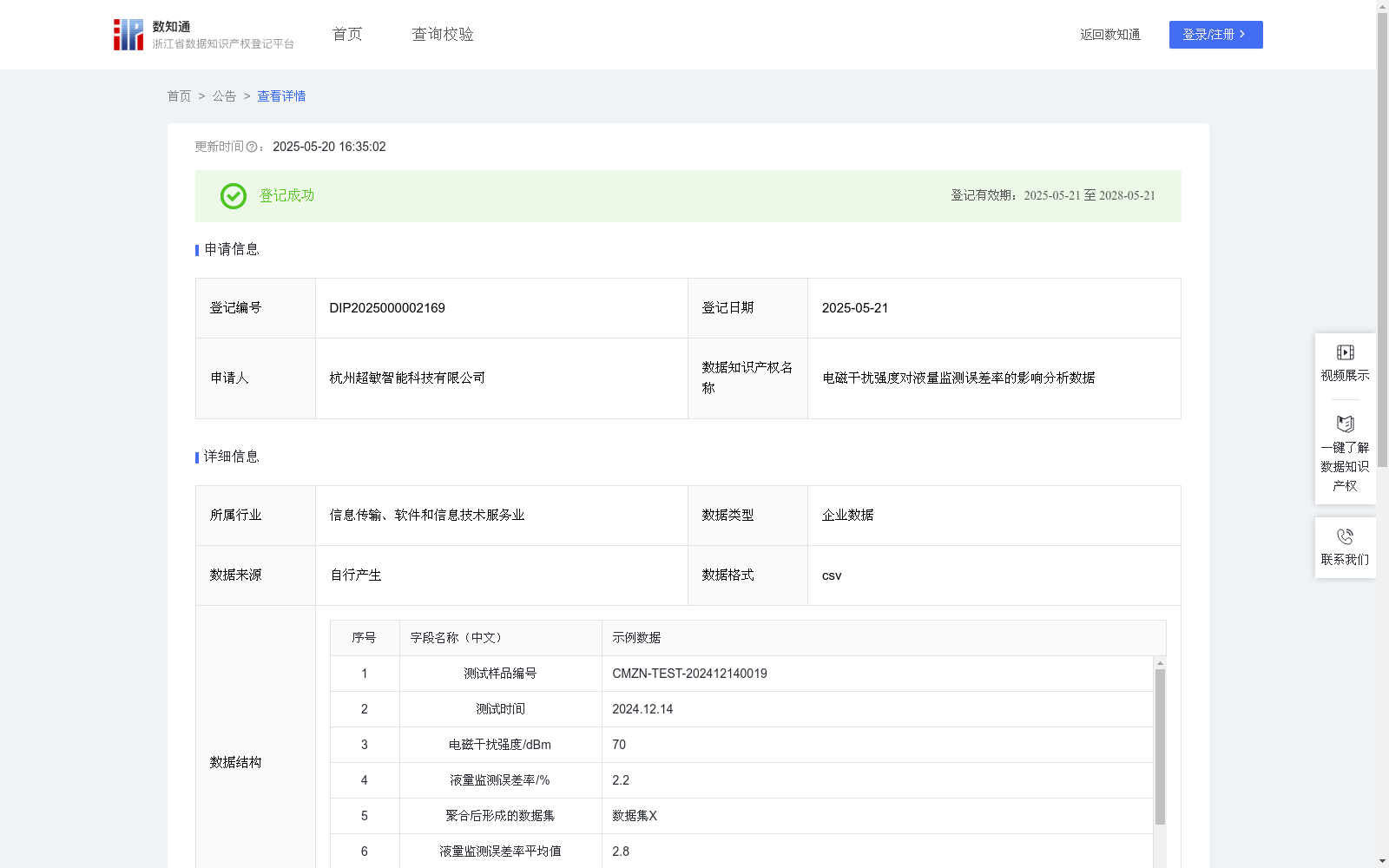
电磁干扰强度对液量监测误差率的影响分析数据
收藏资源简介:
本数据聚焦于分析电磁干扰强度对液量监测误差率的影响,明确了电磁干扰强度与液量监测准确性之间的量化关系,为公司及外部相关方提供了重要的决策依据,具有显著的应用价值。具体体现在以下几个方面: 1. 优化监测系统设计:公司依据该数据,能够针对性地调整监测系统的参数设置或优化监测算法,使其更好地适应不同电磁干扰强度下的液量监测需求。例如,根据电磁干扰强度对传感器检测精度的影响规律,调整传感器的灵敏度和数据采集频率,从而提高液量监测的准确性和稳定性,有效降低液量监测误差率,提升整个智能输液监控系统的性能和可靠性。 2. 保障输液治疗精准性:医疗机构参考这些分析数据,可精准选择适合特定治疗场景和电磁干扰强度的输液监控设备,确保输液治疗过程中液体剂量的精确控制。例如,在电磁干扰强度较高的环境中,选择能够自动补偿电磁干扰影响的监控设备,减少因电磁干扰强度差异导致的监测误差,进而降低医疗风险,保障患者治疗的安全性和有效性。 3. 完善行业标准制定:监管部门根据该数据,能够更准确地把握电磁干扰强度对液量监测的影响规律,从而制定出更具科学性、合理性和针对性的行业标准和规范。1.数据采集:实时记录不同电磁干扰强度下的液量监测误差率测试数据,包括测试样品编号、测试时间、电磁干扰强度/dBm、液量监测误差率/%等字段。 2.数据预处理:(1)对采集的数据进行去噪处理,确保数据准确性。(2)把历史采集的数据(包含本次采集)进行聚合,形成数据集X,并针对数据集X中的液量监测误差率字段,计算出其平均值。 3.计算线性回归斜率a和截距b:基于数据集X(以电磁干扰强度为自变量、液量监测误差率为因变量),运用SLOPE函数,基于最小二乘法原理确定斜率a,运用INTERCEPT函数确定截距b。斜率a表示单位电磁干扰强度变化对液量监测误差率的影响程度,截距b表示基准电磁干扰强度下液量监测的误差率值。 4.结果运用:(1)计算比例系数k:k=|a/液量监测误差率平均值|×100%;(2)若k≥10%,则判定为“高影响”,若5%≤k<10%,则判定为“中影响”,若k<5%,则判定为“低影响”。
This dataset focuses on analyzing the impact of electromagnetic interference (EMI) intensity on the error rate of fluid volume monitoring, and clarifies the quantitative relationship between EMI intensity and the accuracy of fluid volume monitoring. It provides important decision-making basis for the company and relevant external parties, and has significant application value, which is specifically reflected in the following aspects: 1. Optimizing monitoring system design: Based on this dataset, the company can adjust the parameter settings of the monitoring system or optimize the monitoring algorithm in a targeted manner to better adapt to fluid volume monitoring requirements under different EMI intensities. For example, according to the influence law of EMI intensity on sensor detection accuracy, adjust the sensor sensitivity and data acquisition frequency, thereby improving the accuracy and stability of fluid volume monitoring, effectively reducing the fluid volume monitoring error rate, and enhancing the performance and reliability of the entire intelligent infusion monitoring system. 2. Ensuring the accuracy of infusion therapy: Medical institutions can accurately select infusion monitoring equipment suitable for specific treatment scenarios and EMI intensities by referring to these analytical data, ensuring precise control of liquid dosage during infusion treatment. For example, in environments with high EMI intensity, select monitoring equipment that can automatically compensate for the impact of EMI, reduce monitoring errors caused by differences in EMI intensity, thereby lowering medical risks and ensuring the safety and effectiveness of patient treatment. 3. Improving industry standard formulation: Regulatory authorities can more accurately grasp the influence law of EMI intensity on fluid volume monitoring based on this dataset, thereby formulating industry standards and specifications that are more scientific, reasonable and targeted. Specific data processing steps are as follows: 1. Data collection: Real-time record of test data on fluid volume monitoring error rate under different EMI intensities, including fields such as test sample number, test time, electromagnetic interference intensity/dBm, fluid volume monitoring error rate/%, etc. 2. Data preprocessing: (1) Denoise the collected data to ensure data accuracy. (2) Aggregate the historically collected data (including this collection) to form dataset X, and calculate the average value of the fluid volume monitoring error rate field in dataset X. 3. Calculation of linear regression slope a and intercept b: Based on dataset X (with EMI intensity as the independent variable and fluid volume monitoring error rate as the dependent variable), use the SLOPE function to determine the slope a based on the principle of least squares method, and use the INTERCEPT function to determine the intercept b. The slope a represents the degree of influence of unit EMI intensity change on the fluid volume monitoring error rate, and the intercept b represents the error rate value of fluid volume monitoring under the reference EMI intensity. 4. Result application: (1) Calculate the proportional coefficient k: k = |a / average value of fluid volume monitoring error rate| × 100%; (2) If k ≥ 10%, it is judged as "high impact"; if 5% ≤ k < 10%, it is judged as "medium impact"; if k < 5%, it is judged as "low impact".