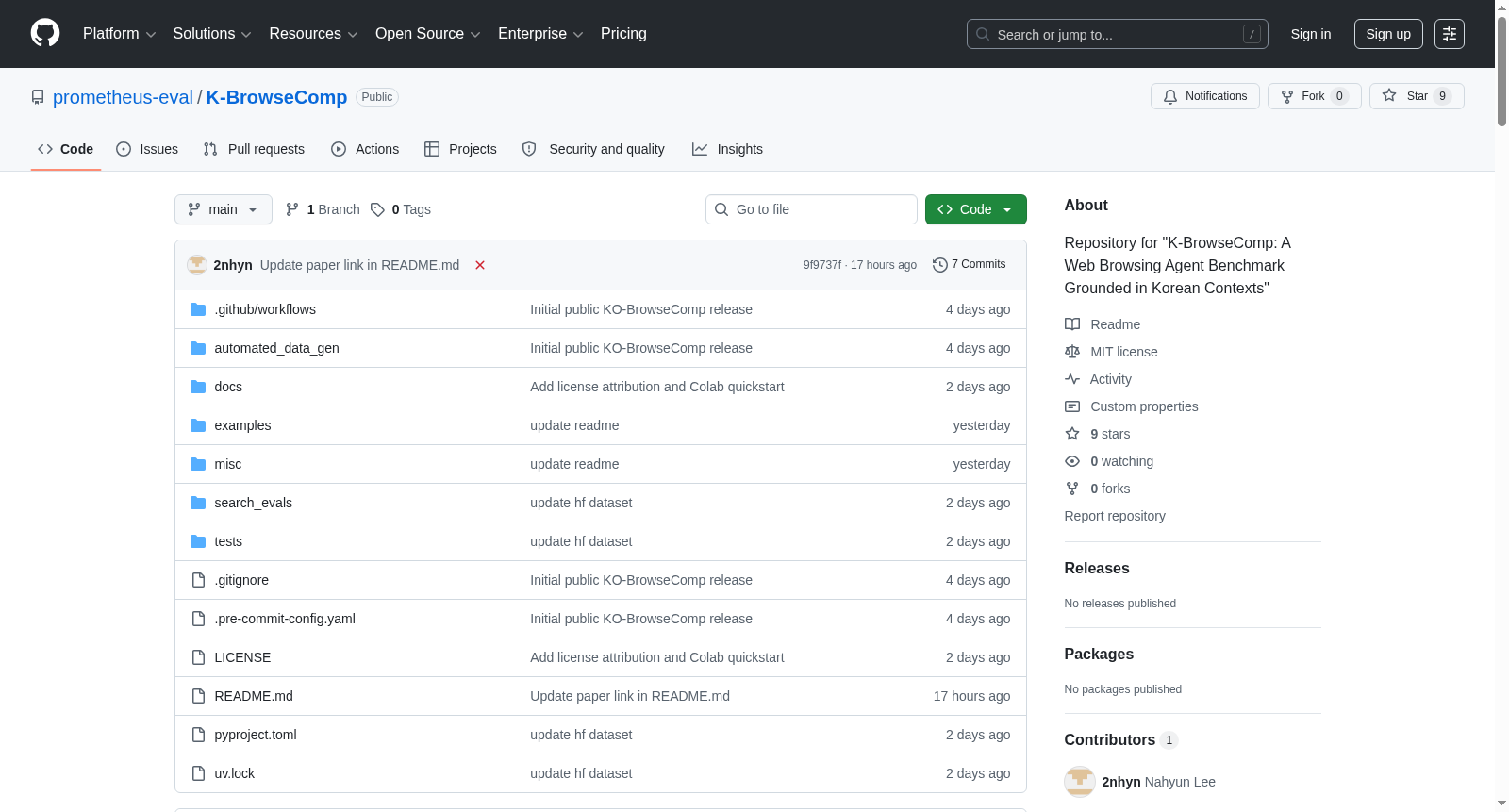
K-BROWSECOMP
收藏资源简介:
K-BROWSECOMP是由韩国多所顶尖学术机构与科技企业联合构建的韩语语境网络浏览智能体基准数据集,旨在填补韩语智能体评估领域的空白。该数据集共计包含400个复杂问题,其中300个为人工精心构建并经过母语者验证的K-BROWSECOMP-VERIFIED子集,涵盖娱乐媒体、地理区域、教育考试等十大类别,问题设计依赖于公开的网络文本证据,并包含多跳推理与并行约束两种推理模式。数据集的创建过程严格遵循三项标注准则,确保问题扎根于韩国本土文化背景、答案唯一且证据可公开追溯,并创新性地利用失败模式分类与少量示例引导大型语言模型生成了100个具有诊断性的合成问题。本数据集主要应用于评估和提升大型语言模型在韩语环境下的网络浏览代理能力,旨在解决模型在检索韩国本地化信息、处理复杂网页结构及跨源信息合成等方面的关键瓶颈,以推动面向韩国用户的定制化智能体发展。
K-BROWSECOMP is a Korean contextual web browsing agent benchmark dataset jointly developed by multiple top-tier South Korean academic institutions and technology enterprises, aiming to fill the critical gap in the field of Korean-language intelligent agent evaluation. This dataset comprises a total of 400 complex questions, among which 300 constitute the K-BROWSECOMP-VERIFIED subset. These 300 questions are manually curated and verified by native Korean speakers, covering ten major categories such as entertainment media, geographical regions, and educational examinations. The design of these questions relies on publicly available web textual evidence, and incorporates two reasoning paradigms: multi-hop reasoning and parallel constraints. The dataset construction process strictly adheres to three annotation principles, ensuring that all questions are grounded in South Korea's local cultural context, have unique answers, and their supporting evidence is publicly traceable. Additionally, it innovatively leverages failure mode classification and few-shot examples to guide large language models (LLMs) in generating 100 diagnostic synthetic questions. This dataset is primarily designed to evaluate and enhance the web browsing agent capabilities of large language models within the Korean-language context, targeting key bottlenecks faced by such models when retrieving South Korean localized information, processing complex web page structures, and synthesizing cross-source information, with the goal of advancing the development of customized intelligent agents tailored for South Korean users.
数据集概述:K-BrowseComp
K-BrowseComp 是一个针对韩语网络浏览代理(web-browsing agent)的基准测试,旨在评估代理从韩语网站检索难以获取的公开信息、追踪多跳或多路径证据,并返回基于韩语语境的单一简短答案的能力。
论文地址:https://arxiv.org/abs/2606.02404
数据集地址:https://huggingface.co/datasets/prometheus-eval/k-browsecomp
数据集规模与构成
- 总共包含 400 道题目,分为两个子集:
- K-BrowseComp-Verified:300 道由母语为韩语的人员手动编写并验证的题目。
- K-BrowseComp-Synthetic:100 道机器生成的诊断性题目,使用少量高难度示例和针对失败模式的生成策略创建(生成流程见
automated_data_gen/目录)。
题目设计特点
- 每个验证过的题目均设计为需要 多跳推理 或 并行分支约束满足,涉及韩语公开网络证据。
- 数据集提供以下内容,支持除最终答案评分外的轨迹诊断:
- 问题(problem)
- 标准答案(gold answer)
- 预期轨迹(expected trajectory)
- 源 URL(source URLs)
- 关键中间证据的检查清单值(checklist values)
模型表现
- 在实验中,即使表现最强的模型在 K-BrowseComp-Verified 上的准确率也低于 50%,在 Synthetic 子集上仅达到 26%。
评估框架与代码
- 该仓库改编自 perplexityai/search_evals,提供评估和自动化问题生成代码。
- 默认情况下,评估时会从 prometheus-eval/k-browsecomp 下载数据集,仓库中也包含备用本地 JSONL 副本:
search_evals/datasets/ko_browsecomp.jsonl(验证集)search_evals/datasets/ko_browsecomp_synthetic.jsonl(合成集)
许可与归属
- 除特别注明外,本仓库采用 MIT 许可协议(详见 LICENSE)。
- 评估框架改编自 perplexityai/search_evals,同样采用 MIT 许可协议。
环境设置与使用
- 使用
uv管理 Python 依赖:uv sync - 提供 Colab 快速启动笔记本:https://colab.research.google.com/github/prometheus-eval/K-BrowseComp/blob/main/examples/k_browsecomp_colab.ipynb
- 运行评估需要配置相应的 API 密钥(支持 Perplexity、Brave、Exa、Tavily 等搜索引擎,以及 GPT、Gemini、Claude、OpenRouter 等模型)。